
- Why Raw Material Supply Chain Delays Hurt More Than You Think
- Common Causes of Raw Material Supply Chain Delays
- How Manufacturers Can Build a More Reliable Inbound Supply Chain
- Example: An Auto Component Maker Loses Two Shifts
- Common Mistakes That Make Manufacturing Supply Chain Delays Worse
- Make Inbound and Bulk Cargo Predictable With Shiprocket
- निष्कर्ष
The steel is ready at your supplier's yard. The purchase order was confirmed a week ago. But the truck that was meant to collect it on Monday morning shows up on Wednesday afternoon, and your press shop runs out of coil on Tuesday night.
तेच raw material supply chain delays look like inside most Indian factories. The material exists, and the supplier has done their part. The gap is in the movement between their gate and yours.
For manufacturers running tight schedules, that gap is expensive. This guide explains how inbound delays affect production, why they happen, and how to build a raw material transportation plan that keeps your lines running.
Why Raw Material Supply Chain Delays Hurt More Than You Think
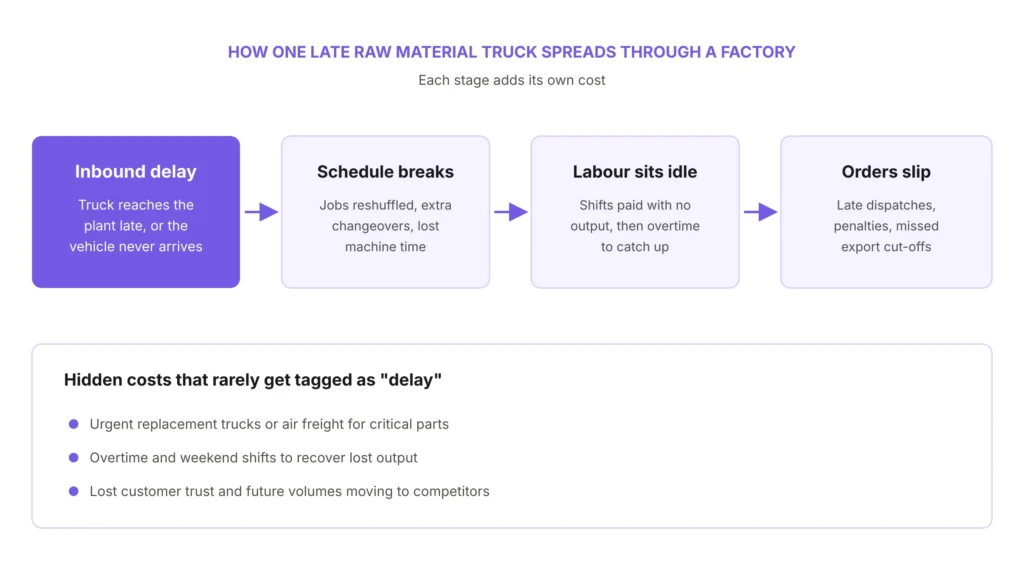
A delayed inbound shipment isn't just a logistics problem. It spreads through every team that depends on that material, and each team adds its own cost.
Production schedules break
Most plants plan production around expected material arrivals. When a consignment arrives late, planners have to reshuffle jobs, run smaller batches or switch to products they didn't plan to make that day. Every changeover eats machine time.
आपण अनुसरण केल्यास lean manufacturing practices with low inventory, the impact is even sharper. Lean plants hold less buffer stock by design, so they feel a late truck within hours.
Labour sits idle
Shift workers, machine operators and contract labour are paid whether the material arrives or not. A half-day stoppage on a line with 40 workers is 20 worker-days paid for no output. Overtime to catch up later adds a second bill.
Orders and customer commitments slip
The delay then reaches your customers. An OEM expecting components on a fixed date may delay its own assembly line, levy penalties under the supply contract or move future volumes to a competitor. For exporters, a missed vessel or flight cut-off can push a shipment by a week or more.
Costs build quietly
Expedited trucks, air freight for urgent parts, extra handling and overtime don't always show up as a "delay cost" in your books. They hide inside freight and labour lines. That's why many plants underestimate how much factory production delays really cost them.
Logistics is already a large cost head for Indian industry. A DPIIT-commissioned study by NCAER put India's logistics cost at 7.97% of GDP in 2023-24, according to the वाणिज्य व उद्योग मंत्रालय. Delays push your own share of that cost higher.
Common Causes of Raw Material Supply Chain Delays
Supply chain disruption gets blamed on big events like port congestion or global shortages. But most day-to-day inbound delays for Indian manufacturers have more ordinary causes.
Vehicle shortages at the wrong time
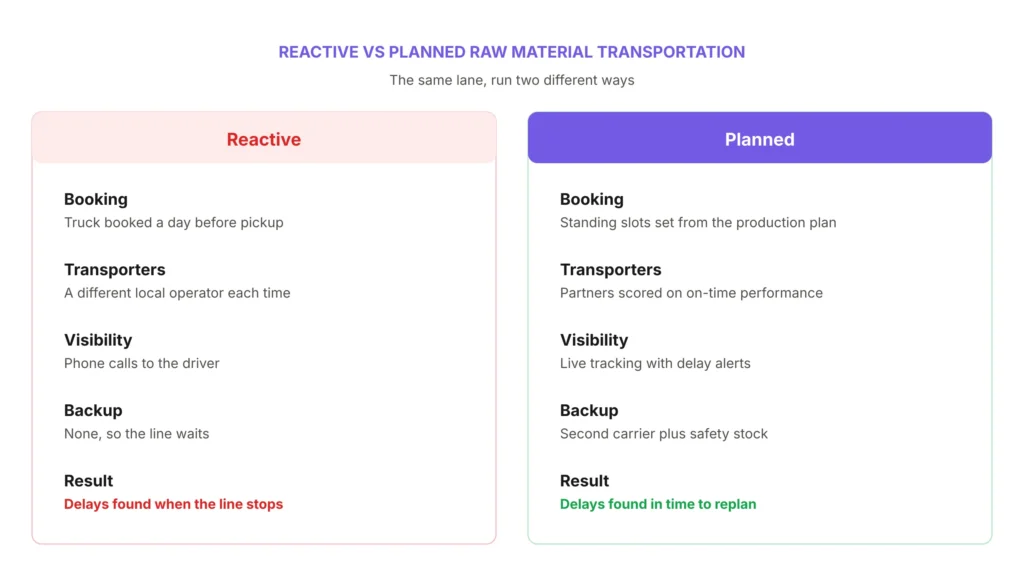
Truck availability swings with the season. During harvest periods, festive peaks and the financial year-end rush in March, transporters get more bookings than they have vehicles. If you book a truck the day before pickup, you're competing with everyone else who did the same.
Poor shipment coordination
Many delays happen at the handover points. The supplier's material isn't packed when the truck arrives. The truck arrives at your plant after the receiving shift ends. Or the e-way bill and invoice aren't ready, so the vehicle waits at the gate. Each small miss can cost hours.
Fragmented transport arrangements
A typical mid-sized plant may use different local transporters for each supplier, each lane and each load type. Nobody has a full picture of what's moving, rates vary from booking to booking, and there's little accountability when something goes wrong.
No visibility into cargo movement
When your only tracking tool is a phone call to the driver, you learn about a delay when the truck doesn't show up. By then, it's too late to reschedule production or arrange a backup. Real-time tracking in logistics changes that, because you see the problem while there's still time to act.
Port and long-haul dependencies
Imported raw materials such as resins, specialty steel or electronic parts add another layer. Port dwell time, customs clearance and the onward road leg from the port to the plant all have to line up. A gap at any one stage pushes the whole consignment back.
How Manufacturers Can Build a More Reliable Inbound Supply Chain
You can't control the weather or a highway closure. You can control how you plan, book and track the movement of your materials. Here's a practical approach for industrial logistics teams.
1. Plan transportation in advance
Start from your production plan, not from the supplier's dispatch date. Work backwards: when does the line need the material, how long is the transit, and how much buffer do you want? That tells you the latest safe pickup date.
Then book capacity ahead for regular lanes. If you move steel from the same supplier every week, a standing weekly booking is far more reliable than a fresh enquiry each time.
2. Match the load to the right mode
Not every consignment needs a full truck. Choosing the right mode saves money and often improves reliability:
| लोड प्रकार | Typical mode | When it works best |
|---|---|---|
| Small, frequent loads from many suppliers | LTL (less than truckload) | Low volumes per supplier, regular replenishment |
| Medium loads that don't fill a truck | PTL (part truckload) | Shared truck space with direct movement |
| Large bulk material transportation | FTL (full truckload) | Steel coils, granules, cement, high-volume lots |
| Urgent, high-value or critical parts | हवाई मालवाहतूक | When a line stoppage costs more than the freight |
3. Fix pickup and delivery windows
Agree fixed pickup windows with each supplier and fixed delivery slots at your plant. Share them with your transport partner in writing.
Appointment-based delivery helps your stores team plan unloading labour and avoids trucks queueing outside the gate. It also makes late arrivals visible straight away, rather than hidden in a general "arriving today".
4. Evaluate transport partners on performance
Price matters, but a cheap truck that arrives two days late is the most expensive option you have. Score your transport partners every month on:
- On-time pickup and on-time delivery percentage
- Vehicle availability when you need it, especially at peak times
- Tracking and proactive delay alerts
- Damage and shortage claims
- Documentation accuracy, including e-way bills and LRs
Share the scores with partners. Good transporters welcome the data, and it gives you a fair basis for moving volume.
5. Build contingency capacity
Every critical lane needs a Plan B. That could be a second approved transporter, an aggregator that can source a vehicle from a wider network, or an agreed air cargo option for urgent parts.
Pair this with a small safety stock of your most critical materials. Rank materials by lead time, cost of a stoppage and the number of alternative suppliers. The highest-risk items deserve the biggest buffer.
6. Track every inbound shipment
Make tracking a requirement, not a favour. When planners can see that a truck is running six hours behind at 10 a.m., they can move the next job forward and keep the line busy. Delay alerts turn a crisis into a schedule change.
Example: An Auto Component Maker Loses Two Shifts
Here's a hypothetical example based on a common pattern. Names and figures are illustrative only.
A Pune-based auto component maker presses brackets and housings for two-wheeler OEMs. It needs a 20-tonne consignment of steel coils every week from a steel service centre about 150 km away. Each week, the purchase team calls whichever local transporter is free.
During a busy month, the transporter can't find a vehicle until two days after the planned pickup. Nobody at the plant knows until the truck fails to arrive. The press line runs out of coil and stops for two shifts.
त्याचे दूरगामी परिणाम:
- About 60 operators and helpers are paid for two shifts with no output.
- A weekly dispatch to an OEM goes out a day late, and the OEM's planning team escalates.
- The plant pays for weekend overtime and an urgent second truck to catch up.
After the incident, the company changes its approach to raw material transportation:
- It books a standing weekly FTL slot for the steel lane, with a fixed pickup window every Monday morning.
- It moves smaller consumables, like fasteners and packaging, to scheduled LTL pickups.
- It tracks every inbound truck and sets an alert if one is more than four hours behind plan.
- It keeps three days of safety stock for steel coil and approves a backup transport option.
The result is a predictable inbound flow. When a delay does happen, planners know about it in time to switch jobs, and the line keeps running. That's the real value of organised B2B cargo transportation: not zero delays, but no surprises.
Common Mistakes That Make Manufacturing Supply Chain Delays Worse
Even well-run plants repeat a few habits that make delays more likely:
- Booking transport on the day of pickup. You get whatever vehicle is left, if any.
- Treating freight as a pure cost line. Choosing the cheapest bid often means the least reliable service.
- No owner for inbound logistics. When purchase, stores and production each assume another team is tracking the truck, nobody is.
- Ignoring the receiving end. A truck that reaches your gate at 9 p.m. with no unloading crew is still a delay.
- Keeping one transporter per lane with no backup. One breakdown or busy week stops everything.
Fixing these doesn't need a big technology budget. It needs a clear process and a well-designed supply chain network where every lane has a plan and an owner.
Make Inbound and Bulk Cargo Predictable With Shiprocket
For domestic raw material movement, शिप्रॉकेट कार्गो gives manufacturers LTL, PTL, FTL and air cargo options in one dashboard. Its AI-based partner selection compares freight partners by weight, destination and timelines. Real-time tracking and appointment-based delivery help your stores team plan unloading, and bulk order upload saves time when you move many consignments at once.
If you also ship finished goods overseas, शिप्रॉकेट कार्गोएक्स handles bulk B2B export consignments starting from 20 kg. You can compare air cargo options, schedule pickups and track each shipment, so overseas customer commitments stay on time.
निष्कर्ष
Raw material supply chain delays are rarely caused by one big failure. They usually come from small, fixable gaps: late bookings, missed handovers, scattered transporters and no tracking.
Start with your most critical lanes. Plan transport from the production schedule, lock in pickup and delivery windows, score your partners and keep backup capacity ready. Once inbound movement becomes predictable, your production schedule, workforce and customers all benefit.
For more ways to cut freight spend once your lanes are stable, read our guide on how to reduce cargo transportation costs.