


- What Counts as a High Value Shipment?
- Where High Value Shipments Go Wrong
- How to Pack High Value Commercial Goods
- Handling Rules That Prevent Damage
- Documentation for High Value Exports
- Tracking and Visibility in Transit
- Insurance and Shipment Protection
- A Risk Plan for Every High Value Shipment
- Ship High Value Cargo With CargoX and SecureX
- தீர்மானம்
A buyer in Germany has approved a ₹12 lakh order for servo drives and sensor modules. The parts fit in two cartons. If either carton goes missing or arrives with a cracked board, the margin on the whole order disappears, and so might the customer.
That is the core problem with shipping high value goods internationally. The cargo is small, attractive to thieves and easy to damage, while the paperwork gets more scrutiny at customs. A routine shipment process built for low-value parcels leaves too many gaps.
This guide is for Indian manufacturers, distributors and exporters who send machinery parts, electronics components, precision instruments and premium commercial goods overseas. It covers how to assess risk, pack, handle, document, track and protect each shipment.
What Counts as a High Value Shipment?
There’s no single legal threshold. In practice, a shipment is high value when losing it would hurt your business more than the freight bill suggests.
Use these signals to flag high value cargo shipping in your own process:
- High value per kilogram: a 3 kg box of ICs or a calibrated gauge can be worth more than a tonne of raw material.
- Hard to replace: custom-machined parts, calibrated instruments and made-to-order spares have long lead times.
- Theft appeal: electronics, branded goods and anything easy to resell attract organised theft.
- பலவீனம்: sensors, optics, PCBs and precision bearings fail from shock, vibration, static or moisture.
- Customs sensitivity: dual-use items, batteries and goods with complex classification face extra checks.
Indian courier exports also changed recently. From 1 April 2026, CBIC removed the earlier ₹10 lakh per-consignment value cap on commercial courier exports, according to the PIB release on the courier reforms. That makes the courier route available for more high value consignments, so your protection plan matters even more.
Where High Value Shipments Go Wrong
Cargo rarely gets damaged or stolen while it sits on a plane. Most problems happen when it changes hands or waits somewhere.
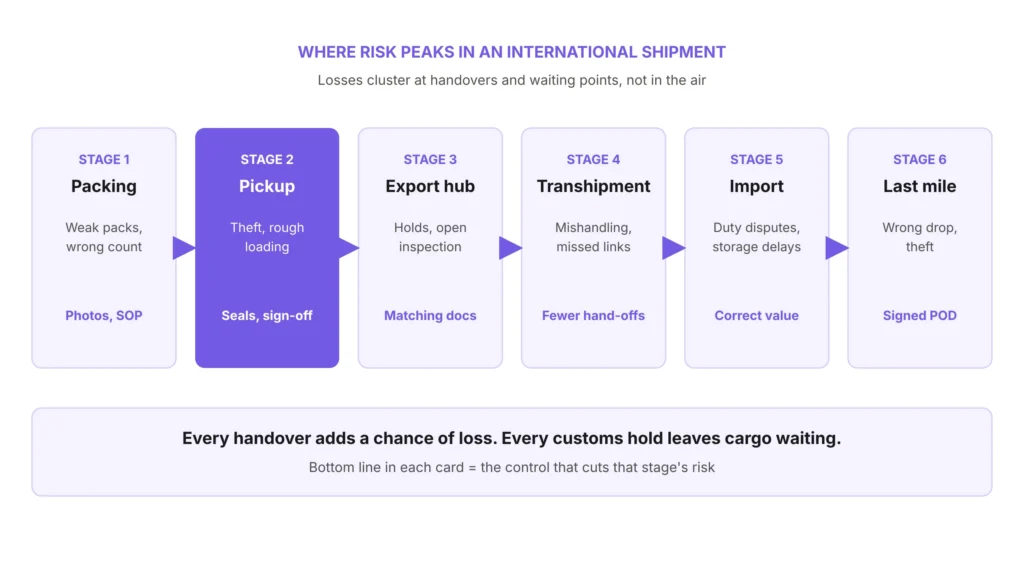
Map your own shipment against these stages:
| மேடை | முக்கிய ஆபத்து | Control that works |
|---|---|---|
| Packing at your unit | Poor packing, wrong count | Packing SOP, photos, weight record |
| Pickup and first mile | Theft, rough loading | Sealed cartons, verified pickup, handover sign-off |
| Origin hub and export customs | Delays, open inspection | Matching documents, accurate HS code |
| Flight and transhipment | Mishandling, missed connections | Strong outer pack, handling labels, fewer hand-offs |
| சேருமிட சுங்கம் | Holds, duty disputes | Correct value, Incoterm, importer details |
| கடைசி மைல் | Wrong delivery, theft | Signature on delivery, tracking alerts |
Two patterns stand out. Each extra handover adds another chance of loss, and every customs hold leaves cargo sitting in a shed. A good plan removes hand-offs and prevents holds.
How to Pack High Value Commercial Goods
Packaging is your first line of protection. Damage claims are often rejected when the insurer or carrier decides the packing was inadequate, so treat it as evidence too.
Inner Protection for Electronics and Instruments
Electronics components need anti-static bags or shielding packs, plus desiccant to control moisture on long routes. Precision instruments need foam inserts cut to shape so nothing moves inside the box.
Keep at least 5 cm of cushioning between the item and the outer walls. Lock moving parts such as gauges, spindles and probes before packing, and follow the manufacturer’s transport instructions.
Outer Packaging for Machinery Parts
Heavy or dense parts belong in double-wall corrugated boxes, wooden crates or crates on a skid. Bolt or strap heavy parts to the base so they can’t shift.
If you use solid wood, it must meet ISPM 15 heat-treatment standards for most destinations. Our guide to choosing international cargo boxes covers box strength and sizes, and these சர்வதேச கப்பல் போக்குவரத்து பேக்கேஜிங் குறிப்புகள் cover cushioning and sealing.
Keep the Outside Plain
Don’t print brand names or product names on the outer carton. A box marked “laptop processors” invites attention at every hub.
Use neutral cartons, security tape that shows if it has been cut, and numbered seals. Record the seal numbers on your packing list so the receiver can check them on arrival.
Handling Rules That Prevent Damage
Good packing still fails if handlers can’t tell how to treat the cargo. Clear marks and a tight chain of custody close that gap.
- Handling labels: use standard symbols for fragile, this way up, keep dry and centre of gravity where they apply.
- Shock and tilt indicators: these cheap stickers show if a carton was dropped or tipped, which helps with claims and supplier feedback.
- Weight and lifting points: mark gross weight and forklift or sling points on crates.
- Fewer hand-offs: a direct routing or a single freight partner from pickup to delivery reduces exposure.
- Signed handovers: get a signature, time and carton count at every transfer you control.
For electronics with lithium batteries, check dangerous goods rules before you book air cargo. A battery that isn’t declared can stop the whole shipment.
Documentation for High Value Exports
Customs officers look closely at high value cargo. A mismatch between the invoice, packing list and labels is the most common reason for a hold.
Prepare these documents for every consignment:
- வணிக விலைப்பட்டியல்: an exact description, quantity, unit value, total value, currency and Incoterm.
- பட்டியலில் பொதி: box-by-box contents, net and gross weights, dimensions and seal numbers.
- Shipping bill: filed through customs with the correct HS code and declared value.
- Air waybill or bill of lading: issued by the carrier or freight partner.
- IEC and AD code: registered for your business and linked for export.
- தோற்றச் சான்றிதழ்: when the buyer needs it for preferential duty.
- காப்பீட்டு சான்றிதழ்: when the Incoterm makes you responsible for cover, such as CIF or CIP.
Classify goods carefully. Electronics and machinery parts often sit under chapters 84, 85 and 90, and a wrong code can mean the wrong duty or an export-control question. Our explainer on சர்வதேச கப்பல் போக்குவரத்தில் HS குறியீடுகள் shows how to find the right one.
Never under-declare value to cut duty for the buyer. It’s a customs offence, and it also caps what you can recover if the goods are lost.
Tracking and Visibility in Transit
Tracking is a protection tool, not just a customer service feature. The sooner you know a shipment has stalled, the sooner you can act.
மைல்கல் கண்காணிப்பு
At a minimum, watch for pickup, export clearance, departure, arrival, import clearance and delivery. Set an internal alert if a shipment sits at one milestone longer than normal for that lane.
Share tracking with the buyer too. They can prepare import paperwork early, which cuts the time cargo waits at destination customs. Learn more about சர்வதேச ஏற்றுமதி கண்காணிப்பு.
Device Tracking for Very High Value Cargo
For the most valuable consignments, some exporters add GPS or IoT trackers that report location, shock, temperature or light exposure. A light sensor can show when a crate was opened.
Check that the carrier accepts the device, since most contain lithium batteries that must meet air transport rules.
Insurance and Shipment Protection
This is where many exporters get caught out. They assume the carrier will pay the full value if something goes wrong. It usually won’t.
Why Carrier Liability Isn’t Enough
For international air cargo, the Montreal Convention limits carrier liability by weight. ICAO raised the cargo limit from 22 to 26 Special Drawing Rights per kilogram from 28 December 2024, which ICAO puts at roughly US$35 per kilogram, according to its notice on revised liability limits.
That works for heavy, low-value freight. For a 5 kg precision instrument worth ₹8 lakh, it covers only a small fraction of the loss.
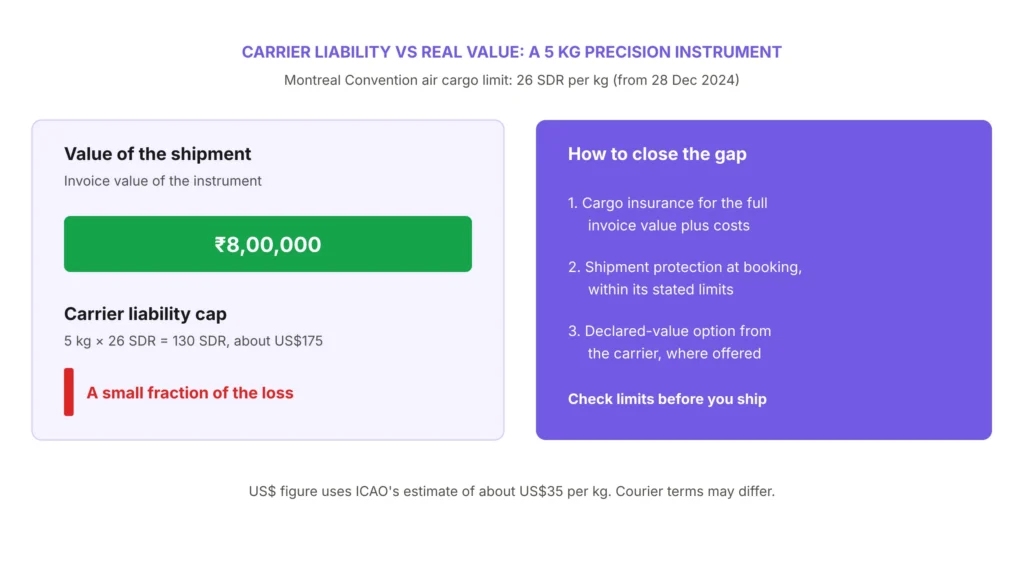
Some carriers let you declare a higher value for an extra charge, and courier services set their own liability terms. Either way, check the limits in the contract before you ship.
Cargo Insurance vs Shipment Protection
International cargo insurance is a policy, usually from an insurer, that covers the goods against named risks or all risks for a declared sum. Exporters often insure at the invoice value plus a margin for freight and costs. Read our explainer on what cargo insurance covers.
Shipment protection is a cover offered through the shipping platform at booking. It is simpler to add per shipment, but the limits, eligible goods and claim rules are set by the provider. Compare both against your typical shipment value.
| கேட்க வேண்டிய கேள்வி | ஏன் முக்கியம் |
|---|---|
| What is the maximum payout per shipment? | High value consignments can exceed it |
| Which goods are excluded? | Electronics, precious items and used goods are often restricted |
| Is theft covered, or only damage and loss? | Theft is a major risk for electronics |
| What is the claim deadline? | Late claims are usually rejected |
| What proof is needed? | Photos, invoices and delivery remarks decide outcomes |
Prepare Claim Evidence Before You Ship
Claims succeed on evidence. Photograph the goods, the inner packing and the sealed carton with its seal number. Keep weight records from your unit.
Ask the receiver to note any visible damage on the delivery receipt before signing, and to photograph it straight away.
A Risk Plan for Every High Value Shipment
Commercial shipment protection works best as layers. No single step stops every loss, but together they make each one much less likely and much easier to recover.
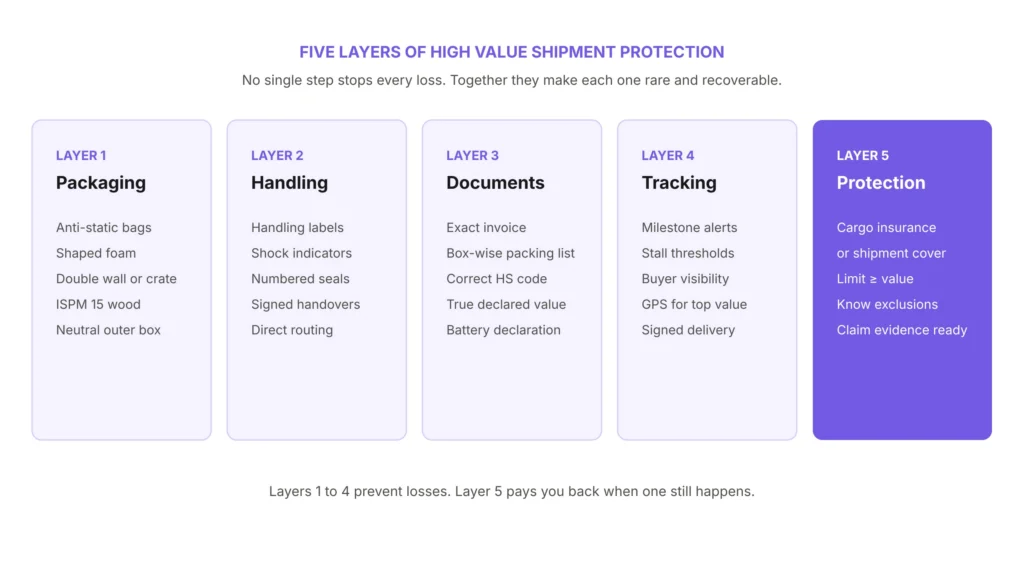
Run this short checklist before every high value booking:
- Is the declared value correct and consistent across all documents?
- Does the packing meet the carrier’s rules and survive a drop test?
- Are outer markings neutral, with tamper-evident tape and recorded seals?
- Is the route the most direct option with the fewest hand-offs?
- Are batteries, dual-use items and restricted materials checked?
- Is insurance or shipment protection active, and does its limit cover the value?
- Does the buyer have tracking and know what to check on delivery?
For extra-sensitive spares, split large orders into several shipments. A single loss then doesn’t wipe out the whole order, and the buyer can keep working with what arrived.
Ship High Value Cargo With CargoX and SecureX
Shiprocket ன் CargoX international B2B shipping handles bulk exports from 20 kg, with scheduled pickup, real-time tracking and multiple international carrier partners. Its team also helps with export documentation, which reduces the mismatches that cause customs holds. It’s a good fit for machinery parts and components that need சர்வதேச விமான சரக்கு வேகம்.
For transit risk, SecureX international shipment protection can be switched on for eligible CargoX and ShipX shipments, either for all future shipments or at booking, and claims are raised through Shiprocket as a single point of contact. Before relying on it for a high value consignment, check the coverage limit, excluded goods and claim window in the current terms. [[VERIFY: SecureX maximum coverage per shipment, excluded goods and claim deadline]]
தீர்மானம்
Shipping high value goods internationally is manageable when you plan for risk before the pickup. Most losses come from weak packing, unclear handling, mismatched papers or a gap in cover.
Pack for the worst handling, keep the outside plain, make every document match and track each milestone. Then check that your insurance or shipment protection actually covers the value you’re sending. Do that every time, and your valuable cargo has a much better chance of reaching the buyer on time and intact.


