
A customer in Toronto finds your oxidised silver earrings on Instagram. They cost ₹400. She orders one pair, and you are thrilled, until you book the shipment and see the courier charge is higher than the earrings.
This is the everyday problem with international shipping for small products. Accessories, stationery, jewellery, small home decor and beauty products are light and easy to pack, but their low price means a fixed shipping cost takes a huge bite out of every order. Sell enough single ₹400 orders abroad and you can grow revenue while losing money.
The fix is not just finding a cheaper courier. It is changing what goes into each parcel, how you price it and which products you send abroad at all. This guide walks through the levers Indian D2C brands can pull, with a worked unit economics example.
Why Small, Low-Value Products Struggle Abroad
Shipping cost does not scale with your product price. It scales with weight, size, distance and the service you pick. A ₹400 pair of earrings and a ₹4,000 silk scarf can weigh almost the same, so they cost almost the same to ship.
That makes shipping a fixed cost per parcel. On a high-value item it is a small share of the price. On low value export products, it can be more than 100% of the price.
Three things make it worse for small sellers:
- Minimum billable weight. Many international services charge a base slab, so a 60 g parcel can be billed like a much heavier one.
- வால்யூமெட்ரிக் எடை. Couriers bill on the higher of actual and volumetric weight. A light item in an oversized box pays for air. Our guide to volumetric weight in ecommerce shipping கணிதத்தை விளக்குகிறது.
- Fixed costs per order. Packaging, payment fees, ad spend and returns handling hit every order, whether it is worth ₹400 or ₹4,000.
Duty rules for low-value parcels have changed
Low-value parcels used to slip into major markets duty-free. That has changed. The USA suspended its $800 de minimis exemption for all countries from 29 August 2025, and in June 2026 CBP made that suspension indefinite for both postal and non-postal shipments, as set out in the கூட்டாட்சிப் பதிவேடு அறிவிப்பு.
The EU now charges a temporary €3 customs duty on low-value ecommerce parcels from 1 July 2026. According to the ஐரோப்பிய ஆணைக்குழு, it applies per item based on tariff classification, not quantity. So five T-shirts attract one €3 duty, while three T-shirts and a watch attract two.
For a ₹400 order, these charges matter a lot. For a ₹1,500 bundle, they shrink as a share of the basket. Rules keep moving, so check the current position for each market before you set prices.
Unit Economics: One ₹400 Item vs a ₹1,500 Bundle
Let’s put numbers on it. The figures below are hypothetical, built to show how the maths works. They are not quoted courier rates, so plug in your own costs.
Assume a jewellery brand ships to the USA. The buyer pays a flat ₹300 shipping fee at checkout. Product cost is 35% of the selling price, payment and platform fees are 5% of what the buyer pays, and the brand spends ₹150 on ads to win each order.
| வரி உருப்படி | ஒற்றை உருப்படி | Bundle of 4 |
|---|---|---|
| தயாரிப்பு விலை | ₹ 400 | ₹ 1,500 |
| Shipping fee paid by buyer | ₹ 300 | ₹ 300 |
| மொத்த வருவாய் | ₹ 700 | ₹ 1,800 |
| Product cost (35%) | ₹ 140 | ₹ 525 |
| பேக்கேஜிங் | ₹ 30 | ₹ 40 |
| Payment and platform fees (5%) | ₹ 35 | ₹ 90 |
| Ad cost per order | ₹ 150 | ₹ 150 |
| Actual shipping cost | ₹550 (150 g) | ₹850 (450 g) |
| ஒவ்வொரு ஆர்டருக்குமான பங்களிப்பு | - ₹205 | +₹145 |
| Shipping cost per ₹100 of product | சுமார் ₹138 | சுமார் ₹57 |
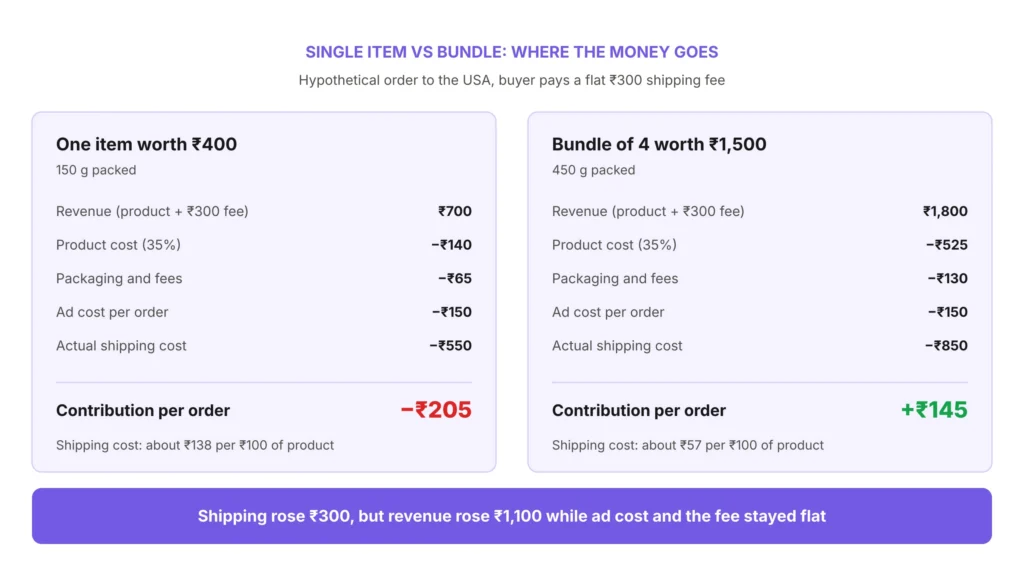
The single item loses ₹205 on every order. The bundle makes ₹145. Shipping cost went up by ₹300 for the bundle, but revenue went up by ₹1,100, and the ad cost and shipping fee stayed flat.
Why courier price alone is the wrong comparison
Suppose you find a courier that ships the single item for ₹500 instead of ₹550. That saves ₹50, and the order still loses ₹155. A cheaper rate cannot rescue a basket that is too small.
A better question is: how much can I spend on shipping and still break even? Take revenue and subtract every other variable cost. That gives you a shipping ceiling.
- Single item: ₹700 − ₹140 − ₹30 − ₹35 − ₹150 = ₹ 345. Any service above ₹345 loses money.
- Bundle: ₹1,800 − ₹525 − ₹40 − ₹90 − ₹150 = ₹ 995. Even a faster, pricier service still fits.
This is what international shipping profitability really comes down to. Compare each option against your contribution margin per order, then pick the cheapest service that meets your delivery promise. Our guide to சர்வதேச கப்பல் போக்குவரத்து செலவுகளை ஒப்பிடுதல் covers the rate side.
6 Ways to Make Small-Product Exports Profitable
Once you see the numbers, the strategy for international shipping for small products is clear: put more value into each parcel, put less weight and volume into it, and price by destination.
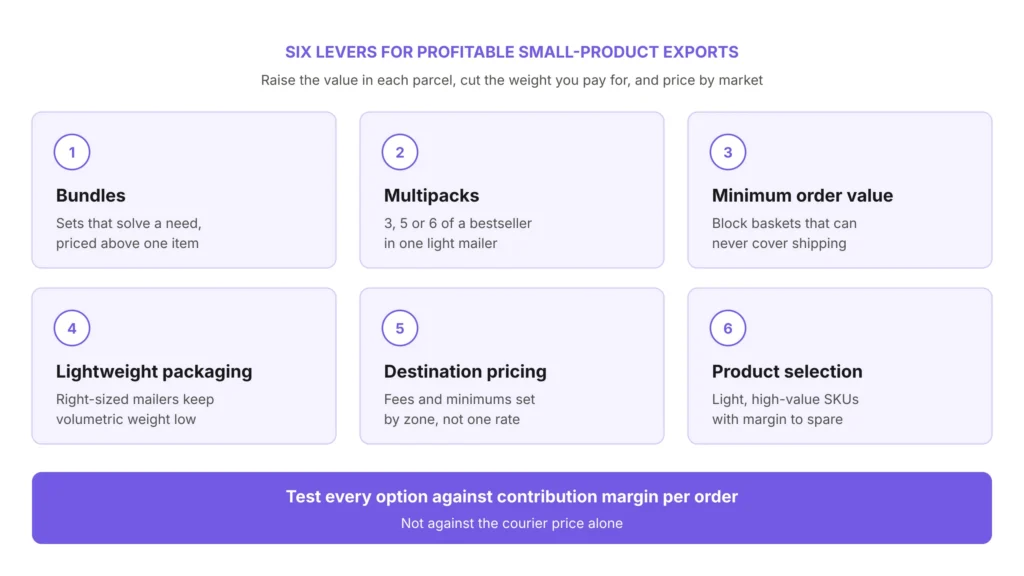
1. Build bundles that make sense to the buyer
Bundles work best when they solve a need, not when they just pile up stock. Think “earrings, ring and anklet set” for a wedding guest, or “festive diya set of six” for Diwali in the diaspora.
Price the bundle so it feels like a deal against buying items one by one, but still lifts your basket size well above the single-item price. Our guide to product bundling and bundle marketing மேலும் யோசனைகள் உள்ளன.
2. Offer multipacks of bestsellers
Multipacks are the simplest bundle. Sell lip balms in packs of three, notebooks in sets of five or hair clips in sets of six. They weigh little more than one unit and ship in the same mailer.
In the EU, identical items in the same tariff classification attract a single €3 duty, so a multipack can also be more duty-efficient than mixed singles.
3. Set a minimum order value for international orders
You don’t have to accept every single-item order abroad. Many brands set an international minimum, say equal to the bundle value where contribution turns positive, or offer free shipping only above a threshold.
Use your shipping ceiling to pick the number. If orders below a certain value can never cover the cost, a minimum protects you. Show it clearly on the cart page, and see our tips to சராசரி ஆர்டர் மதிப்பை அதிகரிக்கும் for nudges like “add one more to unlock free shipping”.
4. Switch to lightweight, right-sized packaging
For jewellery, stationery and cosmetics, a padded mailer or slim box often protects as well as a carton at a fraction of the weight. Remove empty space, use thinner fillers and keep the outer dimensions tight so volumetric weight never exceeds actual weight.
Weigh and measure every SKU in its final pack, and save those numbers in your system. That also prevents billing disputes; see how to எடை வேறுபாடுகளை குறைக்க. For fragile items, our international packaging tips help you stay light without risking damage.
5. Price by destination
Shipping to the UAE costs far less than shipping to Australia or Canada. A single global shipping fee either overcharges nearby buyers or loses money on distant ones.
Set shipping fees or minimums by zone. You can also adjust product prices by market, since buyers in higher-income markets often accept a higher price for Indian handcrafted goods. Factor in duties: for the USA, decide whether you collect duties at checkout or the buyer pays on delivery, because surprise charges cause refused parcels. Our explainer on DDP vs DDU ஷிப்பிங் சாதக பாதகங்களை உள்ளடக்கியது.
6. Choose the right products to export
Not every SKU belongs in your international catalogue. The best export small products from India tend to be:
- light and compact, ideally under 500 g packed;
- high in perceived value, such as handcrafted, artisanal or uniquely Indian items;
- non-fragile and free of restrictions, so no liquids, aerosols or batteries that need special handling;
- priced with enough gross margin to absorb shipping and duty.
Run the unit economics for each candidate before listing it abroad, because international shipping for small products only pays off when the SKU has room for it. Our guide to selecting export products மற்றும் எங்கள் export market selection guide help you shortlist the right mix.
Picking a Low Cost International Shipping Service
Once your basket is healthy, choose the service. For international shipping for small business sellers, economy services are often the sweet spot for low-value goods: slower, but much cheaper than express. Our comparison of பொருளாதாரம் vs நிலையான சர்வதேச கப்பல் போக்குவரத்து explains when each fits.
Also check how you file the export. Ecommerce sellers shipping by courier usually use a courier shipping bill, and our guide to சிஎஸ்பி-IV மற்றும் சிஎஸ்பி-V ஒப்பீடு explains which one fits commercial ecommerce shipments.
Finally, track returns and refused deliveries by market. A single returned international parcel can wipe out the margin on several good orders, so watch which destinations and products cause them.
Run the Numbers and Ship Smarter with Shiprocket X
ஷிப்ரோக்கெட் எக்ஸ் lets you ship to 220+ countries and territories from one dashboard. You can use its shipping rate calculator to check costs before you set prices, and pick from economy, duty-paid and other service options by destination, including US services with dead-weight-only pricing for light, high-volume parcels.
Once orders flow, you can import them from your connected sales channels, share branded tracking pages and updates with buyers, manage returns, and use the analytics dashboard to see country-wise order distribution and courier performance. That data shows you which markets and SKUs actually earn money, so you can refine bundles and minimums over time.
தீர்மானம்
International shipping for small products can be profitable, but a single low-value item rarely survives the cost of shipping on its own. The brands that make it work treat shipping as part of the product, not an afterthought.
Bundle and multipack your bestsellers, set sensible minimums, pack light, price by destination and export only SKUs with room for shipping. Above all, measure each option against your contribution margin per order. When the basket is right, almost any reasonable courier works. When it is wrong, no rate is cheap enough.