
- MAWB vs HAWB at a Glance
- How One MAWB and Many HAWBs Work Together
- How to Tell a MAWB From a HAWB by Its Number
- Who Is Liable Under Each Bill?
- Which Document Do You Need at Each Stage?
- Consolidated, Direct and Courier Shipments Compared
- Common MAWB and HAWB Mistakes That Delay Cargo
- How e-AWB Is Changing Both Bills
- Ship Air Cargo Abroad With Shiprocket X
- निष्कर्ष
You hand over 180 kg of handloom cushion covers to a freight forwarder in Delhi for a buyer in Frankfurt. A day later, you get a document that says “House Air Waybill”. Your buyer’s customs broker, meanwhile, asks for “the master number”. Now you’re holding one bill and being asked about another.
That confusion is exactly what the MAWB vs HAWB question is about. Both are air waybills, and both travel with the same cargo. But they’re issued by different parties, they record different contracts, and customs, banks and ground handlers use each one for a different job.
We already have separate explainers on the house air waybill आणि ते airway bill in international shipping. This guide focuses only on the differences: how to tell the two apart, which one you need at each stage, and what goes wrong when they don’t match.
MAWB vs HAWB at a Glance
An air waybill (AWB) is the transport document for air cargo. It’s a receipt for the goods and evidence of the contract of carriage. Unlike an ocean bill of lading, it is non-negotiable, so it doesn’t transfer ownership of the goods.
The split into master and house exists because of consolidation. Airlines prefer to sell space in bulk, so forwarders combine many small shipments into one larger load. The airline issues one master bill for that load. The forwarder then issues a house bill to each customer inside it.
Here’s the short version of the master AWB vs house AWB difference:
| फरकाचा मुद्दा | एमएडब्ल्यूबी (मास्टर एअर वेबिल) | HAWB (House Air Waybill) |
|---|---|---|
| द्वारा जारी | The airline or its authorised agent | The freight forwarder or consolidator |
| यांना जारी केले | फॉरवर्डर | The individual shipper or exporter |
| Contract between | Airline and forwarder | फॉरवर्डर आणि माल पाठवणारा |
| कव्हर | The whole consolidated load on that flight | One shipper’s cargo within the load |
| Shipper and consignee named | Origin forwarder and destination agent | Actual exporter and actual buyer or importer |
| संख्या स्वरूप | 11 digits: 3-digit airline prefix + 8 digits | Forwarder’s own format, no airline prefix |
| वस्तूंचे वर्णन | Often “Consolidation as per attached manifest” | Specific goods, pieces, weight and HS code |
| Used for at destination | Airline release to the destination agent | Customs clearance and delivery to the buyer |
| ट्रॅकिंग | Airline tracking for the whole load | Forwarder tracking for your shipment |
The rest of this guide unpacks the rows that matter most in practice.
How One MAWB and Many HAWBs Work Together
Think of the MAWB as the envelope and the HAWBs as the letters inside it. The airline only sees the envelope. The forwarder and customs open it and deal with each letter.
Say a forwarder in Mumbai collects cargo from three exporters: a spice brand, a leather goods maker and a jewellery seller, all heading to Dubai. Each exporter gets a HAWB. The forwarder books space with an airline for the combined weight, and the airline issues one MAWB naming the forwarder as shipper and its Dubai agent as consignee.
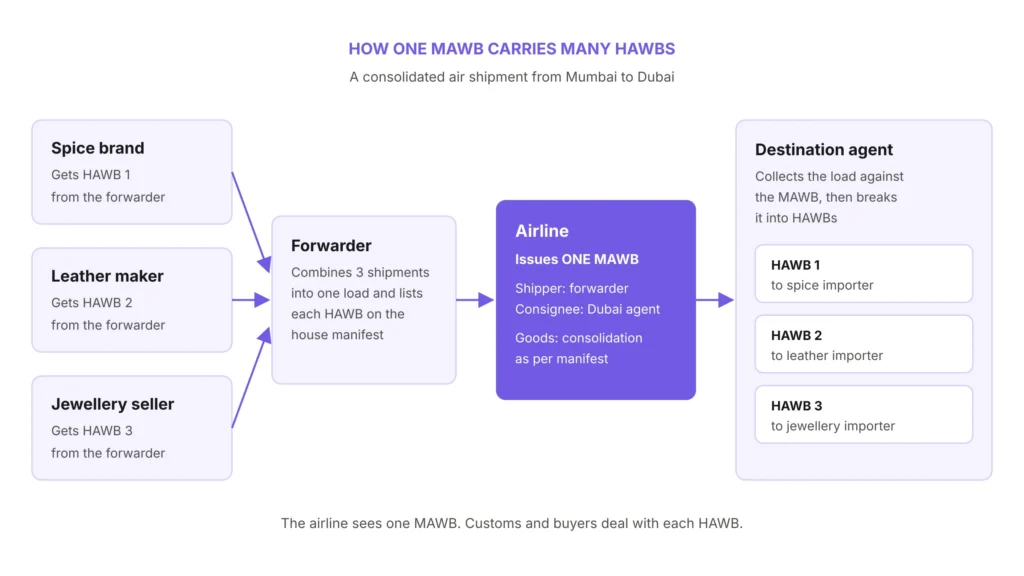
Here’s how the documents move:
- बुकिंग: The forwarder books space with the airline and gets a MAWB number from the airline’s stock.
- House issue: The forwarder issues a HAWB to each shipper and lists every HAWB on a house manifest, also called a consolidation manifest.
- निविदा: The forwarder hands the whole load to the airline under the MAWB, with the manifest attached. Our guide to the एअर कार्गो मॅनिफेस्ट explains what that document holds.
- आगमन: The airline releases the load to the destination agent named on the MAWB.
- मोठ्या प्रमाणात विभाजन: The destination agent “deconsolidates” the load and releases each shipment against its HAWB to the right importer or their customs broker.
The order matters. At Indian airports, for example, Mumbai’s cargo terminal FAQ notes that a break-bulk agent can issue a delivery order for a house waybill only after the airline has issued the delivery order for the master. A hold on the MAWB holds every HAWB inside it.
The same logic applies at sea. If you also ship by ocean, our comparison of master and house bills of lading works the same way, with one big difference: some ocean bills are negotiable, while air waybills never are.
How to Tell a MAWB From a HAWB by Its Number
The fastest way to tell which document you’re holding is to read the number.
The MAWB Number Format
A MAWB number has 11 digits. The first three are the IATA airline prefix, which identifies the carrier. Air India’s prefix is 098, for example. The next seven digits are a serial number, and the last digit is a check digit.
The check digit is the serial number divided by 7, keeping the remainder. Take a serial of 1234567: 1234567 ÷ 7 leaves a remainder of 5. So the full MAWB number is 098-12345675. If the last digit doesn’t match this calculation, the number has been mistyped. That’s a quick sanity check you can do on a phone calculator before you share the number with a buyer.
आमचे मार्गदर्शक AWB क्रमांक covers where else this number appears, and the IATA airport codes guide explains the three-letter origin and destination codes printed beside it.
The HAWB Number Format
A HAWB number follows the forwarder’s own system. It’s often a mix of letters and digits, such as a branch code followed by a running number. It has no airline prefix and no IATA check digit.
What a valid HAWB must carry is the MAWB number it travels under. If your HAWB has no master reference, ask the forwarder for it before the flight. You’ll need it to track the flight and to answer your buyer’s broker.
Who Is Liable Under Each Bill?
This is the difference most sellers only discover after a damaged or lost shipment.
Each bill is a separate contract, so each has its own claim path:
- Under the MAWB, the airline is liable to the forwarder. For international carriage, the Montreal Convention caps airline liability for lost, damaged or delayed cargo at a set amount per kilogram. That cap rose from 22 to 26 Special Drawing Rights per kg on 28 December 2024, as FIATA’s air freight alert स्पष्ट करते.
- Under the HAWB, your contract is with the forwarder. When a forwarder issues its own house bill, it acts as the “contracting carrier” for your goods, so you claim from the forwarder, not the airline. The forwarder then recovers from the airline under the MAWB.
The practical takeaway: read the conditions of carriage on your HAWB. Check the liability limit, the claim deadline and whether the forwarder offers cover beyond the per-kg limit. On a low-weight, high-value shipment such as silver jewellery, a per-kg cap pays back very little, so एअर कार्गो विमा is worth pricing in.
Which Document Do You Need at Each Stage?
Different people in the chain ask for different bills. Use this as a cheat sheet.
| Who’s asking | What they usually need | का |
|---|---|---|
| You, the exporter | HAWB | It’s your receipt and your contract with the forwarder |
| Your buyer | HAWB, plus the MAWB number | HAWB for their records; MAWB number to track the flight |
| Destination customs broker | HAWB, with the MAWB reference | The HAWB names the actual importer and details the goods |
| Airline and ground handler | MAWB | They release the whole load to the agent named on it |
| Your bank, for a letter of credit | Whatever the LC wording says | Some LCs accept a house bill, others insist on a carrier-issued one |
Customs Clearance in India and Abroad
On the import side, the airline files the Import General Manifest (IGM) on ICEGATE before arrival. For consolidated cargo, it lists the MAWB and the HAWBs under it. The importer’s customs broker then files the Bill of Entry against their HAWB. Our explainer on the एअर IGM walks through that process.
Many destinations now want house-level data before the cargo even flies. The EU’s Import Control System 2 (ICS2), for instance, requires a forwarder issuing a HAWB to declare the MAWB number it sits under, and air carriers need house-level details, including a 6-digit HS code, for consolidated loads. If your HAWB has a vague description like “gifts” or “samples”, expect questions before departure, not after.
पतपत्रे
If you’re paid under a आभाराचे पत्र, the wording decides which bill the bank will accept. Banks generally accept a HAWB when the credit simply asks for an “air waybill” or “air transport document”. If the LC explicitly calls for a “master air waybill” or a carrier-issued document, a HAWB can be refused.
Read the LC draft before you agree to it. If you plan to ship through a consolidator, ask your buyer to word the credit so a house air waybill is acceptable.
Consolidated, Direct and Courier Shipments Compared
Not every air shipment has both bills. Which documents you get depends on how the cargo moves.
- Consolidated shipment: One MAWB for the load, plus one HAWB per shipper. This is the most common setup for SMEs, because sharing space with other shippers lowers the rate per kg. Our consolidated shipping guide explains the cost side.
- Direct shipment: A large shipper, or a forwarder moving one customer’s full load, uses only a MAWB. The MAWB then names the actual exporter and buyer, so no HAWB is needed.
- Express courier shipment: The courier’s waybill works like a HAWB. The courier bags many parcels under its own master bills behind the scenes, but you only ever see and track the courier’s number.
How the Choice Changes Speed and Risk
Consolidation is cheaper, but it adds a step at each end. The forwarder waits to fill the load at origin, and the destination agent needs time to break it down. Budget for that when you quote delivery times.
A direct MAWB is faster to release because there’s no break-bulk step. It costs more per kg, and you usually need enough volume to justify it. For many Indian SMEs, a consolidated HAWB is the sensible default until monthly volumes grow.
Common MAWB and HAWB Mistakes That Delay Cargo
Most air cargo holds trace back to the two bills disagreeing with each other, or with your invoice. Watch for these:
- Weight mismatches: The total of all HAWB weights should match the weight on the MAWB. If one house bill shows gross weight and another shows chargeable weight, the totals won’t reconcile.
- Piece count errors: Ten cartons on the HAWB and nine on the airline’s records will hold the whole consolidation until the gap is explained.
- Wrong or missing MAWB reference: A HAWB without the correct master number can’t be matched at destination.
- Vague goods descriptions: “General cargo” or “parts” on a HAWB invites a customs query. Use the same description and HS code as your commercial invoice.
- Consignee details that don’t match the invoice: A spelling difference in the buyer’s company name or tax ID is enough for an inspection.
- Duplicate bills: Two HAWBs for the same cargo, often after a rebooking, confuse customs and the destination agent.
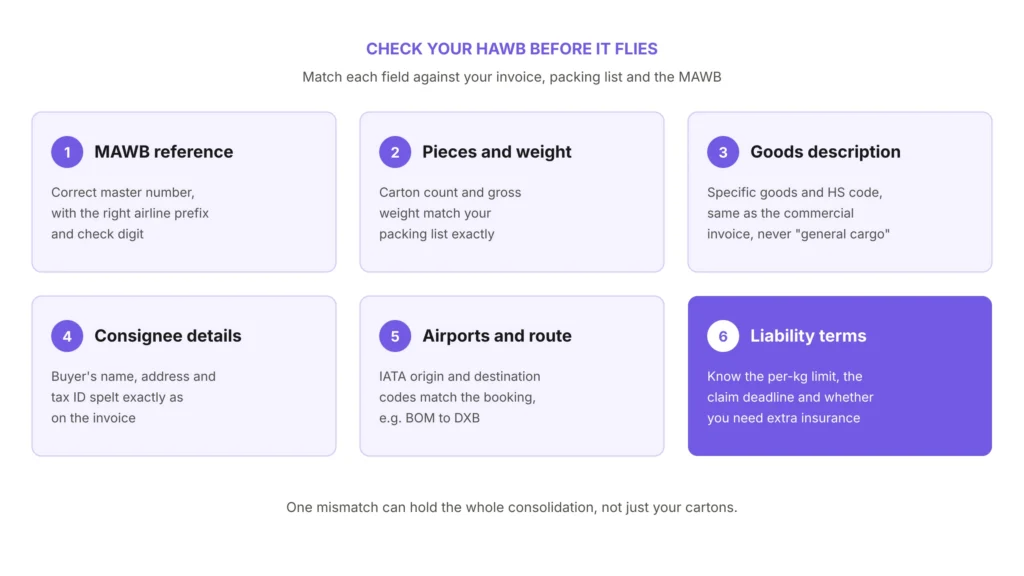
Before you accept your HAWB, match it line by line against your commercial invoice, packing list and shipping bill. Our list of mandatory documents for international shipping shows which other papers need to agree with it.
How e-AWB Is Changing Both Bills
Paper air waybills are fading out. Under IATA’s Multilateral e-AWB Agreement, set out in Resolution 672, airlines and forwarders sign once and can then exchange air waybill data electronically instead of printing paper bills. IATA’s e-AWB programme page explains how the agreement works.
The master and house split survives in digital form. The forwarder sends master data to the airline in one electronic message (FWB or XFWB) and house data in another (FHL or XFZB). For you, the effect is practical: errors in your HAWB data now flow straight into the airline’s and customs’ systems, so accurate details at booking matter even more.
Ask your forwarder whether they file electronically on your route. It usually means faster acceptance at the terminal and fewer lost-paper problems.
Ship Air Cargo Abroad With Shiprocket X
Shiprocket X is Shiprocket’s cross-border shipping platform for Indian businesses. For parcels, you book international shipments to 220+ countries and territories and get one AWB per order to track, so you and your buyer don’t have to deal with master and house bills at all. For bulk and B2B cargo, CargoX offers door-to-door air freight from India with no weight restrictions.
You can track shipments by AWB or order ID, and buyers can get updates by email and WhatsApp on a branded tracking page. For freight bookings, ask which air waybill you’ll receive and its MAWB reference before pickup, so you can share both with your buyer. Explore the services on the शिप्रॉकेट एक्स page to compare options for your route.
निष्कर्ष
The MAWB vs HAWB difference is about layers. The MAWB is the airline’s contract with the forwarder for the whole load. The HAWB is the forwarder’s contract with you for your share of it.
As an exporter, the HAWB is usually your document. Check that it carries the right MAWB number and matches your invoice on weight, pieces, description and consignee. Know who you’d claim from if something goes wrong. Get those details right and most air freight paperwork problems never happen.