


- Why Machinery Exports Need a Different Approach
- Step 1: Assess the Shipment Before You Book
- Step 2: Get Dimensions and Weight Exactly Right
- Step 3: Pack Machinery for Export
- Step 4: Plan Handling at Both Ends
- पायरी २: निर्यात दस्तऐवजीकरण तयार करा
- Step 6: Get Customs Classification and Export Controls Right
- Step 7: Choose the Right Freight Option
- Ship Heavy B2B Consignments Abroad With Shiprocket CargoX
- निष्कर्ष
A buyer in Kenya has approved your packaging machine, and a plant in Germany needs a replacement gearbox by next week. The machine weighs over a tonne and the gearbox can’t afford a single scratch. Both orders are worth a lot, and both can go wrong in transit.
That’s the reality of आंतरराष्ट्रीय स्तरावर औद्योगिक यंत्रसामग्री पाठवणे. Machines are heavy, awkward to lift, sensitive to moisture and shock, and often expensive enough that a damaged crate wipes out the margin on the order. Customs also looks closely at machinery, because classification and value are easy to get wrong.
This guide is for Indian machinery manufacturers, engineering companies and industrial suppliers who export equipment or spare parts. It walks through the seven steps that matter: assessment, dimensions and weight, packing, handling, documentation, customs and choosing the right freight option.
Why Machinery Exports Need a Different Approach
Shipping a parcel of apparel and shipping a CNC machine are two very different jobs. That’s why shipping industrial machinery internationally needs its own plan. A machine is rarely a neat box. It may have a high centre of gravity, protruding parts, residual oil or a control panel that hates humidity.
The cargo is also high value and often custom built. If it arrives damaged, you can’t just send another one from stock. Your buyer’s production line may be waiting, so delays cost them money too.
India’s engineering sector exports to buyers worldwide, and bodies like ईईपीसी इंडिया support these exporters with market information and trade promotion. But the shipping itself is still your responsibility, and it starts long before the truck arrives.
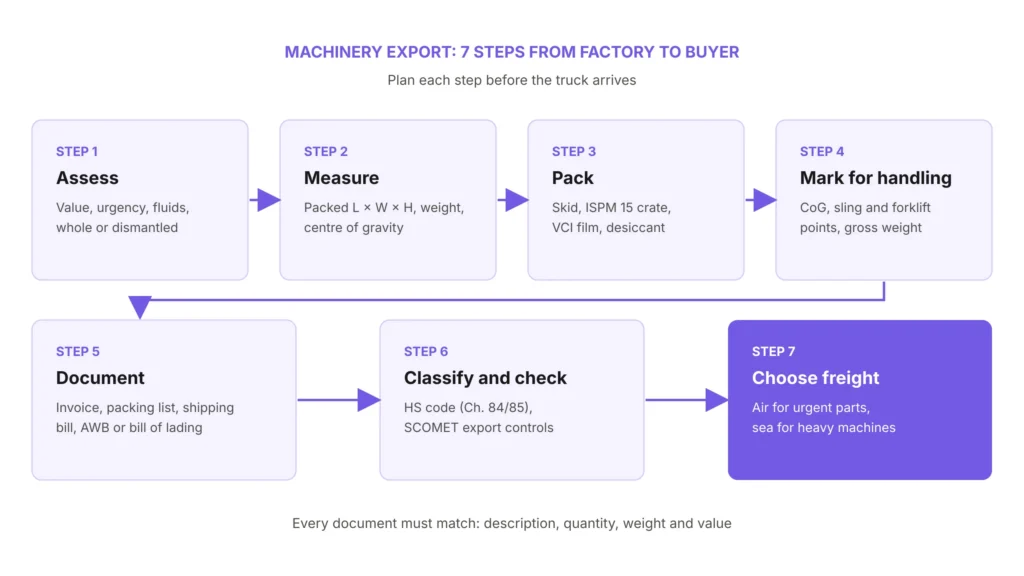
Step 1: Assess the Shipment Before You Book
A good shipment assessment answers one question: what does this cargo need to reach the buyer safely, legally and on time? Skip it and you’ll be rebooking, repacking or paying extra at the port.
Check these points for every consignment:
- हे काय आहे: a complete machine, a knocked-down machine shipped in parts, or spare parts.
- Value and urgency: a breakdown spare that stops a plant needs speed. A new production line usually needs low cost and safe handling.
- नाजूक घटक: sensors, PLCs, glass panels, precision spindles and anything that must stay level.
- Fluids and batteries: oil, fuel, coolant, hydraulic fluid and backup batteries can make the shipment dangerous goods, especially by air.
- Agreed Incoterm: it decides who pays for freight, insurance, export clearance and destination charges. Our guide to सामान्य इन्कोटर्म चुका covers the traps.
Should You Ship the Machine Whole or Dismantled?
Large machines often travel partly dismantled. Removing a hopper, a conveyor section or a control cabinet can bring the cargo within container or aircraft limits and cut costs.
The trade-off is reassembly at the buyer’s site. If you dismantle, tag every part, photograph the connections and send a clear assembly guide or plan for a technician visit.
Step 2: Get Dimensions and Weight Exactly Right
Measure the machine as packed, not as listed in the brochure. Record length, width and height in centimetres at the widest points, plus gross weight, net weight and the centre of gravity for heavy pieces.
These numbers drive almost every decision that follows. They decide whether the cargo fits a standard container, needs an open-top or flat-rack, or can fly in a freighter. They also set your freight bill.
हवाई मालवाहतुकीसाठी आकारणीयोग्य वजन कसे काम करते
Airlines charge on whichever is higher: actual weight or volumetric weight. A common air cargo formula divides length × width × height in centimetres by 6,000 to get volumetric weight in kilograms.
Take a crated machine of 200 × 120 × 150 cm that weighs 450 kg. Its volume is 3,600,000 cubic centimetres, so its volumetric weight is 600 kg. You pay for 600 kg, not 450 kg.
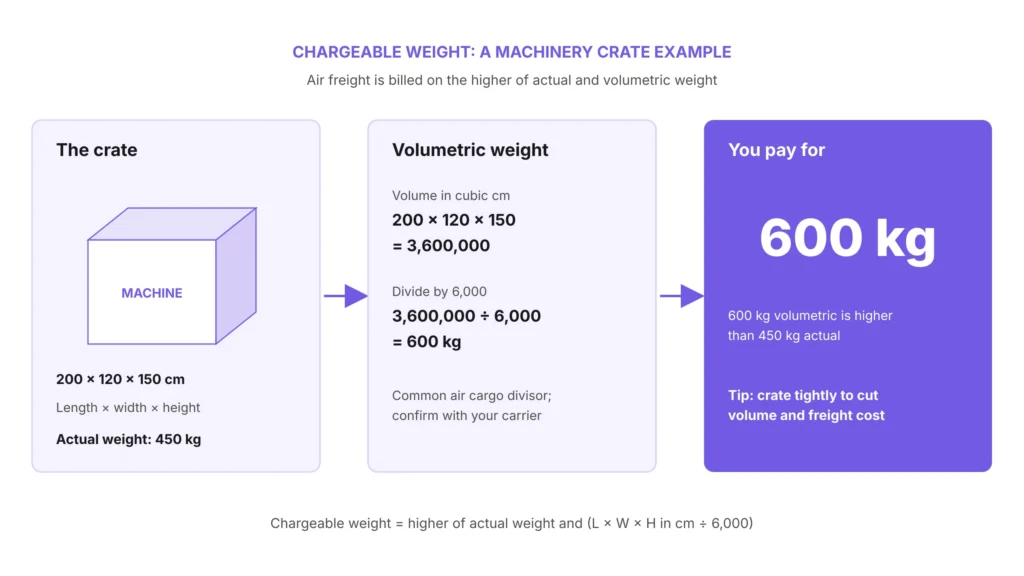
That’s why compact crating saves real money in industrial equipment air freight. Read our explainer on हवाई मालवाहतुकीसाठी आकारणीयोग्य वजन for more worked examples, and check when cargo is too heavy for air freight.
Step 3: Pack Machinery for Export
Machinery export packaging has three jobs: keep the machine still, keep it dry and make it easy to lift safely. A carton and stretch film won’t do any of these for a heavy machine.
Skids, Crates and Bracing
Bolt the machine to a strong wooden or steel skid through its own mounting points. Then build a crate around it for full protection, or use a skid with a frame for very heavy units that will be lifted by crane.
Brace any moving parts, such as arms, slides and spindles, so they can’t shift. Fill gaps with blocking rather than loose filler, because heavy parts crush soft padding.
ISPM 15 for Wooden Packaging
Most countries require wooden crates, pallets and dunnage to meet ISPM 15, the international standard for wood packaging material. The wood must be treated, usually heat treated, and carry the official ISPM 15 mark.
Buy crates from a certified supplier and check that the mark is clear on at least two sides. Untreated or unmarked wood can lead to cargo being held, treated or sent back at the destination.
गंज आणि ओलावा संरक्षण
Sea voyages expose steel to humidity and salt air for weeks. Coat bare machined surfaces with a rust preventive, wrap the machine in VCI film or a sealed barrier bag and add desiccant packs.
Drain fuel, coolant and hydraulic fluid where the manufacturer allows it, and disconnect batteries. This reduces leak risk and often keeps the cargo out of dangerous goods rules. Our guide to packing cargo for air freight adds more tips for air shipments.
Packing Spare Parts
Shipping machine parts overseas is usually simpler, but small parts get lost and precision parts get damaged easily. Pack each part in its own bag or box with its part number, then consolidate them in a strong outer carton or crate on a pallet.
Step 4: Plan Handling at Both Ends
Most machinery damage happens during lifting, not on the ship or plane. Mark the crate clearly so every handler knows how to move it.
| चिन्हांकित करत आहे | हे महत्वाचे का आहे |
|---|---|
| गुरुत्वाकर्षण केंद्र | Stops the load tipping when lifted |
| Sling or lifting points | Shows where to attach crane slings |
| Forklift entry points | Prevents forks puncturing the crate |
| This way up arrows | Keeps sensitive parts level |
| एकूण वजन | Lets handlers pick the right equipment |
| रचू नका | Protects crates that can’t bear a load |
Confirm that your factory, the port or airport, and the buyer’s site all have the right equipment. A 3-tonne crate needs a forklift or crane at pickup and at delivery, not just at the terminal.
पायरी २: निर्यात दस्तऐवजीकरण तयार करा
Machinery exports need the standard export papers, prepared with extra care on technical details. Every document must show the same description, quantity, weight and value.
- व्यावसायिक चलन: buyer, seller, Incoterm, value, currency and a precise description with model and serial numbers. See our guide to the commercial invoice for international shipping.
- पॅकिंग सूची: each crate’s dimensions, gross and net weight, marks and contents.
- शिपिंग बिल: the export declaration filed with Indian customs, usually by your customs broker or freight forwarder.
- एअर वेबिल किंवा बिल ऑफ लॅडिंग: the transport contract for air or sea.
- IEC and AD code registration: both are needed to export from India and receive payment.
- मूळ प्रमाणपत्र: needed when your buyer wants to claim duty benefits under a trade agreement.
- विमा प्रमाणपत्र: strongly recommended for high-value equipment. Here’s why cargo insurance matters.
- तांत्रिक कागदपत्रे: catalogues, specifications and manuals help customs confirm classification.
Some destinations add their own rules, such as conformity marking for machinery sold in the EU or pre-shipment inspection for used equipment. Ask your buyer what their customs and regulators expect before you pack.
Step 6: Get Customs Classification and Export Controls Right
Most machinery falls under HS Chapter 84, and electrical machinery under Chapter 85. The exact code depends on what the machine does, so classify by function rather than by its trade name. Our explainer on the आंतरराष्ट्रीय शिपिंगमधील एचएस कोड shows how codes are built.
Spare parts need care too. Parts made for a specific type of machine often have their own heading, while general-purpose items like bolts and bearings are classified separately. A wrong code can mean duty disputes for your buyer and delays for you.
Also check export controls. Certain high-precision machine tools and equipment with possible dual uses fall under India’s SCOMET list and need authorisation before export. If your equipment is advanced, confirm its status with your forwarder or the DGFT before you accept the order.
Step 7: Choose the Right Freight Option
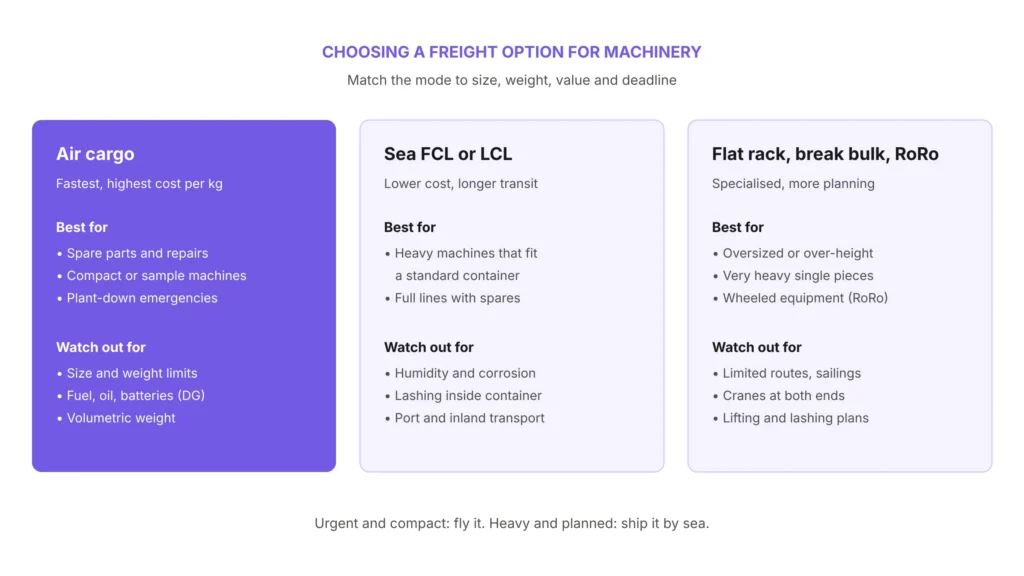
When shipping industrial machinery internationally, the right mode depends on size, weight, value and deadline. Here’s how the main options compare for machinery.
| Freight option | सर्वोत्कृष्ट साठी | व्यापार-बंद |
|---|---|---|
| हवाई मालवाहतूक | Spare parts, urgent repairs, compact machines | Highest cost per kg, size and weight limits |
| समुद्री एफसीएल | Large machines or full production lines | Slower, needs port and inland transport |
| समुद्र एलसीएल | Smaller machines sharing container space | अधिक हाताळणी, जास्त वेळ वाहतूक |
| Flat rack or open top | Oversized or over-height machinery | Specialised equipment, more planning |
| Break bulk or RoRo | Very heavy or wheeled equipment | Limited routes and sailings |
जेव्हा हवाई वाहतूक अर्थपूर्ण असते
Air is the clear choice when a machine is down at the buyer’s plant and every day costs money. It also suits high-value parts, small machines and sample units for trials.
Costs vary by route, chargeable weight and season. Our air freight charges guide breaks down the components, and our आंतरराष्ट्रीय हवाई कार्गो guide explains how the process works. For very large pieces, read about oversized air cargo.
जेव्हा समुद्री मालवाहतूक अर्थपूर्ण असते
Heavy machinery and complete lines usually go by sea. A full container gives you space for the machine plus its spares, and our एफसीएल शिपिंग मार्गदर्शक covers how to plan one.
For complex moves with multiple legs, a forwarder coordinates trucking, customs, port handling and delivery. Our guide to आंतरराष्ट्रीय मालवाहतूक अग्रेषण explains each stage.
Ship Heavy B2B Consignments Abroad With Shiprocket CargoX
When you export machinery or spare parts regularly, you need a partner built for B2B cargo, not parcels. शिप्रॉकेट कार्गोएक्स handles bulk international consignments starting from 20 kg, to 200+ countries and territories. You can request a quote, compare air cargo options and schedule a pickup online, then track each shipment in real time and share updates with your buyer.
CargoX offers Priority, Express and Economy services, so you can send an urgent gearbox fast and a planned spares order at lower cost. Documentation support helps with the IEC, commercial invoice, packing list and certificate of origin, and a dedicated key account manager is available for queries. [[VERIFY: maximum piece weight and dimensions CargoX accepts, and whether it handles oversized or sea freight machinery consignments]] Learn more about जागतिक शिपिंगसाठी कार्गोएक्स.
निष्कर्ष
Shipping industrial machinery internationally comes down to preparation. Assess the cargo, measure it as packed, crate it to ISPM 15 with corrosion protection, mark it for safe handling and make sure every document tells the same story.
Then match the freight mode to the job: air for urgent parts and compact units, sea for heavy and oversized equipment. Get these steps right and your machines reach buyers on time, in working order and without customs surprises.


