


- Why Buyer Deadlines Change How You Plan Export Shipments
- How to Work Backwards From the Required Delivery Date
- A Worked Example: Planning Backwards From D-Day
- How Much Buffer Should You Add?
- How to Choose a Freight Service That Fits Your Deadline
- Avoid Promising Delivery Dates You Can’t Control
- Plan Deadline-Driven Exports With Shiprocket CargoX
- निष्कर्ष
Your buyer in Hamburg has a store launch on 15 March. Their team needs your stock two days earlier to unpack and merchandise it. Miss that window and the launch goes ahead with empty shelves, and your next order probably goes to someone else.
म्हणूनच आंतरराष्ट्रीय मालवाहतूक वितरण नियोजन matters so much in B2B exports. Overseas buyers rarely care when your goods leave India. They care when the goods reach their production line, project site or warehouse.
This guide shows you how to work backwards from the buyer’s required date, where to add processing and customs buffers, and how to pick a freight service that fits the time you have. It is written for Indian exporters shipping air cargo, but the method works for any mode.
Why Buyer Deadlines Change How You Plan Export Shipments
Most exporters plan forwards. Production finishes, the goods get packed, and then someone books freight and hopes for the best.
That works when the buyer has flexible stock. It fails when the order is tied to a fixed event, such as:
- A production date: a garment brand needs your fabric or trims before its cutting schedule starts.
- A project deadline: a contractor needs your fittings or machinery parts before installation day.
- A retail launch: a store or marketplace seller needs stock before a season, sale or launch campaign.
- A replenishment window: a distributor needs a top-up before its safety stock runs out.
In each case, the buyer’s deadline is fixed and everything upstream has to bend around it. So the useful question is not “when can we ship?” It is “when must we ship to arrive on time, with room to spare?”
Agree on What “Delivery” Means First
Before you count a single day, confirm which point the deadline refers to. Is it the date the cargo lands at the destination airport, clears customs, or reaches the buyer’s door?
Your Incoterm answers this. Under FCA or FOB-style terms, your responsibility may end in India. Under DAP or DDP, it runs all the way to the buyer’s premises. The आयसीसीचे इन्कोटर्म्स नियम define these delivery points, and our guide to शिपिंग इनकोटर्म्स explains how each one splits cost and risk.
Write the agreed delivery point and date into the purchase order. It prevents the classic dispute where you say “shipped on time” and the buyer says “arrived late”.
How to Work Backwards From the Required Delivery Date
Backward scheduling is the core of international cargo delivery planning: start at the buyer’s deadline and subtract the time each step needs, from last to first. The result is the latest date each step can start.
Here are the stages to subtract, in order.
1. Buyer’s Receiving and Inspection Time
Ask the buyer how many days they need between delivery and use. A factory may need a day for incoming quality checks. A retailer may need two or three days to unpack, tag and display.
This is their time, not yours. But if you ignore it, you will “deliver on time” and still miss their real deadline.
2. Final-Mile Delivery at Destination
After clearance, the cargo still has to move from the airport or cargo terminal to the buyer. For a city-centre buyer this can be quick. For an inland factory or a remote site, it can take longer.
Ask your forwarder whether their quoted timeline is airport-to-airport or door-to-door. That single detail can shift your plan by several days.
४. डेस्टिनेशन कस्टम्स क्लिअरन्स
Import clearance depends on the destination country, the product and the paperwork. Clean documents and pre-filed data usually clear quickly. A query, an inspection or a missing certificate can add days.
Treat this as a range, not a single number. Plan on the normal case and protect against the slow case with a buffer, covered in the next section.
4. International Transit Time
This is the cargo transit time from departure in India to arrival at destination. It depends on the service level, the route, connections and airline capacity.
Use the upper end of the quoted range, not the lower end. If a service is quoted at 7–9 days, plan around 9.
5. Export Clearance and Handover in India
Your goods need a shipping bill, customs clearance and a Let Export Order before they can fly. Our guides to the निर्यात घोषणा आणि ते निर्यात ऑर्डर द्या explain both steps.
Air cargo clears fast in India when the paperwork is right. CBIC’s National Time Release Study 2025 found that export regulatory clearance at air cargo complexes, from arrival to Let Export Order, averaged under four hours. That average assumes clean documents, so still allow time for pickup, terminal handling and the next available flight.
6. Packing, Labelling and Documentation
Packing export cargo properly takes time, especially for palletised or fragile goods. So does preparing the commercial invoice, packing list and any certificates the buyer’s country needs.
आमच्या तपासणी सूची हवाई मालवाहतुकीसाठीची कागदपत्रे helps you prepare these in parallel with production, not after it.
7. Production and Quality Check
Finally, subtract your own manufacturing lead time and final QC. This gives you the latest production start date that still meets the buyer’s deadline.
If that date is already in the past, you know right away. You can then talk to the buyer about a split shipment, a faster service or a revised date, before anyone has made a promise they can’t keep.
A Worked Example: Planning Backwards From D-Day
Let’s apply the method to the Hamburg launch. Call the buyer’s in-hand deadline “D”. The day counts below are an example only; replace them with your forwarder’s quoted windows and your own production data.
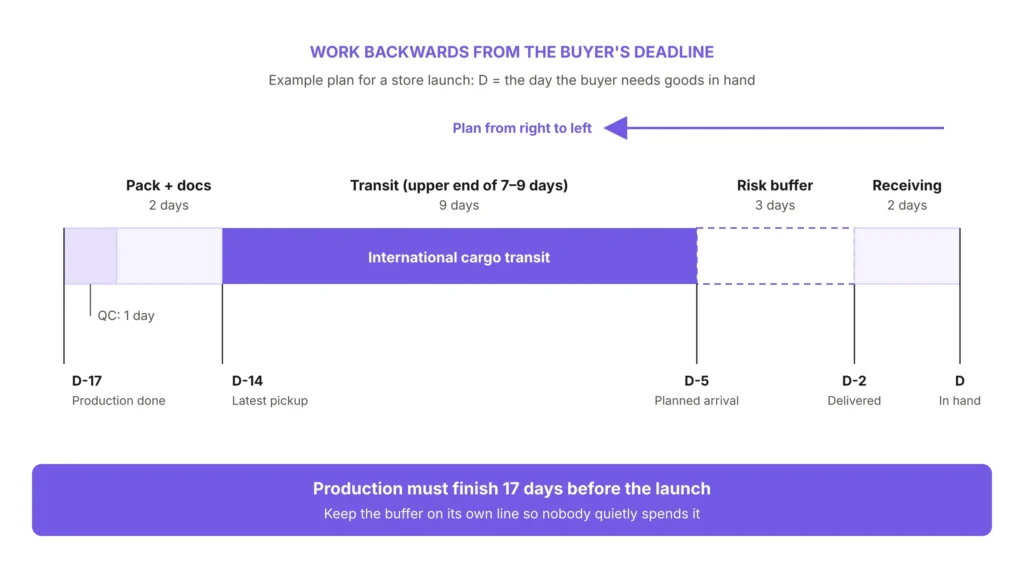
| Step (working backwards) | Days allowed | Latest date |
|---|---|---|
| Buyer needs goods in hand | - | D |
| Buyer receiving and set-up | 2 | Delivered by D-2 |
| Risk buffer for customs, holidays, missed connections | 3 | Planned arrival D-5 |
| Door-to-door transit, upper end of a 7–9 day window | 9 | Pickup by D-14 |
| Packing, labelling and export documents | 2 | Ready to pack D-16 |
| अंतिम QC | 1 | Production complete D-17 |
So production must finish 17 days before the launch. If your factory needs 20 days to make the order, production has to start by D-37.
Notice that the 3-day buffer sits on its own line. It is not hidden inside the transit time. That makes it visible, so nobody quietly spends it on a late production run.
How Much Buffer Should You Add?
There is no universal number. The right buffer depends on the lane, the product, the season and how reliable your past shipments on that route have been.
Instead of one blanket figure, build the buffer from specific risks:
| धोका | When to add more buffer |
|---|---|
| Customs queries or inspection | New product, new HS code, regulated goods, first shipment to a country |
| दस्तऐवजीकरण त्रुटी | New buyer, unfamiliar certificates, consignee details still changing |
| सार्वजनिक सुट्ट्या | Diwali in India; Christmas, New Year or Lunar New Year at destination |
| पीक-सीझन क्षमता | Festive and holiday peaks, when airlines and terminals are busiest |
| Transhipment and connections | Routes with one or more stops, or destinations with few direct flights |
| Final-mile complexity | Inland factories, project sites, appointment-only warehouses |
Track your actual door-to-door times for each lane. After a few shipments you will know which routes run close to the quote and which need extra slack. Our guide to ETA in shipping explains how to read and update arrival estimates as the shipment moves.
How to Choose a Freight Service That Fits Your Deadline
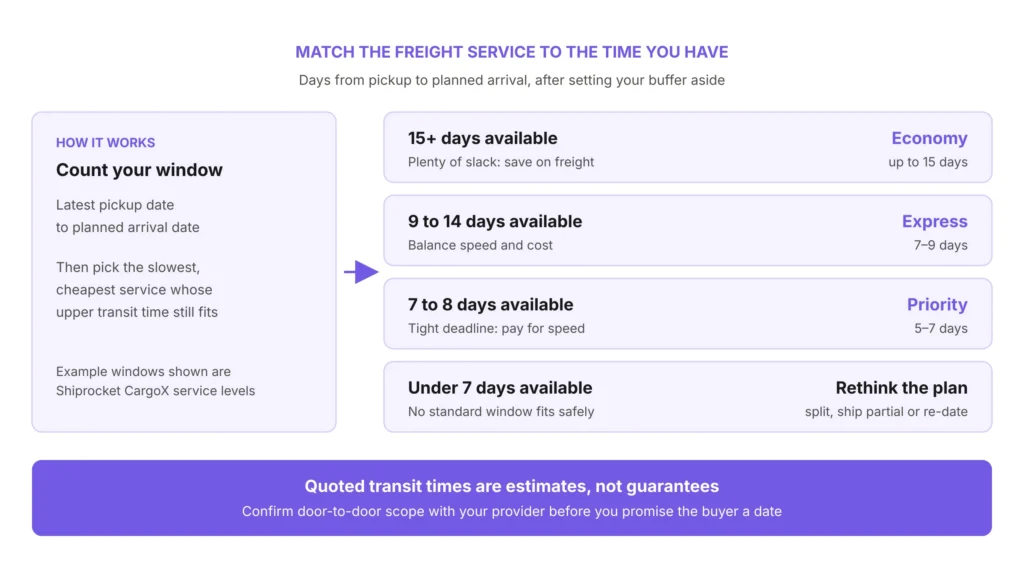
Once you know the time available between your ready date and the planned arrival date, choosing a service becomes a matching exercise. Pick the slowest, most economical service whose upper transit time still fits that window.
When You Have Slack, Use It
If your goods are ready well ahead of the deadline, an economy air service or, for heavy and non-urgent volumes, ocean freight can cut costs a lot. Paying for priority speed on a shipment that would sit in the buyer’s warehouse for a week is wasted margin.
आमच्या air freight shipping guide covers how air cargo is priced and booked. Remember that chargeable weight, not just actual weight, drives the bill.
When the Calendar Is Tight, Pay for Speed Selectively
If the window is short, move up to an express or priority service. If even that does not fit, look at options before you promise anything:
- Split the shipment: fly the quantity needed for the launch or production start, and send the balance on a slower, cheaper service.
- Ship partial production: dispatch finished batches as they clear QC instead of waiting for the full order.
- Renegotiate the date: buyers usually prefer an honest revised date today to a broken promise later.
Questions to Ask Your Freight Provider
- Is the quoted time door-to-door or airport-to-airport?
- Does it include export and import clearance?
- What is the pickup cut-off for the next departure?
- Are there known capacity constraints or holidays on this lane in my shipping window?
- How will I be updated if the shipment is delayed?
चांगले आंतरराष्ट्रीय मालवाहतूक अग्रेषण partner will answer these clearly. Treat quoted transit times as estimates, not guarantees, unless the provider confirms otherwise in writing.
Avoid Promising Delivery Dates You Can’t Control
Freight providers quote transit windows because flights, weather, customs and terminal congestion are outside anyone’s full control. So keep your commitments to the buyer realistic.
Promise a dispatch date you control, and give an estimated arrival range based on the service you booked. Share tracking from pickup onwards so the buyer can plan with live information.
If something slips, tell the buyer early, with a revised estimate and what you are doing about it. Early bad news protects the relationship far better than a surprise on launch day.
Plan Deadline-Driven Exports With Shiprocket CargoX
शिप्रॉकेट कार्गोएक्स is built for B2B export consignments starting from 20 kg, to 200+ countries and territories. It offers three service levels, which map neatly onto backward planning: Priority (5–7 days) for tight deadlines, Express (7–9 days) for a balance of speed and cost, and Economy (up to 15 days) for planned or high-volume exports.
You can compare international courier partners, schedule a pickup and track each shipment in real time, then share updates with your buyer. Documentation support and a dedicated key account manager help you catch paperwork issues before they cost you days. [[VERIFY: whether CargoX delivery windows are door-to-door and include export and import customs clearance]] Read more about जागतिक शिपिंगसाठी कार्गोएक्स.
निष्कर्ष
Meeting an overseas buyer’s deadline is less about speed and more about international cargo delivery planning. Start at the date they need the goods in hand, then subtract receiving, final-mile delivery, customs, transit, export clearance, packing and production.
Keep your buffer on its own line, size it to the real risks on each lane, and choose the slowest service that still fits. Do that consistently, and your export shipment planning becomes predictable, your freight spend stays sensible, and your buyers learn they can rely on you.


