
- How to ship clothing to international buyers from India: start with GST registration, an IEC, an AD code and an LUT, plus the right HS code on every invoice.
- Knitted garments fall under HS Chapter 61 and woven garments under Chapter 62. A wrong code can mean extra duty or a customs hold.
- Import duties depend on the destination. The USA no longer has a duty-free de minimis, while the UK, UAE and Australia offer zero duty on most Indian garments with proof of origin.
- Garment exports are zero-rated under GST. Export under an LUT without paying IGST, or pay IGST and claim a refund.
- Pack in tissue and poly bags, add silica gel for silk and zari, and share a size chart in centimetres to cut returns.
- Why Indian Clothing Sells Well Abroad
- What Does International Cloth Shipping From India Involve?
- How to Ship Clothing Internationally From India: Step by Step
- HS Codes for Garment Exports
- Import Duties on Indian Clothing by Market
- GST on Garment Exports from India
- Documents You Need to Export Clothes by Courier
- How to Pack Clothing for International Courier Shipments
- Handling Sizing and International Returns
- Pre-Shipment Checklist for Garment Exports
- Ship Clothing Worldwide With Shiprocket X
- উপসংহার
A customer in London finds your hand-block printed kurta on Instagram and wants three of them. Another buyer in New Jersey asks if you can ship a Banarasi saree before a family wedding. The demand is real, but the questions start piling up: which HS code, who pays the duty, and do you charge GST?
এই গাইড ব্যাখ্যা how to ship clothing to international buyers from India, step by step. It covers the registrations you need, HS codes for garment exports, import duties on Indian clothing in the five biggest markets, GST on garment exports from India, packaging, paperwork and returns.
Clothing is one of the easiest products to export by courier. It’s light, it packs flat and it rarely breaks. Most first-time exporters don’t struggle with the shipping itself. They struggle with classification, duties and tax, so that’s where this guide spends most of its time.
Why Indian Clothing Sells Well Abroad
Ready-made garments are India’s single largest textile export. According to আইবিইএফ, ready-made garments contributed 44% of India’s textile and apparel exports in FY26, worth US $ 15.77 বিলিয়ন.
Buyers come from two groups. The Indian diaspora in the USA, UK, UAE, Canada and Australia wants festive and wedding wear that is hard to find locally. Mainstream shoppers want block prints, handloom cotton, khadi and embroidered pieces they can’t get from fast-fashion chains.
You don’t need a container load to take part. Marketplaces like Etsy and Amazon Global Selling, and your own Shopify or WooCommerce store, make single-parcel exports practical. Our guide on how the AEPC supports Indian apparel exporters covers the trade-body help available as you grow.
What Does International Cloth Shipping From India Involve?
International cloth shipping from India means sending garments such as kurtas, sarees, dupattas, shirts and dresses to overseas buyers, usually by international courier. Each shipment needs a correct HS code, export paperwork filed with Indian Customs and a clear plan for who pays the import duty at the destination.
There are two broad models:
- B2C or D2C exports: single orders shipped by courier to individual buyers. These usually move under the courier shipping bill (CSB-V) for commercial exports.
- B2B garment exports: bulk orders to boutiques, wholesalers or brands abroad. These often go by air or sea freight with a regular shipping bill, and they attract full import duty in the buyer’s country.
Most of this guide focuses on courier exports, since that’s where small brands and D2C sellers start.
How to Ship Clothing Internationally From India: Step by Step
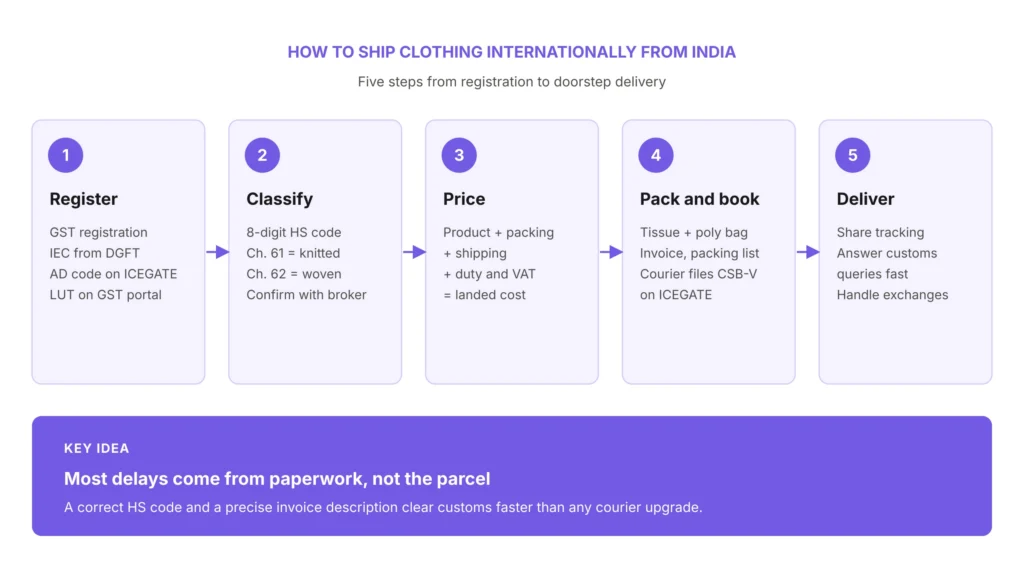
If you’re wondering how to ship clothing to international buyers from India without customs trouble, follow these five steps in order.
Step 1: Get Your Registrations in Place
You need four things before your first commercial shipment:
- জিএসটি নিবন্ধন: required to claim export benefits and refunds.
- আমদানি রপ্তানি কোড (IEC): issued by the DGFT against your PAN. Our guide to the আমদানি রপ্তানি কোড explains the online application.
- AD কোড: a 14-digit code from your bank, registered on ICEGATE, so export proceeds can be tracked. Read more on what an AD code is.
- Letter of Undertaking (LUT): filed on the GST portal so you can export without paying IGST.
Step 2: Classify Every Product With the Right HS Code
Find the 8-digit Indian tariff code for each garment. Your courier and customs broker use it on the invoice and shipping bill, and the destination country uses the first six digits to set the duty. The next section breaks down the codes.
Step 3: Price for the Landed Cost
Add product cost, packaging, international shipping, import duty, VAT or sales tax and payment fees. Then decide whether you or the buyer pays the duty. Our explainer on জমির দাম shows how to calculate it.
Step 4: Pack, Document and Book
Pack each order to protect the fabric and keep volumetric weight low. Prepare a commercial invoice and packing list, then book with an international courier, which files the CSB-V on your behalf.
Step 5: Track, Deliver and Handle Returns
Share tracking with the buyer, watch for customs queries and keep a clear returns or exchange policy. Keep your shipping bill and payment records for GST refunds and export incentives.
HS Codes for Garment Exports
HS codes for garment exports start with the fabric construction. Knitted or crocheted garments fall under Chapter 61, and woven garments fall under Chapter 62. The same kurta can sit in different chapters depending on whether the fabric is knitted or woven.
India uses 8-digit ITC(HS) codes. The first six digits are shared worldwide, and the last two are India-specific.
| শিরোনাম | এটা কভার কি | Common Indian examples |
|---|---|---|
| 6109 | T-shirts and vests, knitted | Cotton printed T-shirts |
| 6104 / 6204 | Women’s suits, dresses, skirts and trousers (knitted / woven) | Dresses, co-ord sets, palazzos |
| 6106 / 6206 | Women’s blouses and shirts (knitted / woven) | Kurtis and tops |
| 6205 | Men’s shirts, woven | Cotton and linen shirts |
| 6211 | Track suits, swimwear and other garments | Kurta-salwar sets (6211 42 10 for cotton) |
| 6214 | Shawls, scarves, mufflers and stoles | Dupattas, stoles, pashmina shawls |
| 6111 / 6209 | Babies’ garments (knitted / woven) | Baby jhablas, infant sets |
| 6217 | Other made-up clothing accessories | Fabric belts, garment parts |
A few points trip up ethnic-wear sellers:
- Kurta sets: India’s tariff has a specific line, 6211 42 10, for cotton kurta and salwar with or without dupatta. A standalone kurti may instead be classified as a blouse or top.
- শাড়ি: an unstitched saree can be classified as woven fabric by fibre, while a pre-stitched or ready-to-wear saree is treated as a garment. Confirm the code with your broker.
- Fibre matters: the last digits change with cotton, silk, wool or synthetic content, and so does the duty abroad.
Always confirm the full 8-digit code with your customs broker or the DGFT ITC(HS) schedule before your first shipment. Misclassification can lead to reassessment, extra duty or penalties at the destination. Our guide to HS codes in international shipping covers how the system works.
Import Duties on Indian Clothing by Market
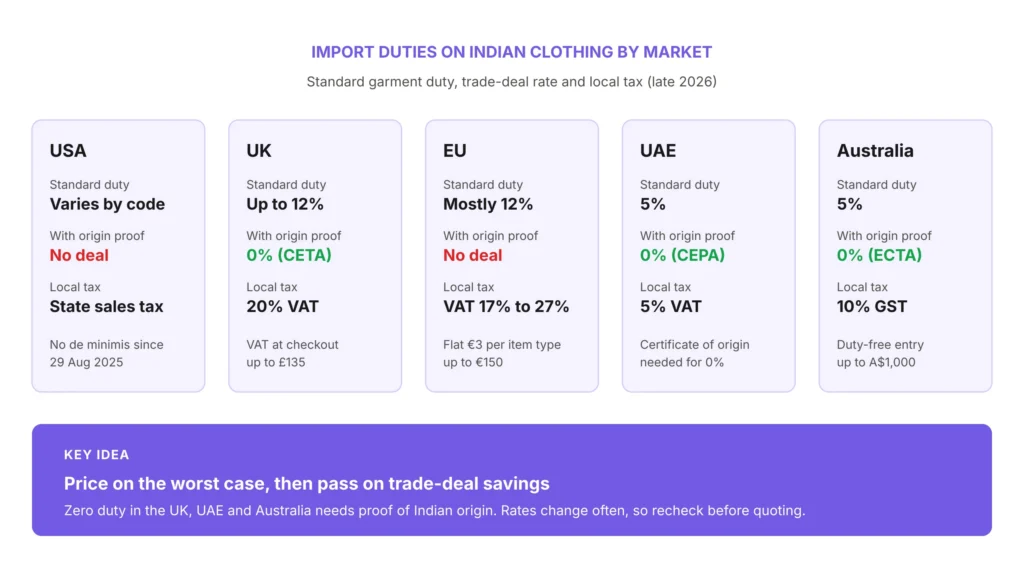
Import duties on Indian clothing depend on the destination, the HS code, the fibre and whether you can prove Indian origin. Here is how the five biggest markets for Indian apparel work in late 2026.
| বাজার | Standard duty on garments | Trade deal benefit | স্থানীয় কর | Low-value parcel rule |
|---|---|---|---|---|
| মার্কিন | Varies by code, e.g. 16.5% on cotton T-shirts, plus any extra tariffs on Indian goods | না | রাজ্য বিক্রয় কর | No de minimis since 29 Aug 2025 |
| UK | 12% পর্যন্ত | 0% under India-UK CETA with proof of origin | 20% ভ্যাট | VAT collected at checkout up to £135 |
| EU | প্রায় ৫% | না | VAT, 17% to 27% by country | Flat €3 duty per item type up to €150 |
| সংযুক্ত আরব আমিরাত | 5% | 0% under CEPA with certificate of origin | 5% ভ্যাট | Check with your courier |
| অস্ট্রেলিয়া | 5% | 0% under ECTA with certificate of origin | 10% জিএসটি | Duty-free entry up to A$1,000 |
মার্কিন
US duty on garments varies widely by HS code and fibre. For example, the মার্কিন যুক্তরাষ্ট্রের সুরেলা শুল্ক সময়সূচী lists 16.5% for cotton knit T-shirts and 32% for many synthetic ones.
The bigger change is the end of the US$800 de minimis exemption for all countries on 29 August 2025. Every commercial D2C parcel from India now pays duty. Additional US tariffs on Indian goods have also changed several times since 2025, so check the current rate before you price.
If your buyer has to pay duty at the door, there’s a real risk they’ll refuse the parcel. Collecting duty upfront through Delivered Duty Paid shipping to the USA সেটা এড়িয়ে চলে।
UK
The India-UK Comprehensive Economic and Trade Agreement (CETA) entered into force on 15 July 2026. Most Indian garments now enter the UK at zero duty, as long as you can show proof of Indian origin.
Without that proof, the standard duty of up to 12% applies. UK VAT of 20% applies either way, and for consignments up to £135 it is collected at the point of sale.
ইউরোপীয় ইউনিয়ন
Most garments attract around 12% EU duty, plus VAT, which ranges from 17% to 27% depending on the country. Under IOSS, VAT on orders up to €150 is collected at checkout. Our introduction to IOSS in international customs explains the registration.
From 1 July 2026, the EU charges a temporary flat €3 customs duty on low-value parcels up to €150. According to the ইউরোপীয় কমিশন, the charge applies per item type: five identical T-shirts attract €3, while three T-shirts and a watch attract €6. Above €150, normal duty rates and import procedures apply.
সংযুক্ত আরব আমিরাত
The UAE charges 5% customs duty and 5% VAT. Under the India-UAE CEPA, most Indian-origin garments can enter at zero duty with a valid certificate of origin.
অস্ট্রেলিয়া
Australia’s standard duty on most garments is 5%, and 10% GST applies. Under the India-Australia ECTA, Indian-origin garments can enter at zero duty with a certificate of origin. Shipments up to A$1,000 generally clear without duty, though registered overseas sellers collect GST at checkout.
Don’t Build Your Pricing on Duty-Free Delivery
Duty-free thresholds and trade-deal rates change often, and they rarely help B2B wholesale exports, which attract full import duty. Price every market on the worst case, then pass on savings where a deal applies. Our guide to মূল শংসাপত্র explains how to claim preferential rates.
GST on Garment Exports from India
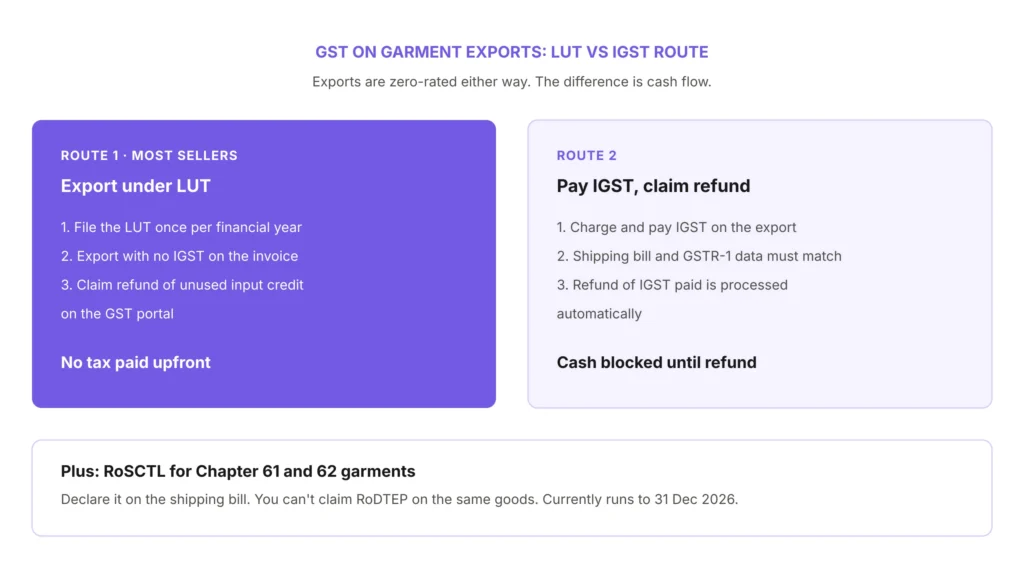
GST on garment exports from India is zero. Exports are treated as zero-rated supplies, so you don’t charge GST to your overseas buyer, and you can get back the GST you paid on inputs such as fabric, trims and packaging.
You can choose one of two routes:
| LUT route | IGST route | |
|---|---|---|
| GST at export | না | Pay IGST on the export invoice |
| What you claim | Refund of unused input tax credit | Refund of IGST paid |
| রিফান্ড কীভাবে কাজ করে | File a refund application on the GST portal | Processed automatically when shipping bill and GSTR-1 data match |
| নগদ প্রবাহ | Better, no tax paid upfront | Money blocked until the refund comes |
| জন্য সেরা | Most small and growing exporters | Exporters with large unused credit |
The LUT is filed online, once per financial year. Our guide to the উদ্যোগটা অক্ষর walks through it, and this piece on how GST affects exports in India covers the refund rules.
One apparel-specific trap: GST on many lower-priced garments is lower than the GST on inputs like fabric and job work. That builds up unused credit, so file refund claims on time. Refunds of unused credit must be claimed within two years of the relevant date.
RoSCTL: The Export Incentive for Garments
Garments under Chapters 61 and 62 are covered by the Rebate of State and Central Taxes and Levies (RoSCTL) scheme, not RoDTEP. You can’t claim both for the same goods. The scheme has been extended in short periods and currently runs until 31 December 2026.
Ask your courier or customs broker to declare the RoSCTL claim on the shipping bill, and confirm that it is supported for courier shipments. Our RoSCTL scheme guide explains rates and claims.
Documents You Need to Export Clothes by Courier
Courier exports need less paperwork than freight, but every field has to match. Keep these ready for each shipment:
- বাণিজ্যিক চালান: with your GSTIN, IEC, the 8-digit HS code, fabric description, quantity and value per item.
- প্যাকিং তালিকা: pieces per carton, weight and dimensions.
- Airway bill: issued by the courier.
- Courier shipping bill (CSB-V): filed by the courier on ICEGATE for commercial exports.
- LUT reference: if you export without paying IGST.
- মূল প্রশংসাপত্র: needed to claim zero duty in the UK, UAE and Australia.
- KYC নথি: as asked for by your courier.
Describe goods precisely. “Women’s cotton kurta, woven, printed” clears far faster than “clothes” or “garments”. Our CSB-IV vs CSB-V guide এবং রপ্তানি নথির চেকলিস্ট বিস্তারিত বিষয়গুলো তুলে ধরুন।
How to Pack Clothing for International Courier Shipments
Good packaging protects the garment and keeps your shipping bill low. International couriers charge on the higher of actual and volumetric weight, so an oversized box costs you money on every order.
- Fold with tissue: place acid-free tissue between folds to prevent creasing and colour transfer.
- Use poly bags: seal each piece in its own bag to protect it from moisture and keep sets together.
- Poly mailers for light items: fine for single soft garments under about 1 kg, like T-shirts, light kurtas and dupattas.
- Corrugated boxes for the rest: use them for sets, premium pieces and anything over about 1 kg.
- Don’t compress embellished pieces: sequins, mirror work and beading can flatten or come loose in a tight mailer.
- Roll sarees and heavy dupattas: roll them around acid-free tissue to avoid hard fold lines in silk and zari.
- Add silica gel: moisture can tarnish zari permanently, especially in humid destinations.
Add a thank-you note and care instructions. It costs little and makes an imported purchase feel personal. For more ideas, read our আন্তর্জাতিক শিপিং প্যাকেজিং টিপস.
Handling Sizing and International Returns
Sizing is the biggest cause of returns in cross-border apparel. A UK 10, a US 10 and an Indian M are not the same size, so S/M/L/XL labels alone aren’t enough.
- Add a size chart in centimetres and inches to every listing, with chest, waist, hip and length.
- Note the fit, such as relaxed or tailored, and the model’s height and size.
- State your returns and exchange policy before checkout.
International returns are slow and costly. Build the cost of a second international shipment into your margins, and consider offering exchanges, store credit or local alterations instead of full returns. Our guide to আন্তঃসীমান্ত শিপিংয়ে রিটার্ন ব্যবস্থাপনা বিকল্পগুলো অন্তর্ভুক্ত করে।
Pre-Shipment Checklist for Garment Exports
Run through this list before you hand over a parcel:
- GST, IEC, AD code and LUT are active.
- The 8-digit HS code is confirmed for each garment.
- A certificate of origin is ready where it cuts the duty.
- Duty is either included in the price or clearly disclosed to the buyer.
- The invoice description matches the goods exactly.
- Each piece is wrapped in tissue and a poly bag, with silica gel for silk and zari.
- A size chart in centimetres is in the listing, and the returns policy is clear.
Ship Clothing Worldwide With Shiprocket X
Shiprocket X is Shiprocket’s cross-border shipping platform for Indian sellers. It lets you ship to 220+ countries and territories from one dashboard, connect your store and marketplace accounts to import orders automatically, and upload orders under both CSB-IV and CSB-V.
For US orders, duty-paid shipping is applied on supported shipments. Duties are estimated from the HS code and value at booking and deducted from your Shiprocket X wallet, so your buyer pays nothing extra at the door. [[VERIFY: current list of destinations where DDP is available on Shiprocket X]]
Its HSN Vision tool lets you upload a product photo to find the right HSN code before dispatch. [[VERIFY: HSN Vision is live for all Shiprocket X sellers and its current name]] Buyers get a branded tracking page with email and WhatsApp updates. You can start shipping with Shiprocket X and compare rates for your first order.
উপসংহার
Learning how to ship clothing to international buyers from India is less about the box and more about the details around it. Get your GST, IEC, AD code and LUT in place, classify every garment correctly under Chapter 61 or 62, and price each market on its real landed cost.
Use trade deals where they help, especially the UK, UAE and Australia, and plan for duty in the USA and EU. Pack fabrics with care, publish clear size charts and keep your paperwork tidy for GST refunds and RoSCTL. Do that, and every new overseas buyer becomes a repeat customer rather than a refused parcel.