


- What Is Landed Cost in Exports?
- લેન્ડેડ કોસ્ટ ફોર્મ્યુલા
- Cost Components You Need to Include
- How Incoterms Decide Who Pays What
- Landed Cost Calculation for Exports: Step by Step
- Worked Example: Cotton Shirts from Tiruppur to the UK
- Landed Cost Checklist for Every Shipment
- Common Mistakes That Distort Landed Cost
- Compare International Cargo Options and Quotes with Shiprocket CargoX
- ઉપસંહાર
Your buyer in the UK likes your sample and asks for a price on 2,000 cotton shirts, delivered to their warehouse. You know your factory cost. You have a freight quote. You add a margin and send the offer, and three weeks later you find out that duty, import VAT and the broker’s fees ate most of it.
That gap is why નિકાસ માટે જમીન ખર્ચ ગણતરી matters. The freight quote is only one line of the bill. Handling at both ends, insurance, customs duties and taxes, and last-mile delivery all add up, and whoever pays them will notice.
This guide is for Indian exporters and B2B suppliers who quote international prices. You will get the formula, every cost component, how Incoterms change who pays, a worked example in rupees and a checklist you can reuse for every shipment.
What Is Landed Cost in Exports?
Landed cost is the total cost of a product once it reaches the buyer’s location. It includes the price of the goods plus every charge on the way: packing, inland transport, export clearance, international freight, insurance, import duties, taxes and delivery at the destination.
For your buyer, this is the landed cost of imported goods: the real price they pay per unit before they can sell or use the stock. For you as the exporter, it is the number your buyer will compare against local suppliers and other countries.
If you sell on DDP terms, you pay all of it. If you sell FOB or EXW, your buyer pays most of it, but they still calculate it, and a high landed cost makes your offer less competitive. Either way, you need to know the number. Our broader guide on landed cost for global trade covers the concept for importers too.
લેન્ડેડ કોસ્ટ ફોર્મ્યુલા
At its simplest, the total cost of international shipping to the buyer’s door looks like this:
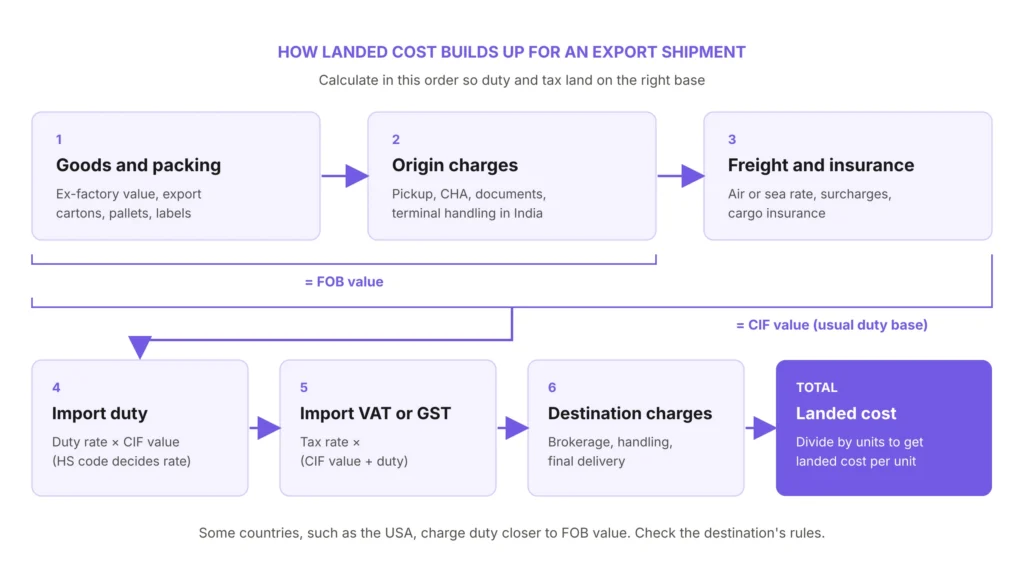
Landed cost = Product cost + Origin charges + Freight + Insurance + Import duty + Import taxes + Destination charges
Two sub-totals make the calculation easier:
- FOB મૂલ્ય = product cost + packing + origin charges up to loading on the aircraft or vessel.
- CIF મૂલ્ય = FOB value + international freight + insurance.
These matter because many countries charge customs duty on the CIF value. Import VAT or GST is then usually charged on CIF plus duty. The International Trade Administration’s guide to total export price uses exactly this order in its worked example. Some countries, such as the USA, value goods closer to the FOB price and exclude international freight from the duty base, so always confirm the destination’s rule.
Cost Components You Need to Include
An international shipping cost calculation is only as good as its inputs. Here is what goes into each block.
Product Cost and Export Packing
Start with the ex-factory cost or invoice value of the goods. Add export packing: cartons, pallets, shrink wrap, labels and any ISPM 15 treated wood for crates. Export packing is often heavier and more expensive than domestic packing, so don’t reuse your local cost.
Origin Charges in India
These are the costs before the cargo leaves India:
- pickup or inland transport from your factory to the airport, port or ICD;
- export customs clearance and CHA fees for the shipping bill;
- documentation such as the certificate of origin;
- terminal handling, security screening and airline or port handling charges.
Most exports from India are zero-rated under GST when you ship under a Letter of Undertaking, so export GST is usually not a landed cost line. Our guide to GST and exports તે કેવી રીતે કાર્ય કરે છે તે સમજાવે છે.
Export Freight Charges
This is the international leg, by air or sea. Air freight is billed on chargeable weight, the higher of actual and volumetric weight. Sea freight is billed per container for FCL or per cubic metre for LCL. Fuel and security surcharges sit on top of the base rate.
Read the quote line by line. A low base rate with high surcharges can cost more than a higher all-in rate. Our guides on નૂર દરની ગણતરી કેવી રીતે કરવી અને air freight charges from India break the components down.
કાર્ગો વીમો
Insurance covers loss or damage in transit. It is usually a small percentage of the cargo value, but it also enters the CIF value, so it affects duty. Under CIF and CIP terms the seller must arrange it. Under other terms, decide who buys it and write that into the contract. Our explainer on કાર્ગો વીમો covers the policy types.
Customs Duties and Taxes at Destination
This is where most estimates go wrong. Customs duties and taxes depend on three things:
- HS કોડ of your product in the importing country’s tariff.
- The duty rate that applies: the standard rate or a lower preferential rate if a trade agreement covers your goods and you hold a valid certificate of origin.
- The valuation basis: CIF or FOB, plus import VAT or GST, which usually sits on top of duty.
Some goods also attract extra duties, such as excise or એન્ટી ડમ્પિંગ ડ્યુટી. Check the destination’s official tariff. For the UK, for example, HMRC explains how to value imports for customs duty.
ગંતવ્ય શુલ્ક
After the cargo lands, there are still costs to pay:
- import customs clearance and brokerage fees;
- airport or port terminal handling and storage;
- delivery from the airport or port to the buyer’s warehouse;
- demurrage or storage if clearance is delayed.
Hidden Costs Exporters Forget
Add a line for currency conversion and bank charges on the payment. Add a buffer for exchange-rate movement between quote and payment. If your buyer’s market sees frequent customs holds, include a small allowance for storage and re-delivery.
How Incoterms Decide Who Pays What
Your Incoterm splits the landed cost between you and your buyer. Use this table to see which lines you need in your quote.
| ઇનકોટર્મ | વિક્રેતા ચૂકવણી કરે છે | ખરીદનાર ચૂકવણી કરે છે |
|---|---|---|
| EXW | Goods and packing only | Everything from pickup onwards |
| એફસીએ / એફઓબી | Goods, packing, origin charges, export clearance | Main freight, insurance, import duty and taxes, destination charges |
| CIF / CIP | Up to main freight and insurance | Import duty and taxes, destination charges |
| ડીએપી | Everything up to the buyer’s door, except import clearance | Import duty and taxes, import clearance |
| ડીડીપી | Everything, including import duty and taxes | Nothing up to delivery |
Under DDP, you carry the full landed cost and the risk of getting the duty wrong. Under DAP, your price looks lower, but your buyer pays duties on arrival. Our comparison of ડીડીપી વિરુદ્ધ ડીએપી શિપિંગ helps you choose, and FOB શિપિંગ શરતો are explained separately.
Landed Cost Calculation for Exports: Step by Step
Follow the same order every time, so the duty and tax bases come out right.
- ઇન્કોટર્મની પુષ્ટિ કરો and the delivery address with your buyer.
- HS કોડ શોધો of the product in the destination tariff, not just the Indian ITC-HS code.
- Add up the FOB value: goods, export packing and all origin charges.
- Get freight quotes for the right mode and service level, and note the chargeable weight.
- વીમો ઉમેરો to reach the CIF value.
- આયાત ડ્યુટીની ગણતરી કરો on the correct base, at the rate that applies to your goods.
- Calculate import VAT or GST, usually on CIF plus duty.
- ગંતવ્ય શુલ્ક ઉમેરો: brokerage, handling and final delivery.
- બફર ઉમેરો for exchange rates, delays and bank charges.
- Divide by the number of units to get landed cost per unit, and compare it with your target price.
If the Indian side of duty still confuses you, our guide on customs duty calculation after GST shows how the import calculation works in India. The same logic of duty first, then tax on top, applies in most markets.
Worked Example: Cotton Shirts from Tiruppur to the UK
Here is an illustrative example. A Tiruppur garment exporter ships 2,000 cotton shirts, about 300 kg, to a buyer in the UK by air on DDP terms. All figures are assumptions for the example, not real quotes or tariff rates. We assume a 10% duty rate and the UK’s standard 20% VAT rate.
| ખર્ચ રેખા | ગણતરી | રકમ (₹) |
|---|---|---|
| Goods, ex-factory | 2,000 shirts × ₹500 | 10,00,000 |
| Export packing and labels | ભાવ | 15,000 |
| મૂળ શુલ્ક | Pickup, CHA, documents, terminal handling | 20,000 |
| FOB મૂલ્ય | 10,35,000 | |
| વિમાન ભાડું | Quote incl. surcharges | 1,20,000 |
| વીમા | ભાવ | 6,000 |
| CIF મૂલ્ય | 11,61,000 | |
| આયાત જકાત | ૧૦% × ૨૮,૦૦૦ | 1,16,100 |
| VAT આયાત કરો | ૧૬% × (૨૮,૦૦૦ + ૨,૮૦૦) | 2,55,420 |
| ગંતવ્ય શુલ્ક | Brokerage, handling, delivery | 30,000 |
| કુલ જમીન કિંમત | 15,62,520 |
The landed cost works out to about ₹781 per shirt, against an ex-factory cost of ₹500. Freight was only about 8% of the total. Duty and VAT together added ₹3,71,520, more than three times the freight bill.
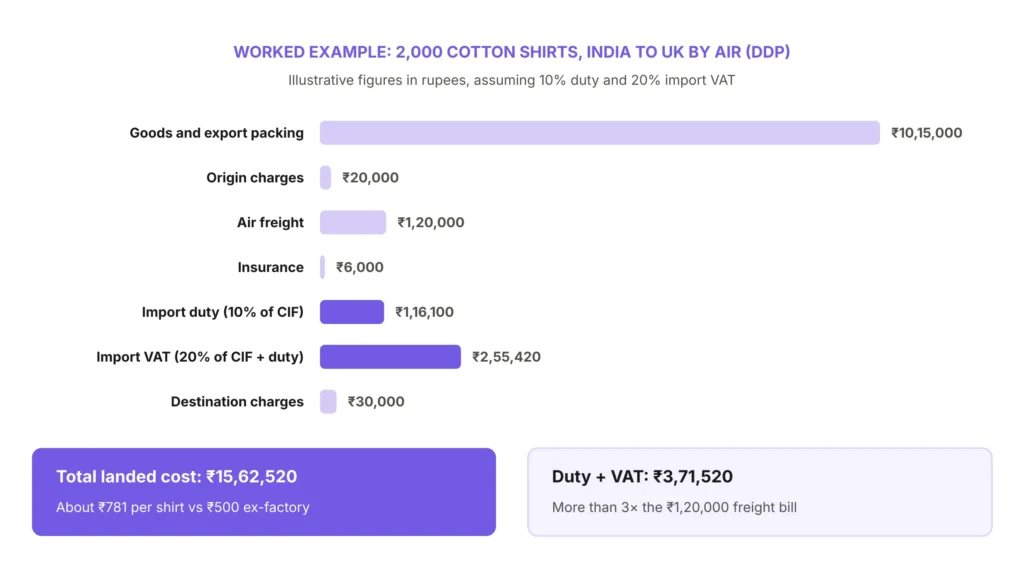
One point to note: a VAT-registered importer can often reclaim import VAT. That is why many B2B exporters show VAT as a separate line in a DDP quote rather than burying it in the unit price. Discuss this with your buyer before you quote.
Landed Cost Checklist for Every Shipment
Run through this before you send any international quote:
- Incoterm agreed and written into the proforma invoice
- Destination HS code confirmed with the buyer or their broker
- Duty rate checked, including any trade agreement rate and certificate of origin needs
- Valuation basis confirmed: CIF or FOB
- Import VAT, GST or sales tax rate confirmed
- Export packing cost and packed dimensions measured
- Chargeable weight calculated for air, or CBM for sea
- At least two freight quotes compared, with all surcharges listed
- Insurance arranged and its cost included
- Origin charges listed: pickup, CHA, documents, terminal handling
- Destination charges listed: brokerage, handling, delivery, storage risk
- Exchange-rate and bank charge buffer added
- Landed cost per unit compared with the buyer’s target price
Common Mistakes That Distort Landed Cost
Quoting on actual weight for air cargo. Bulky goods are billed on volumetric weight. Check હવાઈ ભાડા માટે ચાર્જેબલ વજન before you price.
Using the Indian HS code for the destination tariff. The first six digits match across countries, but national codes and rates differ after that.
Calculating VAT on the goods value only. VAT usually sits on CIF plus duty, so this mistake understates the tax.
Ignoring de minimis changes. Duty-free thresholds for low-value shipments change. The USA, for example, suspended its de minimis exemption in 2025, which changed the maths for many small shipments.
Forgetting storage risk. A shipment held at customs can run up storage charges fast. Clean documents are the cheapest insurance against that.
Compare International Cargo Options and Quotes with Shiprocket CargoX
Once your landed cost model is ready, the freight line is the one you can most easily improve. શિપરોકેટ કાર્ગોએક્સ is built for B2B export consignments starting from 20 kg. You can enter your shipment details, compare cargo options and schedule a pickup, then track the shipment in real time and share updates with your buyer.
CargoX offers Priority, Express and Economy air cargo services, so you can match speed to the order and plug the right freight cost into your calculation. You can request a quote from a CargoX expert, and documentation support helps reduce paperwork errors that cause customs delays. [[VERIFY: whether CargoX quotes include destination clearance and duty handling for DDP shipments]] Read more about વૈશ્વિક શિપિંગ માટે કાર્ગોએક્સ.
ઉપસંહાર
A freight quote tells you what it costs to move your goods. Landed cost tells you what it costs to sell them abroad. The difference is often larger than the freight itself, as the shirt example shows.
Build your landed cost calculation for exports in the same order every time: FOB, then CIF, then duty, then tax, then destination charges. Confirm the HS code, the Incoterm and the valuation basis before you quote. Then compare freight options, add a buffer and quote with confidence.


