Your UK customer was thrilled to order a handwoven silk stole from your website. Two weeks later, they get a card from the courier: pay the import VAT and a handling fee, or the parcel goes back. They decline, email you for a refund, and leave a one-star review.
That’s what usually happens when a ગ્રાહકે કસ્ટમ ડ્યુટી ભરવાનો ઇનકાર કર્યો. The buyer sees an unexpected bill. The seller sees a lost sale, wasted shipping, and a parcel stuck somewhere between two countries.
This guide explains what happens to a refused international shipment, who is responsible under DDU/DAP and DDP terms, what it really costs an Indian seller, and how to stop it from happening again.
What Happens When a Customer Refuses to Pay Customs Duty?
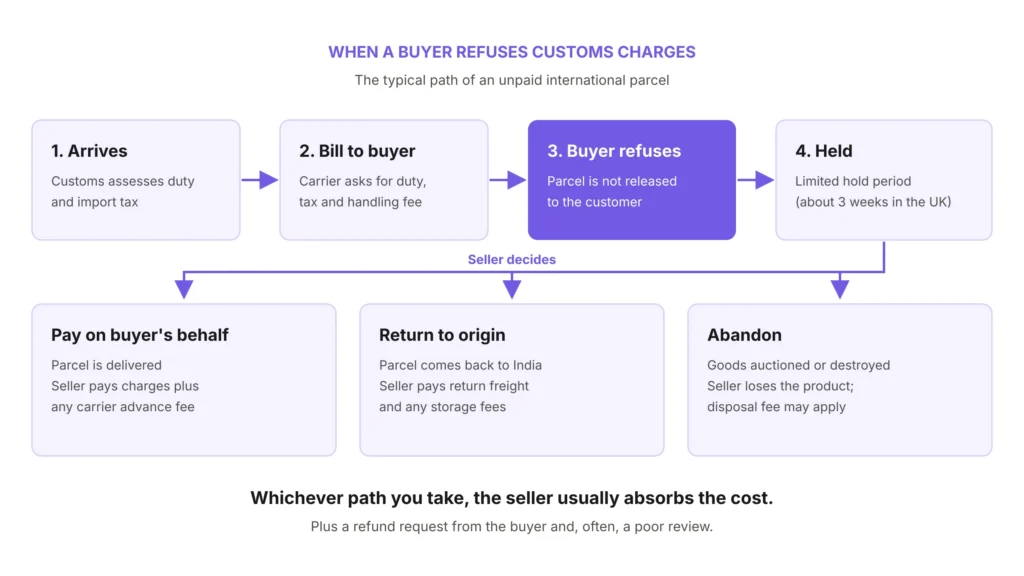
Import duties and taxes are collected by the destination country’s customs authority, usually through the delivering carrier. If nobody pays, the goods aren’t released. From there, the parcel takes one of a few paths.
1. The Shipment Is Held
The carrier or postal operator keeps the parcel at a depot or customs facility and asks the buyer to pay. Hold periods are short and vary by country and carrier.
In the UK, for example, GOV.UK says Royal Mail, Parcelforce or the courier will hold the parcel for about 3 weeks. If the bill isn’t paid by then, the parcel is returned to the sender.
2. The Carrier Contacts the Seller
Express carriers often reach out to the shipper once they record that the customer refused to pay customs duty. You may be offered three choices: pay the duties and taxes yourself so the parcel can be delivered, ask for a return to origin, or abandon the goods.
Paying on the buyer’s behalf can save the order. It also tends to cost more than charging the duty at checkout, because carriers often add a disbursement or handling fee for advancing the payment.
3. Return to Origin
In return to origin international shipping, the carrier ships the parcel back to you. You usually pay the return freight, and sometimes storage fees for the days it sat in the warehouse.
Returned goods also have to clear Indian customs as re-imports. Keep your shipping bill, invoice and airway bill handy so you can claim the goods came from India and avoid paying duty on your own products. Our guide to managing returns in cross-border shipping covers this process.
4. Abandonment and Disposal
If you don’t want the parcel back, or the return costs more than the product is worth, you can abandon it. The carrier or customs authority then auctions, donates or destroys the goods. Some authorities and carriers still bill the shipper a disposal or administrative fee.
Abandoned parcels are common for low-value items, where return freight can exceed the selling price. Read more about abandoned cargo in international shipping.
5. Additional Charges and Disputes
Unpaid duties rarely end with the parcel. Common follow-ups include:
- Carrier billing: Carriers’ terms often let them bill the shipper for return, storage or disposal charges on undeliverable parcels, unless the failure was the carrier’s fault.
- રિફંડ વિનંતીઓ: The buyer asks for their money back, often including the original shipping fee.
- ચાર્જબેક: If you refuse a refund, the buyer may dispute the payment with their card issuer, arguing the item was never received.
- Marketplace claims: On marketplaces such as Amazon, leaving the buyer to pay unexpected import charges can breach the platform’s policies and lead to A-to-z claims.
- સમીક્ષાઓ: A surprise customs bill is one of the fastest routes to a negative public review.
Who Pays Customs Duties: DDU/DAP vs DDP
Who pays the import bill depends on the delivery terms on your shipment. Two arrangements matter most for eCommerce.
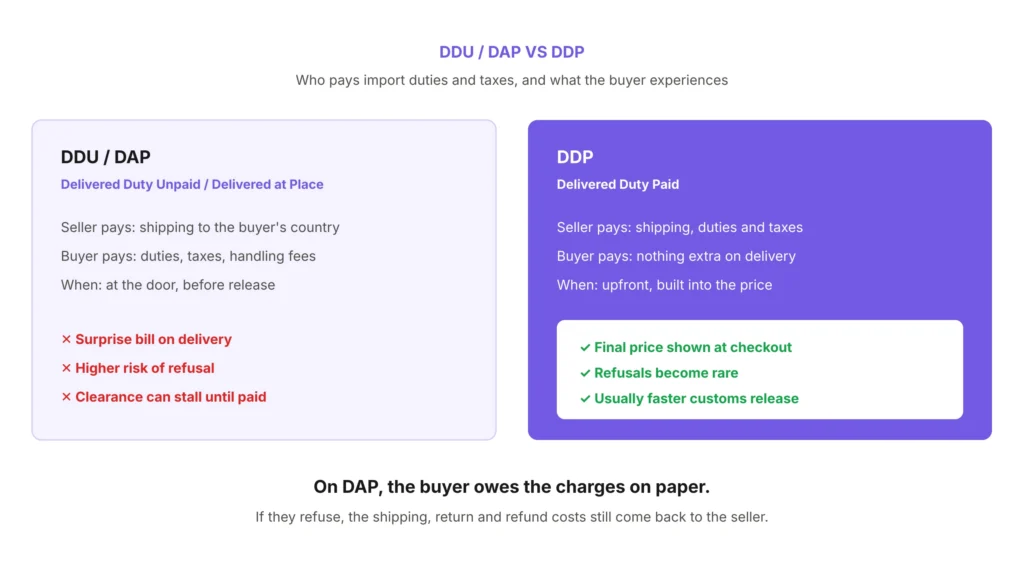
DDU (વિતરિત ડ્યુટી અનપેઇડ) is an older trade term. It was replaced by DAP (સ્થળ પર વિતરિત) in the Incoterms rules published by the આંતરરાષ્ટ્રીય ચેમ્બર Commerceફ કોમર્સ, but couriers still use “DDU” on their booking screens. Under DAP, the seller pays to get the goods to the buyer’s country, and the buyer pays import duties and taxes on arrival.
ડીડીપી (ડિલિવર્ડ ડ્યુટી ચૂકવેલ) puts everything on the seller. You pay shipping, import duties and taxes, and the buyer receives the parcel with nothing to pay at the door.
| પરિબળ | ડીડીયુ / ડીએપી | ડીડીપી |
|---|---|---|
| Who pays import duties and taxes | Buyer, on delivery | Seller, at booking or later billing |
| Price shown at checkout | Lower, but incomplete | Higher, but final |
| ખરીદનારનો અનુભવ | Surprise bill at the door | No-surprise delivery |
| Risk of refusal | ઉચ્ચ | નીચા |
| કસ્ટમ્સ ક્લિયરન્સ ઝડપ | Can stall until buyer pays | Usually faster, as duties are prepaid |
| Who absorbs a refusal | Seller, in practice | Rarely arises |
On paper, DAP makes the buyer responsible. In practice, a buyer who refuses simply walks away, and the costs land back with you. That’s why many sellers treat DAP as a risk to manage, not a way to avoid duties. For a deeper comparison, see our explainer on DDP વિરુદ્ધ DDU શિપિંગ.
Where De Minimis and Seller-Collected Taxes Fit In
Many countries waive duty, tax or both below a set value, known as the de minimis threshold. Below it, there may be nothing for the buyer to pay at all. Our guide to દેશ દ્વારા લઘુત્તમ મૂલ્યો lists the common limits.
Some countries go further and make the seller collect tax at checkout. In the UK, for goods worth £135 or less, the seller usually includes VAT in the price, and there’s no Customs Duty on non-excise goods at that value, per GOV.UK. Above £135, the buyer pays import VAT and any duty to the delivery company before release.
Rules like these change, so check the destination’s customs site before you set your shipping terms.
A Real-World Scenario: A ₹5,000 Order to the UK
Let’s make this concrete. Priya runs a small Jaipur-based block-print brand and sells a ₹5,000 quilted jacket to a buyer in Manchester. The figures below are illustrative assumptions, not carrier quotes.
- Order value: ₹5,000, roughly £45 at an assumed rate of ₹110 to the pound.
- Forward shipping: about ₹1,500, paid by Priya, with shipping offered free to the buyer.
- ડિલિવરી શરતો: DDU, with no UK VAT charged at checkout.
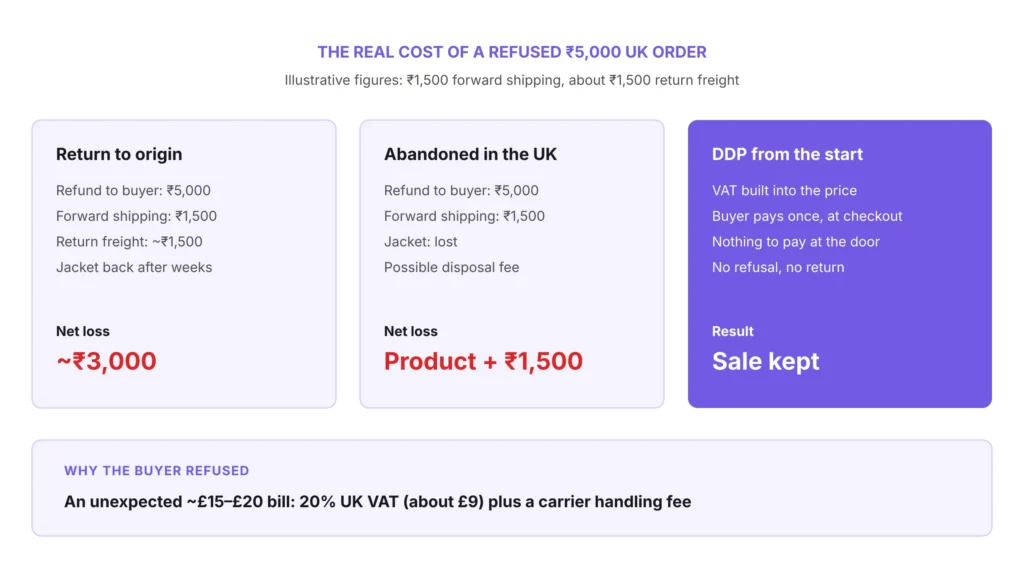
At a value of about £45, UK rules expect the seller to charge VAT at checkout. Priya didn’t, so the parcel arrives with a demand for 20% VAT, about £9, plus a carrier handling fee. Together, the buyer is asked for roughly £15 to £20 they never saw at checkout.
The buyer feels misled and refuses. It is the classic case: a customer refused to pay customs duty they never agreed to. Here’s how that one decision plays out for Priya.
| પરિણામ | What Priya pays or loses | Net result on a ₹5,000 sale |
|---|---|---|
| Buyer pays the charges | Nothing extra, but the buyer is unhappy | Sale kept, repeat purchase unlikely |
| મૂળ સ્થાન પર પાછા ફરો | Refund ₹5,000, forward shipping ₹1,500, return freight about ₹1,500 | Loses about ₹3,000 plus 4–8 weeks of locked stock |
| Abandoned in the UK | Refund ₹5,000, forward shipping ₹1,500, the jacket itself | Loses the product and ₹1,500 in shipping |
| DDP from the start | VAT built into the checkout price | Sale kept, buyer happy, no refusal |
A single refusal can wipe out the margin on several successful orders. It also drags down your marketplace metrics and review scores.
The fix in this scenario is cheap. If Priya had shown a VAT-inclusive price at checkout and shipped on duty-paid terms, the buyer would have paid about the same total, but upfront and without the shock. To price orders like this correctly, work out your જમીનની કિંમત for each market.
How to Prevent Customs Duty Refusals
Most cases where a customer refused to pay customs duty are preventable. The goal is simple: the buyer should never meet a charge at the door that they didn’t agree to at checkout.
Show Import Charges Before Checkout
Tell buyers what they’ll pay, and when. You can:
- Show duty- and tax-inclusive prices for your main markets.
- Use a landed-cost calculator at checkout that estimates duties and taxes from the HS code and order value.
- Add a clear line on product and cart pages, such as “Prices include UK VAT. No extra charges on delivery.”
If you ship on DAP terms, say so plainly: “Import duties and taxes may be collected by the courier on delivery.” A buyer who expects a charge is far less likely to refuse it.
Choose the Right Delivery Terms for Each Market
You don’t need one rule for the world. Use DDP where buyers expect duty-free delivery or where duties are high, and DAP where the order value sits under the de minimis threshold and nothing is due.
Get your HS codes right, too. A wrong code can trigger a higher duty, a reassessment, or a hold. Our guide on import duties for eCommerce explains how duties are worked out.
Register for Destination Taxes Where Required
Some markets require overseas sellers to register and collect tax at the point of sale, such as the UK for consignments of £135 or less. Registering avoids double charges and stops parcels being held for missing tax references.
Publish a Clear International Delivery Policy
Your shipping policy should answer the awkward questions before they come up:
- Who pays duties and taxes for each country.
- What happens if a buyer refuses a parcel because of import charges.
- Whether the refund deducts return freight, duties already paid or disposal fees.
- How long buyers have to respond to a customs or delivery notice.
Link this policy from checkout and from order confirmation emails, so buyers agree to it before they pay.
Communicate Proactively After Dispatch
Send tracking updates, and warn buyers if their parcel needs action at customs. A quick message such as “Your parcel is at UK customs; here’s what to expect” turns a surprise into a known step.
If a buyer flags a charge early, you still have options. You can pay it for them, offer a partial refund, or arrange a return before storage fees build up.
Manage International Shipments and Duty Options With Shiprocket X
Shiprocket X is Shiprocket’s cross-border shipping platform, built for Indian sellers shipping to 220+ countries and territories. Instead of locking every order into one service, you can compare international options, such as economy, expedited and duty-paid services, and choose the right one for each market from a single dashboard.
Duty-paid services are listed for the US and Canada, which means the buyer receives the parcel without a surprise bill at the door. [[VERIFY: whether duty-paid/DDP shipping is available on Shiprocket X for UK orders]] Shiprocket X also sends tracking updates to buyers by email and WhatsApp, so they know when a parcel is moving through customs. Start by checking your rates on શિપરોકેટ એક્સ, or read how to compare international shipping rates.
ઉપસંહાર
When a customer refused to pay customs duty, the parcel is held, then returned or abandoned. Under DDU/DAP terms the buyer technically owes the charges, but the seller nearly always absorbs the loss through shipping, refunds and lost goods.
The answer is transparency. Show import charges before checkout, choose DDP where it makes sense, register for destination taxes where required, and publish a clear delivery policy. Do this, and refused international shipments become rare exceptions instead of a steady drain on your margins.