
- Why International Shoppers Abandon Carts at the Shipping Step
- What Makes Up International Shipping Charges
- How Rules in the USA, UK and UAE Change the Final Price
- Illustrative Checkout Comparison: USA, UK and UAE
- How to Calculate Destination-Specific Shipping Charges
- How to Show Landed Costs Transparently at Checkout
- Offer Delivery Options That Suit Each Market
- Compare Multiple International Couriers to Find the Right Price Point
- Manage International Shipping Charges with Shiprocket X
- ઉપસંહાર
A shopper in London adds a ₹3,500 block-printed dress to their cart. The product page looked great, the price felt fair, and then the checkout page added a shipping fee they didn’t expect and a note saying “duties may apply on delivery.” They close the tab.
આ કેવી રીતે છે આંતરરાષ્ટ્રીય શિપિંગ શુલ્ક quietly kill cross-border sales. The product is right and the buyer is willing, but the final number, or the uncertainty around it, breaks the deal at the last step.
For Indian D2C brands selling abroad, this is fixable. This guide explains why global customers abandon carts over shipping costs, what really makes up international delivery charges, and how to calculate and show them so more buyers finish checkout.
Why International Shoppers Abandon Carts at the Shipping Step
Cart abandonment is common everywhere. Baymard Institute puts the average documented online cart abandonment rate at about 70%, based on 50 studies.
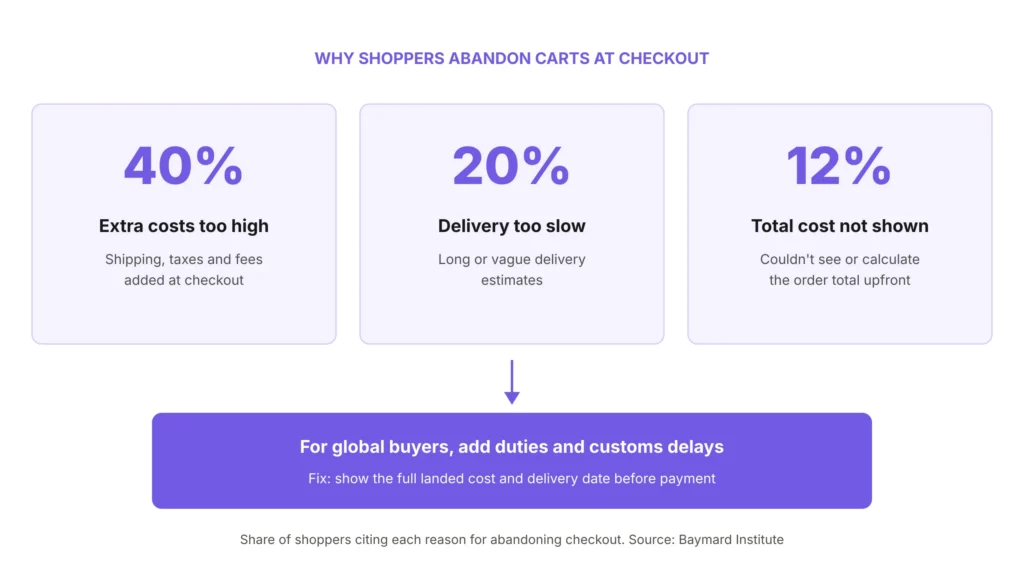
The top reason is cost. In બાયમાર્ડનું ચેકઆઉટ સંશોધન, 40% of shoppers who abandoned said extra costs such as shipping, taxes and fees were too high. Another 20% left because delivery was too slow, and 12% left because they couldn’t see or calculate the total order cost upfront.
Now add a border. A domestic buyer at least knows roughly what shipping costs. An international buyer often has no idea, so three fears stack up:
- Price shock: shipping looks high next to the product price.
- Unknown extras: duties, import taxes or a courier’s clearance fee might appear at the door.
- Uncertain timing: the order might take two weeks, or get stuck at customs.
Each one gives the shopper a reason to wait, compare or leave. For a deeper look at the general problem, see our guide on how to reduce shopping cart abandonment.
What Makes Up International Shipping Charges
To fix the checkout, you first need to know what the customer is really paying. The full amount is called the જમીનની કિંમત: everything needed to get the product into the buyer’s hands. Our explainer on જમીનની કિંમત covers the concept in detail.
Base Freight and Chargeable Weight
Couriers price international parcels by destination zone and weight. They compare the actual weight with the volumetric weight, which is based on the box’s dimensions, and charge for whichever is higher.
That’s why a light but bulky item, like a cushion cover set in an oversized box, can cost more to ship than a small, heavy one. Right-sized packaging is one of the easiest ways to bring rates down.
આયાત જકાત અને કર
Most countries charge customs duty and a consumption tax such as VAT, GST or sales tax on imported goods. The amount depends on the product’s HS code, its declared value and the destination’s rules.
These charges are not part of the courier’s shipping rate. Someone still has to pay them, either you before dispatch or the buyer on arrival. Our guide to આયાત શુલ્ક explains how they’re assessed.
Clearance, Brokerage and Handling Fees
When a courier pays duty on the buyer’s behalf, it may add a processing or disbursement fee. Some destinations also add their own handling fees. In Northern Ireland, for example, યુકે સરકારનું માર્ગદર્શન says non-business recipients pay a handling fee on goods considered “at risk” of moving into the EU.
These small fees often annoy buyers most, because they arrive after the purchase with little explanation.
સરચાર્જ
Carrier rates usually include a fuel surcharge that changes with fuel prices, plus extra charges for remote delivery areas, oversized parcels or special handling. A quote that ignores these will undercharge you, or surprise the buyer later.
ડિલિવરી સમય અને વિશ્વસનીયતા
Time isn’t a charge, but buyers weigh it like one. A low rate with a vague “10–20 days” estimate can lose the sale just as surely as a high fee. Slow delivery was the second-biggest reason for abandonment in Baymard’s data.
How Rules in the USA, UK and UAE Change the Final Price
There’s no single international shipping rate, because each country treats low-value imports differently. Here’s how three popular markets for Indian brands compare.
| પરિબળ | યુએસએ | UK | યુએઈ |
|---|---|---|---|
| Low-value duty exemption | Suspended for all countries since 29 August 2025 | No customs duty on most goods worth £135 or less | Exemption for low-value consignments; threshold set by emirate rules |
| વપરાશ કર | State sales tax rules vary | VAT on almost all imports | આયાત પર ૧૨% વેટ |
| Who collects tax on small orders | Duty is collected at entry by the carrier or broker | For orders of £135 or less, the seller charges VAT at checkout | Usually collected by the courier on delivery |
| Biggest checkout risk | Duty bill the buyer didn’t expect | Wrong VAT handling or a second charge at the door | Small VAT or fee requests at delivery |
યુએસએ
For years, US shoppers could receive orders worth up to $800 duty-free. That changed when the US suspended the de minimis exemption for all countries from 29 August 2025, and CBP made the suspension indefinite in June 2026, according to the ફેડરલ રજિસ્ટર નોટિસ.
Now even a small order from India can carry duty. If you ship “duties unpaid”, your US customer may get a payment request before delivery. US tariff rates have also changed several times, so check the current rate for your HS code before you quote.
UK
The UK charges VAT on almost all goods sent from abroad. Under the GOV.UK rules, for non-excise goods worth £135 or less, the seller includes VAT in the price at checkout, and there’s no customs duty on those goods.
Above £135, the buyer pays VAT, and duty if it applies, to the delivery company before or on delivery. That’s a classic abandonment trigger, so many brands keep UK orders below this threshold or price them duty-paid.
યુએઈ
The UAE charges 5% VAT on imports. Carriers such as DHL and Aramex state that VAT applies to non-document express shipments, and customs duty, usually 5%, applies above a low-value threshold.
Thresholds have been revised more than once in recent years and differ by emirate. Check the current rule with your courier before you set UAE rates.
For a wider view of these costs, read our breakdown of international shipping documentation and taxes.
Illustrative Checkout Comparison: USA, UK and UAE
Picture the same ₹4,000 kurta set sold to a shopper in each market. The product price is identical. What changes is what the shopper sees, and when.
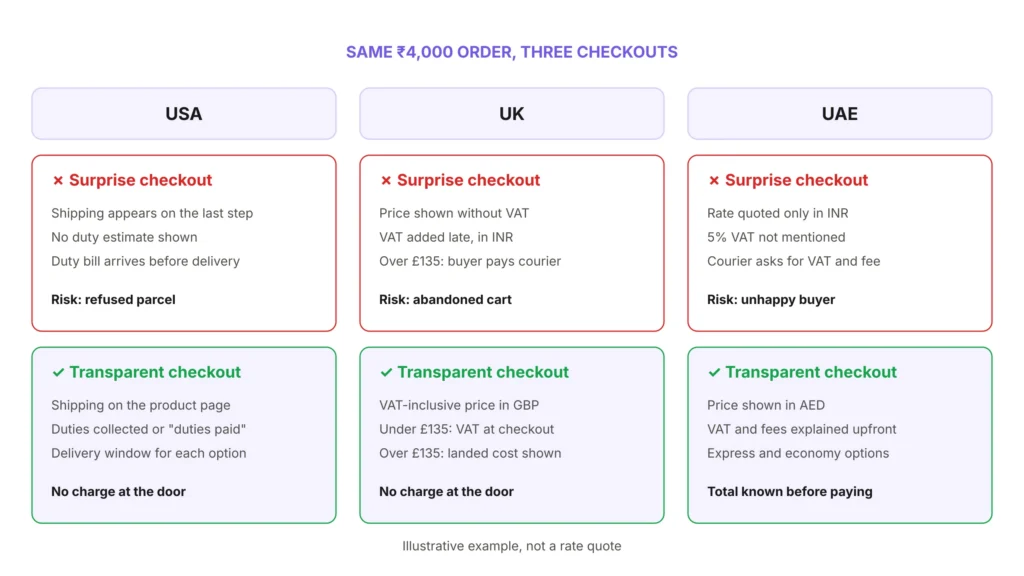
The table below shows a "surprise" checkout and a "transparent" one for each country. It's an illustration of how to present charges, not a rate quote.
| બજાર | Surprise checkout | Transparent checkout |
|---|---|---|
| યુએસએ | Shipping appears only on the last step; a duty bill follows at delivery | Shipping shown on the product page; duties estimated and collected at checkout, or “duties paid” stated clearly |
| UK, order under £135 | Price shown without VAT; VAT added late in checkout | VAT-inclusive price in GBP from the first page, with a clear “no extra charges on delivery” message |
| UK, order over £135 | No mention of import VAT; buyer pays the courier before delivery | Total landed cost shown, or the order priced duty-paid |
| યુએઈ | Rate quoted in INR; courier asks for VAT and a fee at the door | Price in AED; VAT and any fees included or explained before payment |
In every case, the transparent version answers the shopper’s real question: “What will I pay in total, and when will it arrive?”
How to Calculate Destination-Specific Shipping Charges
A single flat “international shipping” fee is easy to set up, but it overcharges some countries and undercharges others. Here’s a practical way to build rates by destination.
- Group your top markets. Start with the three to five countries that bring most of your traffic or orders, then use a rest-of-world rate for the others.
- Measure real packages. Record the actual and volumetric weight of your common order sizes, such as one, two or three items, in your real packaging.
- Pull courier rates per zone. Compare rates from more than one carrier for each weight slab and destination, including fuel and remote-area surcharges.
- Estimate duties and taxes. Use the correct HS code and declared value to estimate duty and VAT for each market. This is where many brands go wrong.
- Decide who absorbs what. Choose whether to pass the full cost to the buyer, build part of it into product prices, or offer free shipping above an order value.
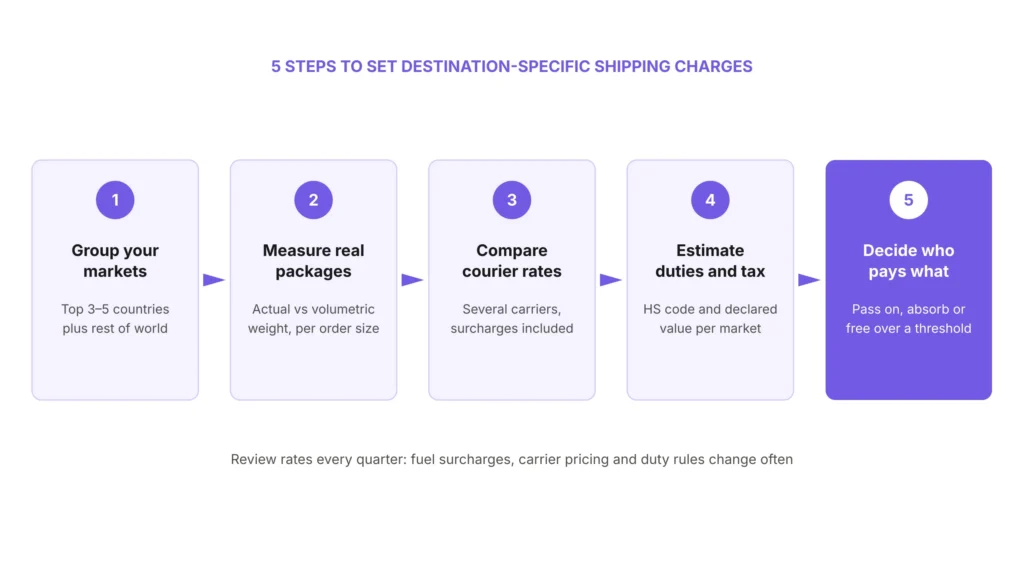
Review these rates every quarter. Fuel surcharges, carrier pricing and duty rules all move, and a rate set last year may now cost you money on every order. Our guide to comparing international shipping costs walks through carrier comparisons in more detail.
How to Show Landed Costs Transparently at Checkout
Once you know your costs, the job is to show them early and plainly. Small changes here often matter more than the rate itself.
Show Shipping Before the Cart
Display an estimated international shipping fee on the product page or in a country selector. Buyers who see the cost early are less likely to feel tricked at the last step.
સ્થાનિક ચલણમાં કિંમત
A UK buyer thinks in pounds and a UAE buyer in dirhams. Showing local currency, with a clear note on the currency they’ll be charged in, removes another moment of doubt. Checkout’s guide to આંતરરાષ્ટ્રીય ચુકવણી પ્રવેશદ્વારો covers multi-currency payment options for Indian brands.
State Who Pays Duties
Pick one approach per market and say it clearly:
- Duties paid (DDP): you collect or absorb duties and taxes, and the buyer pays nothing on delivery.
- Duties unpaid (DAP): the buyer pays on arrival, so warn them at checkout and link to an explanation.
DDP usually converts better for consumer orders because it removes the surprise. DAP keeps your headline price lower but carries more risk of refused parcels. Our comparison of DDP વિરુદ્ધ DDU શિપિંગ ટ્રેડ-ઓફ સમજાવે છે.
Give a Realistic Delivery Window
Show an estimated delivery range for each option, based on actual transit times. “Delivered in 6–9 business days” builds more trust than “ships worldwide.”
Put the Policy Where Buyers Look
Add a short shipping and returns policy for international orders, linked from the cart. Cover duties, delivery times, tracking and what happens if a parcel is refused.
Offer Delivery Options That Suit Each Market
Different buyers want different trade-offs. A gifting customer in Dubai may pay for speed, while a repeat buyer in the US may happily wait to save money.
- એક્સપ્રેસ: faster delivery at a higher price, good for gifts and time-sensitive orders.
- અર્થતંત્ર: lower cost and slower transit, good for price-sensitive or repeat buyers. See our guide to અર્થતંત્ર વિ માનક આંતરરાષ્ટ્રીય શિપિંગ.
- મફત શિપિંગ મર્યાદા: set a minimum order value per market so that shipping is covered by the margin on larger carts.
- Duty-paid option: for markets where surprise charges are common, a duty-paid service can be worth a slightly higher price.
Two or three clear choices usually work better than one fixed option or a long list. Let buyers pick, and show the total for each.
Compare Multiple International Couriers to Find the Right Price Point
No single courier is cheapest and fastest for every country, weight and product. One carrier may be strong on US express lanes, while another offers better economy rates to the Middle East.
Working with several international couriers lets you:
- compare rates and transit times for the same parcel before you book;
- choose a premium service where speed matters and an economy one where price matters;
- switch carriers if one raises rates or has delays on a lane;
- match duty-paid or duty-unpaid services to each market’s checkout promise.
Signing separate contracts with each carrier is hard for a growing D2C brand. That’s why many sellers use a shipping aggregator, which brings multiple carriers into one dashboard. You can read about the trade-offs in our international shipping carriers selection guide.
Manage International Shipping Charges with Shiprocket X
શિપરોકેટ એક્સ is Shiprocket’s cross-border shipping platform for Indian sellers. It gives you access to multiple international courier options from one dashboard, so you can compare services and price points for each destination instead of committing to a single carrier.
Its rate calculator helps you estimate international shipping rates by weight and destination before you set checkout prices. You can choose between express and economy services, use duty-paid shipping on supported lanes such as the US, and share branded tracking pages so buyers know where their order is. Confirm which carriers, services and destinations are available for your products [[VERIFY: current list of Shiprocket X courier partners and duty-paid lanes]] before you finalise your rate card.
ઉપસંહાર
International shoppers don’t leave because they dislike paying for shipping. They leave because the final price is higher than expected, the extra charges are unclear, or the delivery date feels like a guess.
The fix is a checkout that tells the truth early. Calculate international shipping charges by destination, estimate duties and taxes, state who pays them, and offer a choice of delivery speeds.
Review your rates often, compare couriers lane by lane, and treat the landed cost as part of your product price. When global buyers trust the number they see, more of them finish checkout.