
Could you be losing up to 30%
of your Festive Revenue?
Find out where you may be losing sales in just 60 seconds

The festive season, decoded one signal at a time
Watch the trends shaping demand, shopping behaviour and ecommerce growth and what they could mean for your business.






Festive demand rises nationally.
Delivery pressure builds pincode by pincode
2025
Festive signal
-
24% growth in order volumes
-
23% growth in GMV
-
55% of orders from Tier II and III cities
-
20% pre-festive order spike


What it means for brands
in 2026
-
More shipments compete for limited last-mile capacity
-
Every delayed or failed order carries greater revenue risk
-
Courier performance must be evaluated across more complex delivery lanes
-
Delivery networks can begin experiencing pressure even before peak sale days



Your customers are no longer only searching.
They are asking AI what to buy
- Which skincare brand is best for sensitive Indian skin?
- Suggest premium Diwali gifts under ₹2,000
- What are the best healthy snack brands in India?
- Which D2C brands offer reliable next-day delivery?
- Does my website rank on Google?
AI is becoming a new product-discovery channel



Do you want to experience this growth mantra real time?
Join our recurring webinar sessions with top industry leaders and get festive ready





-

-

-

-

-

- foxtale


Frequently asked questions
What is Answer Engine Optimisation, or AEO?
Answer Engine Optimisation helps a brand appear in answers generated by platforms such as ChatGPT, Gemini and Perplexity. While SEO focuses on ranking webpages, AEO focuses on getting a brand understood, cited, mentioned and recommended by AI.
Why should ecommerce brands invest in AI-search visibility?
AI-referred traffic to retail websites grew 693% year-on-year during the 2025 holiday season. May 2026 data also found that AI-referred shoppers generated 53% more revenue per visit than visitors arriving through non-AI sources.
How can brands become more discoverable on AI platforms?
Brands should publish clear product information, answer specific customer questions, add structured FAQs, maintain consistent messaging and build authority through credible third-party sources. AI visibility depends not only on keywords, but also on whether an AI engine can understand and verify what the brand offers.
What does AiTLAS by Shiprocket do?
AiTLAS helps brands understand how they appear across AI-led discovery platforms. It can help monitor relevant prompts, brand mentions, citations, competitor visibility and content gaps—so brands can move from simply being present online to becoming part of AI-generated recommendations.
How is an AI mention different from an AI recommendation?
A mention means the brand appears somewhere in an AI-generated response. A recommendation means the platform actively presents the brand as an answer to the customer’s need. This distinction matters because 62% of AI citations may not produce an explicit brand mention.
Why does courier performance become more important during festive sales?
India’s 2025 festive season recorded a 24% increase in ecommerce orders and a 23% rise in GMV. Tier II and Tier III cities contributed 55% of total orders, spreading delivery demand across a wider and more complex network of pincodes.
What is Shiprocket RADAR?
RADAR is Shiprocket’s AI-powered courier-intelligence tool. It monitors live courier performance at the courier–pincode level, helping sellers identify delivery stress, compare available partners and avoid high-risk routes before assigning a shipment.
How does RADAR evaluate courier performance?
RADAR evaluates five important last-mile signals:
- SLA adherence
- First-attempt speed
- Delayed or missed attempts
- NDR reattempt rate
- RTO without a delivery attempt
This gives sellers a more current view than relying only on national courier averages or past performance.
Why can’t a brand use the same courier for every order?
Courier performance changes by pincode, shipment load, local hub capacity and network conditions. A courier performing well on one delivery lane may be experiencing delays or elevated RTO risk on another, especially during festive peaks.
What is the difference between same-day and next-day delivery?
Same-day delivery means an order reaches the customer on the same day it is shipped. Next-day delivery means it reaches the customer on the following day. Eligibility depends on the pickup location, delivery pincode, order cut-off time and available courier network.
How can brands offer same-day or next-day delivery?
Brands can offer faster delivery by storing inventory closer to high-demand customer locations and assigning eligible orders to suitable express courier networks. Shiprocket’s fulfilment infrastructure supports same-day and next-day delivery from strategically located fulfilment centres.
Can faster delivery improve ecommerce conversions?
Faster delivery can reduce the time between purchase and fulfilment, strengthen buyer confidence and encourage repeat purchases. Shiprocket’s dark-store data indicates that displaying faster delivery can contribute to a 2–4% improvement in checkout conversion, including COD orders; actual results vary by brand and category.
What is a dark store?
A dark store is a micro-fulfilment centre designed specifically for online orders. Inventory is stored closer to clusters of customer demand so that products can be picked, packed and dispatched considerably faster than from a distant central warehouse.
How do Shiprocket Dark Stores support faster delivery?
Shiprocket operates 45+ dark stores across Delhi NCR, Bengaluru, Mumbai and other expanding Tier I and Tier II markets. Depending on inventory placement and customer location, eligible orders can be delivered within four hours, on the same day or on the next day.
Which products should brands place in dark stores?
Brands should prioritise hero SKUs, fast-moving products and items with concentrated demand in particular cities. Historical sales, pincode-level demand, inventory turnover and festive-category trends can help determine what to position closer to customers.
Why do ecommerce shoppers abandon their carts?
Approximately 70% of ecommerce carts are abandoned before purchase. Common causes include unexpected charges, complicated checkout steps, slow form completion and unavailable payment options.
How does Fastrr by Shiprocket improve checkout conversions?
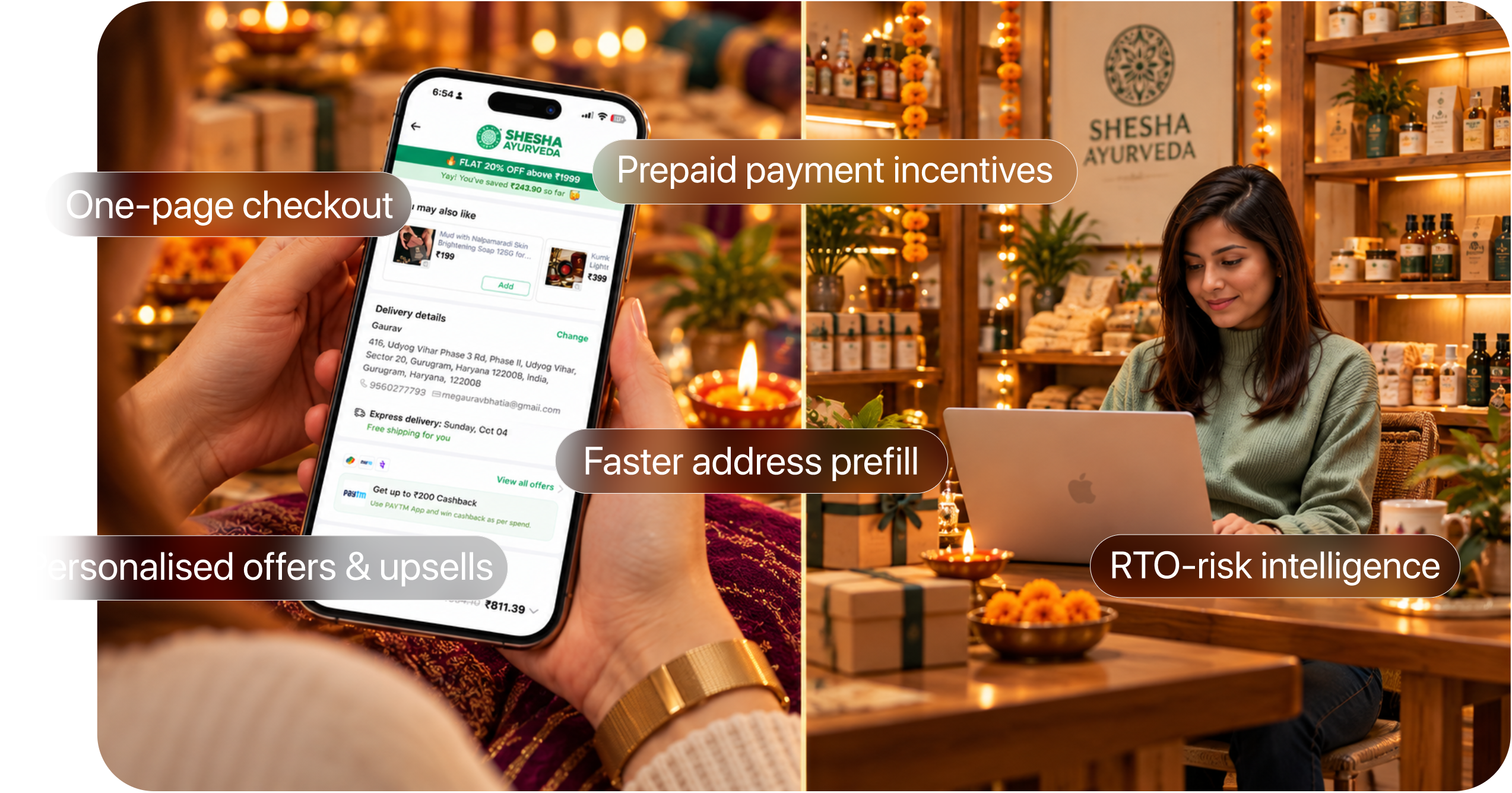
Fastrr reduces friction through a one-page checkout, faster address prefill, multiple payment options, personalised offers, prepaid incentives and RTO-risk intelligence. It is designed to help brands convert more existing traffic rather than depending only on additional advertising.
What conversion results have brands achieved using Shiprocket Checkout?
Blackberrys reported a 48% uplift in conversion rate, an 18% increase in prepaid orders and a 22% increase in average order value. MARS Cosmetics reported a 23% increase in average order value and a 96% address-prefill rate. These are individual brand outcomes and not guaranteed results.
Why are prepaid orders important during the festive season?
Prepaid orders demonstrate stronger buyer commitment, improve cash-flow visibility and can reduce the uncertainty associated with COD orders. Brands can encourage prepaid purchases through relevant incentives and a faster, trustworthy payment experience.
How many pincodes can sellers reach through Shiprocket Shipping?
Shiprocket enables domestic shipping across 19,000+ pincodes through integrations with 25+ courier partners. Its international network extends to more than 220 countries and territories.
How does Shiprocket help sellers choose a courier?
Sellers can compare available courier partners based on factors such as serviceability, price, delivery speed and performance. RADAR adds live courier–pincode intelligence so that selection can reflect current delivery conditions rather than only fixed preferences.
How does Shiprocket support the complete ecommerce journey?
Shiprocket connects multiple stages of ecommerce growth:
- AiTLAS: Helps brands improve visibility in AI-led discovery
- Fastrr: Helps convert more website visitors into orders
- Dark Stores: Positions inventory closer to customer demand
- Same-Day/Next-Day Delivery: Helps eligible orders reach customers faster
- RADAR: Supports data-backed courier selection
- Shipping: Connects sellers with 25+ courier partners across 19,000+ Indian pincodes
Together, these capabilities help brands move customers from discovery to checkout, fulfilment and final delivery.