
You booked the flight, the buyer paid the advance and the pallets left your factory on time. Then the tracking stops moving and shows one line: held at customs. Every day of international cargo held at customs means storage charges, an anxious buyer and money stuck in transit.
The frustrating part is that most holds are avoidable. Customs officers hold commercial cargo when something on the declaration doesn’t add up, or when a document they need is missing. Fix those before dispatch and most of your customs clearance delays disappear.
This guide covers the seven most common reasons export shipments get held, the difference between origin and destination holds, what to do when it happens and a pre-dispatch checklist you can use on every consignment.
What It Means When Cargo Is Held at Customs
A customs hold is a pause before release. The customs authority has stopped your shipment until it is satisfied that the goods, their value and their paperwork match what you declared.
In India, export clearance runs through the Indian Customs EDI system. You or your customs house agent file the shipping bill, and the risk management system decides whether it goes straight to a Let Export Order or gets flagged for document checks or physical examination.
A hold is not the same as a seizure. Most holds end once you answer the officer’s query, submit a missing document or pay the correct duty. Seizures happen only when customs suspects a serious violation, such as prohibited goods or deliberate misdeclaration.
7 Reasons International Cargo Gets Held at Customs
Every customs system, in India or abroad, checks the same basic things: what the goods are, what they’re worth, whether they’re allowed in and who is responsible for them. Each of the seven reasons below is a gap in one of those answers.
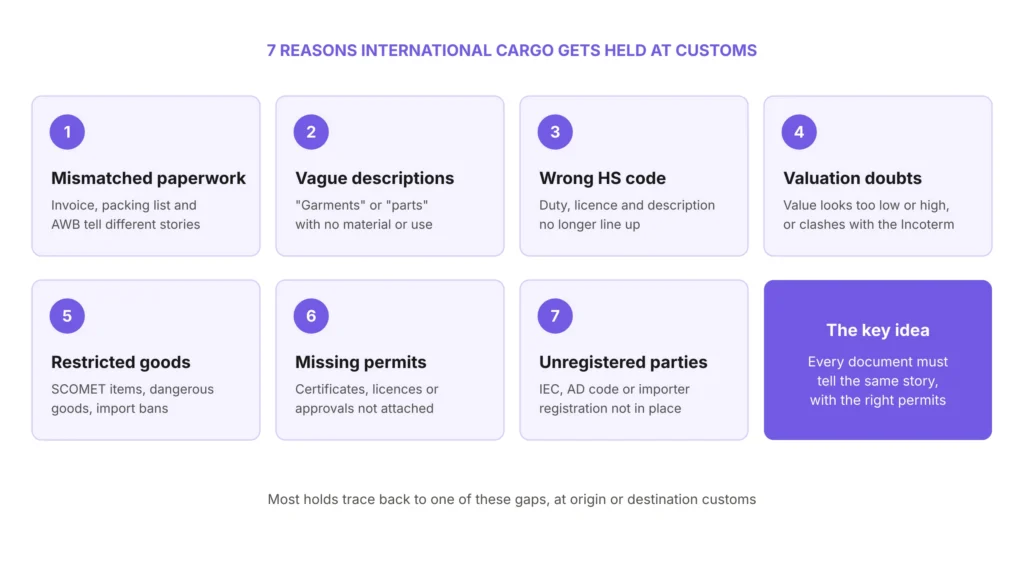
1. Inconsistent paperwork across documents
This is the most common trigger. Your commercial invoice, packing list, shipping bill and air waybill or bill of lading must tell exactly the same story.
Small differences are enough to raise a flag:
- 48 cartons on the packing list but 50 on the air waybill.
- A gross weight that differs between the invoice and the airline booking.
- The buyer’s company name spelt one way on the invoice and another on the shipping bill.
- An invoice number or date that doesn’t match the one quoted in the declaration.
Automated systems compare these fields. A mismatch makes the declaration look unreliable, so an officer reviews it by hand.
2. Vague or incorrect product descriptions
“Garments”, “spare parts” or “samples” tells an officer almost nothing. Customs needs to know what the item is, what it is made of and what it is used for.
Compare “textiles” with “women’s woven cotton kurtas, 100% cotton, printed”. The second version lets the officer confirm the classification and duty without opening the box. FedEx’s guidance on why customs hold shipments names an unclear description as one of the top reasons for holds.
3. Wrong HS code classification
The Harmonized System gives every product a six-digit code, and the World Customs Organization says more than 98% of goods in international trade are classified under it, per its Harmonized System overview. India uses an eight-digit ITC-HS code built on those six digits, and the destination country may use 10 digits or more.
A wrong code can change the duty rate, trigger a licence requirement or clash with your description. If you’re unsure, check our guide to HS codes in international shipping before you file.
4. Valuation issues
Customs uses declared value to calculate duties and check export incentives. A value that looks too low or too high for the product draws attention at both ends.
Common valuation problems include:
- Declaring a low value to cut the buyer’s import duty.
- Marking paid goods as “free of charge” or “no commercial value”.
- Using the wrong Incoterm, so freight and insurance are counted twice or left out.
- Invoice values that differ from the purchase order or the bank remittance.
Destination customs can ask for proof of payment or a price breakdown. Our guide to common Incoterm mistakes explains how the wrong term changes the declared value.
5. Restricted or prohibited goods
Some goods can move only with approval, and some can’t move at all. Dual-use chemicals and electronics may fall under India’s SCOMET list. Lithium batteries, perfumes and aerosols are dangerous goods that need correct packing, labels and a shipper’s declaration for air transport.
Restrictions also depend on the destination. A product that leaves India freely may be banned or licensed in the buyer’s country. Check the list of air cargo restricted items and the importing country’s rules before you quote a delivery date.
6. Missing permits, licences and certificates
Many products need supporting documents beyond the invoice and packing list. Typical examples include:
- A certificate of origin to claim a lower duty under a trade agreement.
- Phytosanitary or fumigation certificates for plant products and wooden packaging.
- An export licence for restricted items.
- Destination approvals, such as prior notice for food shipped to the US.
The US FDA’s prior notice guidance says food arriving without adequate prior notice is subject to refusal and can be held at the port. Missing a permit like this stops the cargo regardless of how clean the rest of your paperwork is.
7. Unregistered exporter or consignee details
Customs must know who is responsible for the goods at both ends. In India, that means a valid IEC and, if you want export benefits, an AD code registered at the port of export.
At destination, the importer may need its own registration, such as an EORI number in the EU. Missing consignee contact details, a wrong tax ID or an importer who isn’t ready to pay duty will all keep cargo sitting in the warehouse.
Origin vs Destination Customs Holds
Cargo can be held twice: once when it leaves India and again when it lands. The causes overlap, but each side cares about different risks.
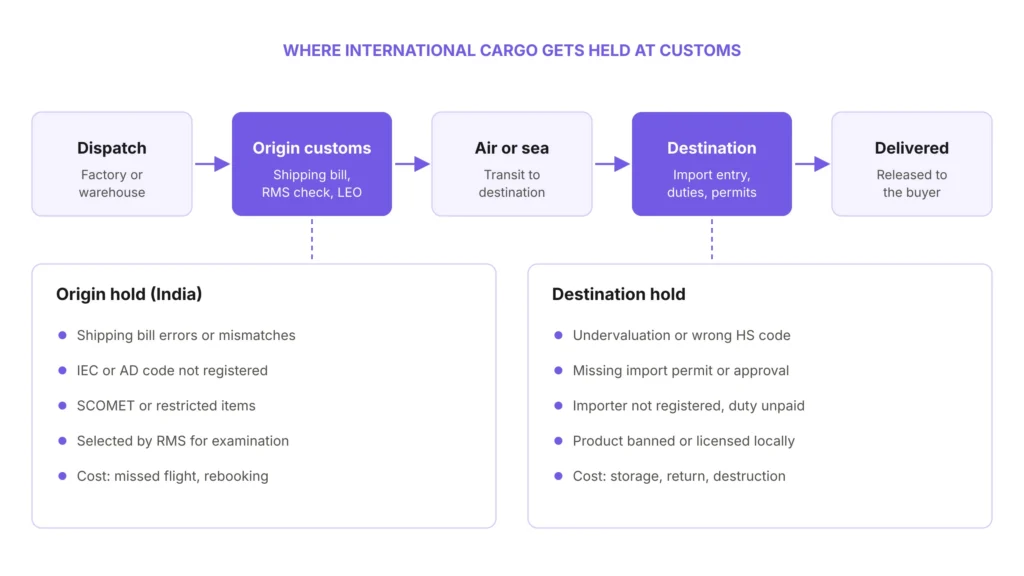
| Origin customs (India) | Destination customs | |
|---|---|---|
| Main focus | Correct export declaration, export controls, incentive claims | Duty collection, product safety, import bans |
| Typical triggers | Shipping bill errors, IEC or AD code issues, SCOMET items, RMS selection for examination | Undervaluation, wrong HS code, missing import permits, unpaid duties |
| Who resolves it | Exporter and customs broker in India | Importer or its broker, with documents from you |
| Main cost | Missed flight or vessel, rebooking | Storage, demurrage, possible return or destruction |
Cargo held at destination customs is usually harder to fix. You depend on the importer and their broker to respond, and you may be in a different time zone with limited control. That’s why getting the origin paperwork right also protects you at destination.
Remember that not every hold is your fault. Risk systems in India and abroad select some shipments for random checks. Clean, consistent documents make those checks shorter.
What to Do When Your Cargo Is Held
Act fast. Storage charges at the airport or port usually start once the free period ends, and they keep running while you wait.
- Get the exact reason. Ask your forwarder or broker for the query text. In India, IEC holders and customs brokers can view and reply to shipping bill queries online on ICEGATE.
- Compare every document line by line. Check quantities, weights, values, HS codes, names and dates across the invoice, packing list, shipping bill and air waybill.
- Send what is missing, once and complete. Partial replies lead to a second query and more delay.
- Brief your buyer early. Tell them what customs asked for and when you expect release. For destination holds, they or their broker will need your documents.
- Record the cause. Add it to your pre-dispatch checklist so the same error doesn’t repeat.
If customs asks for an examination, arrange for your broker to attend. Have the original invoice, packing list and product specs ready, because officers will match the goods to them.
Pre-Dispatch Checklist to Avoid Customs Clearance Delays
Most export shipment delays start at your desk, not at the airport. Run this checklist before every consignment leaves your warehouse.
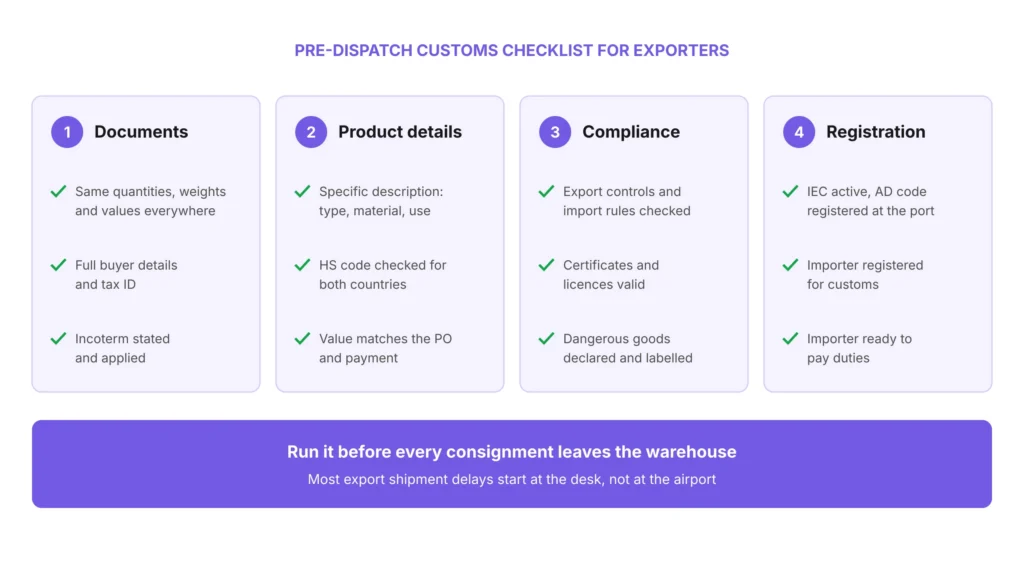
Documents
- Commercial invoice, packing list, shipping bill and air waybill show the same quantities, weights, values, names and addresses.
- Invoice includes the buyer’s full name, address, phone, email and tax or importer ID.
- Incoterm is stated and the value is calculated consistently with it.
- Our export documents checklist covers the full set for most shipments.
Product details
- Each line has a specific description: product type, material and use.
- HS code is checked for both India and the destination country.
- Declared value matches the purchase order and the payment you received.
Compliance
- Goods are checked against Indian export controls and the destination’s import restrictions.
- Required certificates, licences and approvals are issued and valid.
- Dangerous goods are declared, packed and labelled to airline rules.
Registration and packing
- IEC is active and the AD code is registered at the port of export.
- Importer has its customs registration and is ready to pay duties if the Incoterm requires it.
- Cartons are numbered and marked to match the packing list, and wooden pallets are fumigated or heat-treated if required.
For air shipments, our guide to documents for air freight shipping lists the airline paperwork you also need.
Ship B2B Export Cargo With Visibility Using CargoX
Clean paperwork is half the job. The other half is shipping through a partner that keeps you in the loop when something needs attention.
Shiprocket CargoX handles bulk B2B export consignments starting from 20 kg, to 200+ countries and territories. You place a cargo order online, compare air cargo options and prices, and schedule a pickup in a few steps. Real-time tracking from pickup to delivery can be shared with your buyer, documentation support helps with paperwork, and a key account manager is available for queries. If you’re comparing ways to move larger volumes, read our guides to international air cargo and international freight forwarding.
Conclusion
International cargo held at customs is costly, but it is rarely a mystery. The same seven gaps cause most holds: inconsistent documents, vague descriptions, wrong HS codes, valuation doubts, restricted goods, missing permits and unregistered parties.
Treat the pre-dispatch checklist as part of packing, not paperwork you finish later. When every document tells the same story and the right permits travel with the cargo, customs has little reason to stop it, and your buyer gets their goods on time.