
- Why Handicraft Export from India Is Worth the Effort
- What Makes Shipping Handmade Products Internationally Hard
- Prepare Each Material for International Transit
- Describe and Classify Your Products Accurately
- Parcel vs Cargo: Choosing How to Ship
- Manage Fragile and Unusual Items
- First-Export Checklist for Artisan Businesses
- Take Indian Handicrafts Global With Shiprocket X
- Conclusion
A buyer in Melbourne loves your carved sheesham elephant. A boutique in Berlin wants 40 hand-painted blue pottery bowls. The orders are exciting, until you picture the bowls arriving in pieces or the elephant stuck at customs because of a pest-control question.
If you want to export handicrafts from India, the craft is only half the job. The other half is logistics: packing pieces that were never designed to travel, describing one-of-a-kind items on a customs invoice and knowing which countries treat wood, cane or horn as a biosecurity risk.
This guide walks Indian artisans, handicraft manufacturers, independent designers and small brands through that second half. You’ll learn how to pack wooden decor, metal handicrafts, textiles, ceramics and handmade accessories, how to choose between parcel and cargo, and what to check before your first overseas shipment.
Why Handicraft Export from India Is Worth the Effort
Demand for Indian craft is steady and broad. According to the Press Information Bureau, India exported handicrafts worth ₹33,122.79 crore in 2024-25, excluding hand-knotted carpets, up from ₹20,082.53 crore in 2014-15. Woodwares alone contributed about ₹8,524 crore and art metal wares about ₹4,386 crore.
Most of that value still moves through established Indian handicrafts exporters selling to importers. But smaller sellers now have a direct route too. Etsy, Amazon Global Selling and your own Shopify store let you export handicraft items overseas one parcel at a time, at retail prices instead of wholesale ones.
That direct route is where logistics matters most. A wholesaler can absorb one broken carton in a container. A small brand shipping a ₹6,000 brass lamp to a single customer can’t. If you are still setting up your online store, our guide on how to sell handicrafts online covers the selling side.
What Makes Shipping Handmade Products Internationally Hard
Shipping handmade products internationally is harder than shipping factory goods for five reasons.
Fragile materials. Terracotta, glass, ceramic, lacquer and thin carved wood crack under drops and pressure. An international parcel passes through more hands, sorting belts and aircraft holds than a domestic one.
Irregular shapes. A Dhokra horse, a wall-hanging torana or a cane basket doesn’t fit a standard box. Big boxes with lots of padding raise the volumetric weight, so you pay for air.
Handmade variations. No two pieces are identical. Colour, size and finish vary slightly, which can confuse buyers and, if your invoice says “set of 6 identical bowls” and they aren’t, customs officers too.
Vague product descriptions. “Handicraft item” or “decor” on an invoice is a classic reason for a customs query. Officers need to know what the item is, what it’s made of and what it’s for.
Destination rules. Wood, bamboo, cane, jute, seeds, feathers, bone and horn can trigger biosecurity checks or outright bans in countries like Australia and New Zealand. Wildlife-derived materials can also be restricted when leaving India.
Prepare Each Material for International Transit
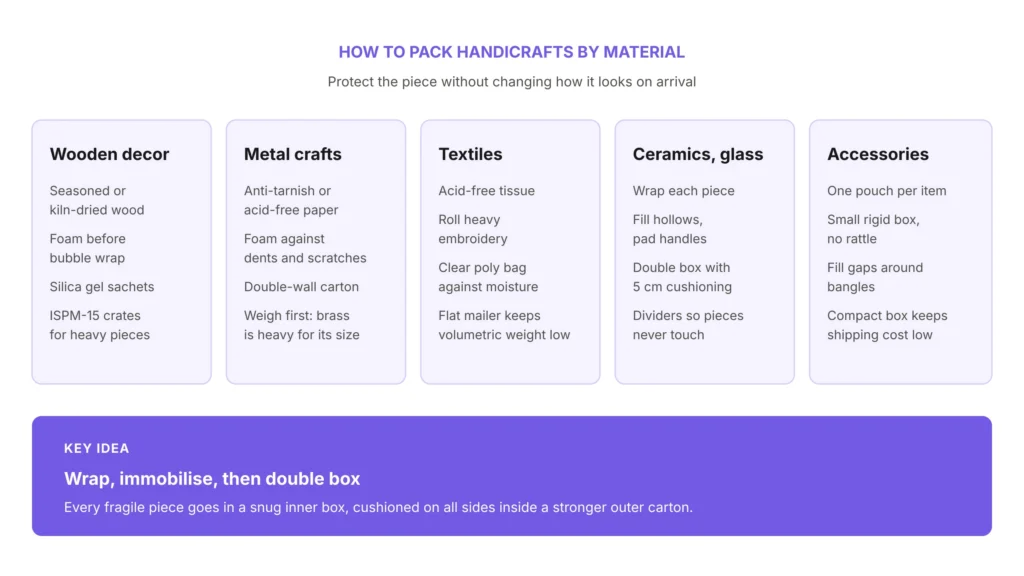
Good export packaging protects the piece without changing how it looks when the buyer opens the box. The core rule for every fragile item is the same: wrap the piece, immobilise it in an inner box, then put that box inside a stronger outer carton with cushioning on all sides. Our guide to shipping fragile items abroad covers the double-box method in detail.
Wooden Decor and Furniture
Wood moves with humidity. A piece made in a humid Saharanpur workshop can crack or grow mould after weeks in a sealed carton, so use seasoned or kiln-dried wood and add silica gel sachets to the inner box.
Wrap carved surfaces in soft foam sheet before bubble wrap, so the bubbles don’t press marks into polish or lacquer. Protect protruding parts like trunks, ears and legs with extra foam corners. For heavy pieces, screw them to a wooden base inside a crate, and make sure that crate is ISPM-15 treated and stamped.
Metal Handicrafts
Brass, copper, bidri and Dhokra pieces rarely break, but they scratch, dent and tarnish. Wrap them in anti-tarnish or acid-free paper first, then foam.
Watch the weight. A solid brass Ganesha can weigh far more than its size suggests, which affects your courier slab and the strength of the box you need. Use a double-wall carton so the piece can’t punch through a corner.
Textiles
Block-printed bedcovers, embroidered cushion covers, phulkari dupattas and handloom stoles are light and forgiving. Fold them along natural lines in acid-free tissue, or roll heavy embroidery to avoid hard creases.
Seal each piece in a clear poly bag against moisture and dust. Textiles pack well in flat mailers or small boxes, which keeps volumetric weight down.
Ceramics, Glass and Terracotta
These need the most care. Wrap each piece individually, fill hollow pieces like vases and cups with crumpled paper, and pad handles and spouts separately.
Leave at least 5 cm of cushioning between the inner box and the outer carton on every side. Never let two ceramic pieces touch. For sets, use cardboard dividers or individual cell packs.
Handmade Accessories
Jewellery, beaded bags, leather wallets and lac bangles are small and high-value. Put each item in its own pouch or tissue wrap, then pack them in a small rigid box so they don’t rattle.
Bangles and thin metal pieces bend easily, so fill gaps tightly. A small box also keeps the dimensional weight low, which matters when you ship many low-value orders.
Describe and Classify Your Products Accurately
Most customs delays on handicraft parcels come from paperwork, not packaging. Each shipment needs a commercial invoice that says what the item is, what it’s made of, how many units there are and what they’re worth.
Write Descriptions Customs Can Use
Compare these two descriptions:
- Weak: “Handicraft decor item, 1 pc”
- Strong: “Hand-carved sheesham wood elephant figurine, decorative, 30 cm, 1 pc, made in India”
The strong version tells the officer the material, the use and the size. It also matches how the item will be classified. If your pieces vary, say so in your listing (“each piece is handmade, so colour and size vary slightly”) and describe the actual piece you’re sending, not a catalogue average.
Get the HS Code Right
The HS code is classified by material and function, not by the word “handicraft”. Here are common starting points at the four-digit level:
| Product | Typical HS heading | What decides the code |
|---|---|---|
| Wooden statuettes and ornaments | 4420 | Wood, decorative use |
| Brass or copper figurines and ornaments | 8306 | Base metal, decorative use |
| Ceramic figurines and ornaments | 6913 | Ceramic, ornamental use |
| Cushion covers, bedcovers, wall hangings | 6304 | Textile furnishing article |
| Handbags and wallets | 4202 | Container or bag, any material |
| Imitation jewellery | 7117 | Non-precious jewellery |
Treat these as a starting point. The full 8-digit Indian code and the destination's own tariff code add more detail, so confirm them with your courier, customs broker or the destination's tariff database before your first shipment.
Declare the Country of Origin
Every invoice should state "Country of origin: India". Many markets, including the USA, also expect imported goods to be marked with their country of origin, so add a small "Made in India" tag, sticker or stamp to each piece where it won't spoil the look.
If a trade agreement gives your buyer lower duty, they may need a certificate of origin. This matters more for wholesale B2B orders than for single retail parcels.
Parcel vs Cargo: Choosing How to Ship
The right mode depends on order size, weight and who your buyer is.
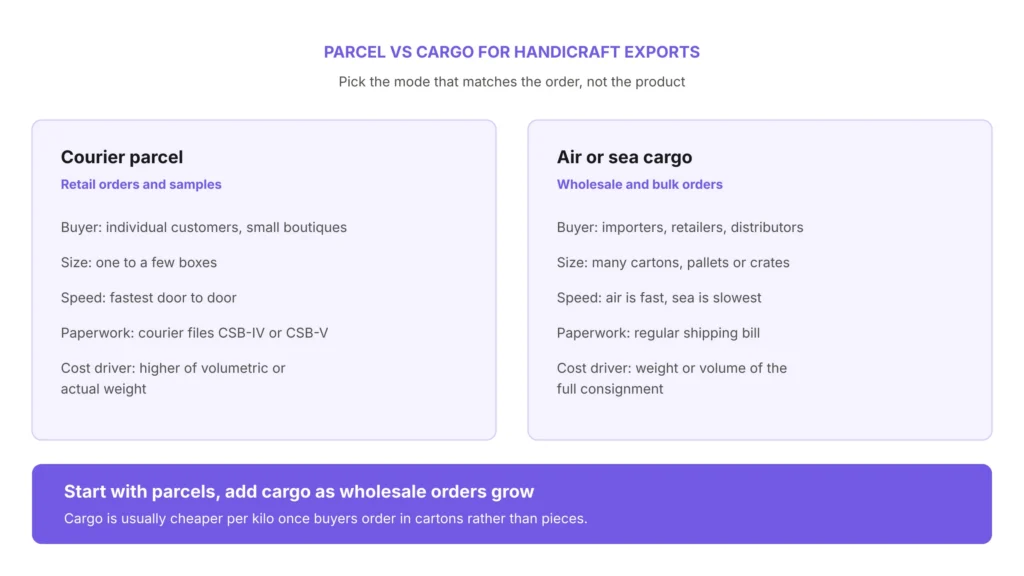
| Factor | Courier parcel | Air or sea cargo |
|---|---|---|
| Best for | Single retail orders, samples, small repeat orders | Wholesale orders, trade shows, bulk shipments |
| Buyer | Individual customers, small boutiques | Importers, retailers, distributors |
| Typical size | One to a few boxes | Many cartons, pallets or wooden crates |
| Speed | Fastest door-to-door | Air is fast, sea is slowest and cheapest per kg |
| Paperwork | Courier files the export under CSB-IV or CSB-V | Regular shipping bill, often through a freight forwarder |
| Main cost driver | Volumetric or actual weight, whichever is higher | Weight or volume of the full consignment |
When Parcel Shipping Makes Sense
If you sell through your website, Etsy or Amazon, almost every order will go by international courier. It’s tracked door to door and the buyer gets it within days or a couple of weeks, depending on the destination.
Commercial ecommerce exports by courier usually move under CSB-V, which lets you claim export benefits. Our guide to CSB-IV vs CSB-V explains which one fits your order. Keep boxes as compact as you safely can, because couriers charge on volumetric weight when it’s higher than the actual weight.
When Cargo Shipping Makes Sense
Once a buyer orders in cartons rather than pieces, cargo is usually cheaper per kilo. Air cargo suits urgent or high-value consignments, while sea freight suits heavy furniture, large planters and full container loads.
Cargo shipments need sturdier packing: palletised cartons, corner boards and ISPM-15 treated wooden crates. Our explainer on air cargo vs air courier breaks down the trade-offs in more detail.
Manage Fragile and Unusual Items
Some handicrafts need extra steps beyond good packing.
- Mark fragile cartons clearly. Use “Fragile” and “This Way Up” labels on several sides. Labels don’t guarantee gentle handling, but they help at manual sorting points.
- Photograph before sealing. Take photos of the item, the inner pack and the sealed box. They’re your evidence if you need to raise a damage claim.
- Insure high-value pieces. Standard carrier liability rarely covers the value of a handmade piece. Look at international shipment protection before you send anything you can’t afford to lose.
- Check for batteries. Handmade lamps or decor with LED lights and lithium batteries count as dangerous goods for air transport and need special declaration, or a battery-free version.
- Avoid restricted materials. Ivory, shahtoosh and products from protected wildlife are banned from export. Sandalwood and red sanders products have their own DGFT export conditions, so check the current policy before listing them.
Destination-Specific Restrictions
Rules change by country, so check the destination before you take the order:
- Australia and New Zealand: strict biosecurity on wood, bamboo, cane, straw, seeds and natural fibres. Items may be inspected, treated at the buyer’s cost or destroyed if they show bark, insects or soil.
- USA: the duty-free de minimis exemption for low-value parcels was suspended for all countries from 29 August 2025, so most handicraft parcels now attract duty. Some wooden products also need a Lacey Act plant declaration with the species name.
- EU and UK: most decorative handicrafts enter freely, but VAT applies to consumer orders, and products like toys, candles or items that touch food face safety rules.
First-Export Checklist for Artisan Businesses
Use this checklist before your first order goes out. It turns everything above into ten practical steps.
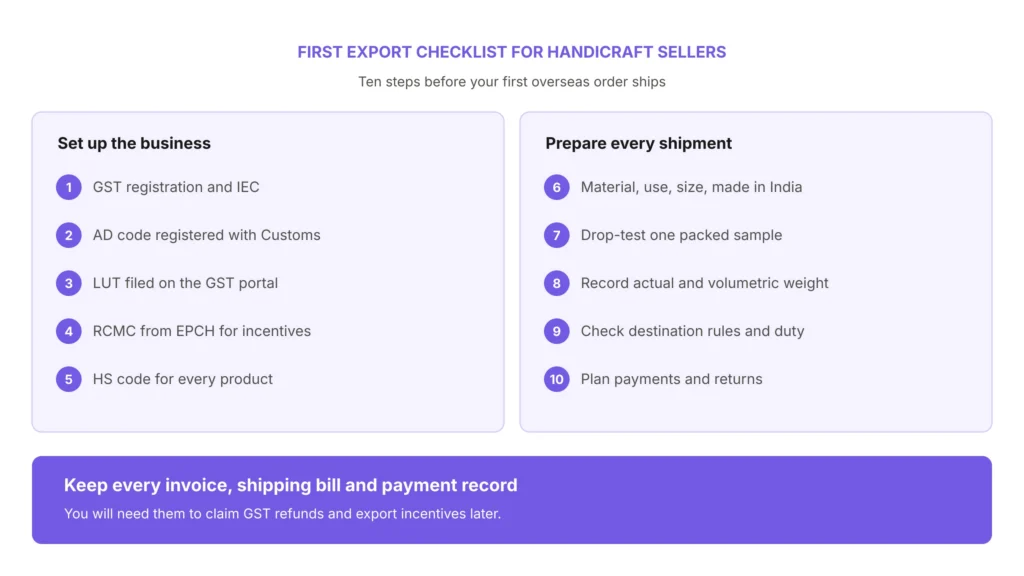
- Register your business. Get GST registration and an Import Export Code from the DGFT.
- Link your bank. Register your AD code with Indian Customs so export proceeds can be tracked.
- File an LUT on the GST portal so you can export without paying IGST upfront.
- Join EPCH if you plan to grow. An RCMC from the Export Promotion Council for Handicrafts unlocks export incentives, trade fairs and buyer leads. Our guide to how EPCH supports exporters explains the benefits.
- Classify every product. Assign an HS code to each SKU based on material and use.
- Rewrite your descriptions. Material, function, size and “made in India” for every item.
- Test your packaging. Pack one sample and drop it from waist height onto a hard floor several times. If anything breaks, repack.
- Weigh and measure. Record actual and volumetric weight for each SKU so your shipping prices are right.
- Check the destination. Confirm import rules, duties and any material restrictions for your top three markets.
- Plan payments and returns. Decide how you’ll collect money and what happens if a buyer returns a fragile item. Our sister blog explains how to receive international payments.
Keep a copy of every invoice, shipping bill and payment record. You’ll need them for GST refunds and export incentives, and our export documents checklist lists the full set.
Take Indian Handicrafts Global With Shiprocket X
Shiprocket X is Shiprocket’s cross-border shipping platform for Indian sellers. It lets you ship to 220+ countries and territories from one dashboard and upload marketplace orders under both CSB-IV and CSB-V, so a single artisan or small brand can sell to overseas buyers without a freight department.
For handicrafts, two features matter most. Shipment security cover lets you claim up to ₹5,000 for damage or loss in transit, subject to its terms, so read them before you ship fragile pieces. Duty-paid shipping to the USA means your buyer doesn’t face a surprise duty bill at the door. When wholesale orders grow beyond parcels, CargoX on Shiprocket X handles door-to-door B2B air shipments, and buyers can follow every order on a branded tracking page with email and WhatsApp updates.
Conclusion
To export handicrafts from India successfully, treat logistics as part of the craft. Pack each material the way it needs to be packed, describe every piece clearly, classify it by what it’s made of and check the destination’s rules before you accept the order.
Start with parcels to retail buyers, learn which products travel well and which need redesigned packaging, then move to cargo as wholesale orders arrive. With the right paperwork and a reliable international shipping partner, a workshop in Moradabad, Jaipur or Khurja can sell to customers anywhere. For more ideas on what sells, see our list of top-selling handmade products, and read our guide to exporting handmade products from India for more on safe worldwide shipping.