
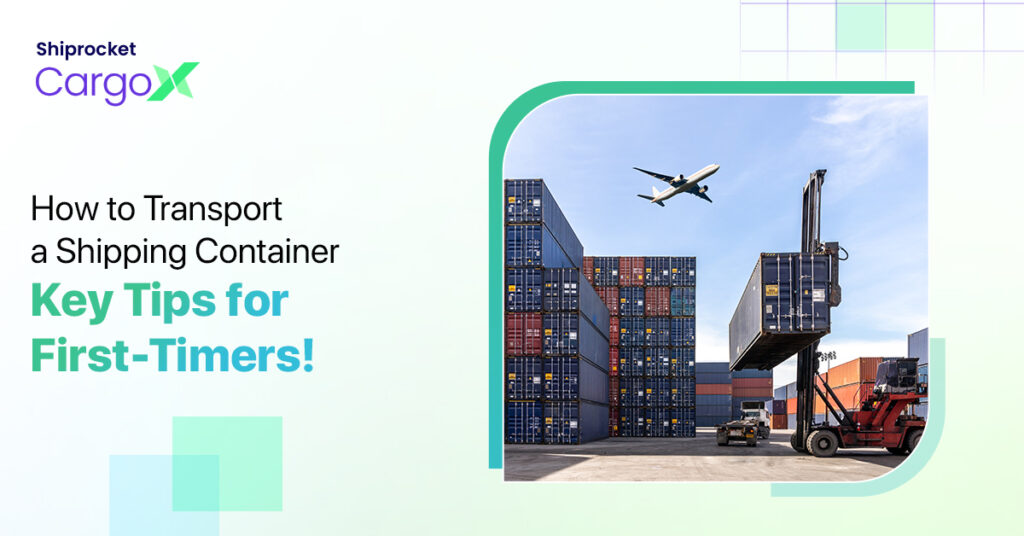
How to Transport a Shipping Container: A Complete Guide

 July 7, 2025
 8 min read
Understanding how to transport a shipping container is essential for businesses moving goods internationally. Businesses rely heavily on various types of shipping containers for the transportation of goods. According to recent statistics, approximately 65 million shipping containers are in use globally. Moving may seem like a complicated task; however, it can be managed with ease if you understand the basics. Whether you are using it for shipping goods within the country or overseas, there are specific steps that must be followed.
Business owners must be aware of the regulations and obtain the necessary permits to ensure a smooth transition. If you are new to this, the information shared here should come handy. This guide for beginners shares how to transport a shipping container. Read on to find out!
What Are the Different Modes to Transport a Shipping Container?
Here is a look at the different modes that can be used for the cross-border shipment of a container:
- Air Transport
This is the fastest mode of transportation, but also the most expensive. It is not used to transport full-sized containers. Businesses primarily use it to transport goods that are valuable or urgent due to the high cost involved in the process.
- Ocean Transport
This is the most common method for shipping containers internationally. It’s best for moving large quantities of goods over long distances at a comparatively low cost. The containers are loaded on the ships and sent to their destinations through different sea routes. It is slower than air transport and usually takes a few days to reach. Thus, it is a good option if speed is not a priority.
What Should You Consider Before Shipping a Container?
It is important to consider the following factors before selecting a container for shipping your goods:
- The Type and Volume of Goods to Ship
Start by assessing what you need to transport. It may include electronics, cosmetics, machinery, or perishable items, among other things. Each kind of item requires specific handling to ensure it reaches the destination in the right condition. For instance, perishable items and certain cosmetics may need temperature-controlled containers. On the other hand, heavy machinery is usually transported in flat racks or open-top containers. In addition to the type, the volume of goods should also be considered. The container size should be selected accordingly.
- The Container Type
Various types of containers are available for transporting goods. Here is a look at these types to help you understand which one is best suited to your requirements:
Dry Container – This is a standard container used to transport general cargo.
Reefer – This is a refrigerated container specially designed for perishable items, certain medicines, and other temperature-sensitive goods.
Tank Containers – This type of container is used to transport chemicals, fuels, and other liquids safely.
Open-Top or Flat-Rack – These types of containers are designed to accommodate heavy and oversized goods, such as large machinery.
3. Container Size Needed
Standard shipping container sizes are primarily 20 feet and 40 feet in length. 10-foot containers are also commonly available, as are containers in larger sizes, such as 45-foot. You may choose between them depending on your shipment’s volume and weight. While 10-foot containers are suitable for smaller shipments, 20-foot ones can accommodate big items. 40-foot containers are far more spacious and an apt choice for shipping bulk goods.
- The Number of Containers Required
The number of containers can be determined after understanding the size of the items to be shipped. If the volume is less than the capacity of a container, then it is a good idea to opt for Less than Container Load (LCL). This proves to be more economical, as it accommodates goods from other businesses as well.
- Mode of Transportation
Containers are shipped using different modes of transportation as mentioned above. While ocean freight is comparatively economical but time-consuming, air freight is quick yet expensive. Rail transport is considered fast, reliable, and reasonably priced. Additionally, many places can only be reached by road transport. The mode of transportation should thus be selected considering various factors.
- Cost of Shipment
Shipping goods through containers involves a number of charges. This includes container leasing charges, freight charges, port handling, customs clearance, and surcharges. The shipping cost varies depending on the distance to be covered, the size and type of container, and demand-supply dynamics, among other factors.
What Is the Step-by-Step Process to Ship a Container?
Here is a step-by-step process for container shipping:
- Plan Your Shipment
Start by noting down the weight and dimensions of the shipment. The type of material to be shipped should be a key consideration. The size and type of container should be selected on its basis.
- Choose a Reliable Freight Forwarder
The next step should be to choose a trusted and suitable freight forwarder. You will find plenty of them in the market. Their rates vary, and so does the quality of their services. Thus, it is important to check their reviews and compare rates before finalising their services.
- Book Your Container & Arrange Shipping
You have the option of choosing between Full Container Load (FCL) and Less than Container Load (LCL). You are required to pay for the entire container when you choose FCL. LCL proves to be reasonable as shipments of other businesses are also loaded on it.
- Prepare Necessary Documents
You must collate all the necessary documents and keep them handy to ensure your shipment moves swiftly and reaches its destination timely. A bill of lading, commercial invoice, import and export permits, customs declarations, and a packaging list are among the necessary documents.
- Load and Secure your Container
Goods must be loaded into the container safely and securely. They should be properly secured using straps or dunnage to prevent damage during transit. The weight of the goods must be checked before loading and should be kept within the permissible limit to avoid a fine. It can even lead to rejection of the consignment.
- Get Customs Clearance
You must check the customs regulations, import duties, and taxes of the destination country and comply with them to ensure clearance.
- Track Shipment
Most shipping companies provide real-time tracking of shipping containers. It is necessary to keep track of shipments and take timely action in case any obstacles arise.
- Receive and Unload the Container
Lastly, receive the container and unload it safely. It is recommended to verify that all your items have arrived securely.
What Common Mistakes to Avoid in Container Shipping?
When it comes to container shipping, even small mistakes can lead to big losses. Here are a few common mistakes to avoid:
- Booking at the Last Minute
This limits carrier options and reduces the chances of obtaining a discount. It also increases the risk of delays. It is recommended to plan at least 2–4 weeks in advance. Start by comparing quotes shared by different shipping companies. Gather all the necessary documents and make other essential arrangements.
- Providing Incorrect Value or Freight Class
It is important to provide the correct shipment value. Providing a lower value may result in a fine, while a higher value can increase the insurance premium. Freight classification should also be done appropriately, else you may incur unnecessary charges.
- Poor Packaging or Securing
The use of low-quality packaging material can damage the goods during transit. Not securing them properly with the use of straps and belts can also lead to loss. The use of sturdy packing material, properly securing the goods, and evenly distributing them according to the weight can ensure their safety.
4. Use of Wrong Container Type
Choosing a container that is too big, too small, or the wrong kind can waste space and increase the cost. This is why it is essential to measure the dimensions and weight accurately before making a decision.
- Skipping Insurance
Many businesses overlook the importance of taking insurance cover and end up incurring losses due to unforeseen circumstances.
How Does CargoX Simplify Container Shipping?
CargoX makes use of advanced technology to move shipping containers securely from one place to another. We have a wide network of courier partners that ship containers to over 100 countries worldwide. Our team acts quickly as soon as you place a request. We select the shipments within 24 hours, secure them in our robust containers, and deliver them safely. Our digitised workflow provides a hassle-free shipping experience.
With the use of the latest tools, we offer real-time visibility of shipments. Our process is completely transparent, and so is our invoicing. There are no hidden charges or conditions.
Moreover, our customer support team is always at your service. Any issues are resolved in a timely and professional manner.
Conclusion
Moving a shipping container from one place to another requires thoughtful planning. From selecting the right type of container to choosing an appropriate size and loading goods safely, several steps are involved in the process. The volume of goods, cost of shipment, and mode of transportation are among some of the other factors to consider.
You can seek assistance from reliable shipping companies such as CargoX to manage the task efficiently. Experienced professionals employed by such carriers assist with customs clearance, documentation, and various other steps involved in the process. Their knowledge and expertise enable a smooth transition.
Take the guesswork out of global shipping. Plan smart, ship with confidence, and let professionals handle the complexity while you focus on growing your business.