
How to Reduce Weight Discrepancies – Hacks for 2026

- Measure dimensions after final packaging
- Optimise box sizes to reduce volumetric weight
- Maintain clear image records for disputes
- Use a shipping platform to track discrepancies on time
- Map packaging material to SKUs
- Consider outsourcing fulfilment as you scale
- What Are Weight Discrepancies in eCommerce Shipping?
- Why Do Courier Companies Re-Measure Shipment Weight?
- What Causes Weight Discrepancies in eCommerce Orders?
- How Do You Calculate Volumetric Weight Correctly?
- How Can Sellers Reduce Weight Disputes in eCommerce?
- How Do Weight Discrepancies Impact eCommerce Profitability?
- Conclusion: How Can You Future-Proof Your eCommerce Shipping Strategy?
eCommerce has transformed the retail industry by opening doors for businesses of all sizes and making shopping more convenient for customers. However, with these opportunities come operational challenges that traditional retail rarely faced. One such challenge is weight discrepancies and courier disputes.
For new sellers, weight discrepancies can be confusing and costly if overlooked. For established sellers, repeated disputes can directly impact margins. Understanding how weight discrepancies occur—and how to reduce them—is essential for controlling shipping costs and scaling efficiently.
What Are Weight Discrepancies in eCommerce Shipping?
When you ship an order, the courier partner re-weighs the parcel at their hub using automated weighing and dimensioning systems. This weight includes:
- Product weight
- Packaging material
- Volumetric (dimensional) weight
If the weight recorded by the courier is higher than the weight you declared, your shipping cost increases. This difference is known as a weight discrepancy.
In simple terms, a weight discrepancy arises when there is a mismatch between:
- The shipment weight measured by you, and
- The shipment weight measured by the courier company
This may lead to:
- Additional shipping charges
- The need to raise disputes with courier partners
- Delays in reconciliation and payouts
Courier companies rely on precise systems to avoid under-billing, customs issues, and operational losses—making accurate seller-side measurement critical.
Why Do Courier Companies Re-Measure Shipment Weight?
Courier partners use high-precision automated systems to:
- Ensure accurate billing
- Avoid undercharging
- Prevent losses at customs or during interline movement
Since most sellers do not have access to similar infrastructure, minor errors in measurement or packaging can quickly turn into chargeable discrepancies.
What Causes Weight Discrepancies in eCommerce Orders?
Several factors contribute to weight disputes:
- Incorrect volumetric weight calculation
- Oversized or inconsistent packaging
- Manual measurement errors
- Variation in packaging for the same SKU
- Lack of image or dimension proof during disputes
Among these, incorrect volumetric weight calculation is the most common cause.
How Do You Calculate Volumetric Weight Correctly?
Volumetric weight (also called dimensional weight) reflects the space a shipment occupies rather than its actual weight.
Formula:
Volumetric Weight (kg) = (Length × Breadth × Height in cm) ÷ 5000
Note: The divisor (5000) may vary depending on the courier partner.
Example:
- Actual product weight: 500 g
- Package dimensions: 25 × 25 × 25 cm
Volumetric weight = (25 × 25 × 25) ÷ 5000 = ~3.1 kg
Even though the product weighs only 500 g, the shipment will be charged at 3 kg due to bulky packaging. This is why optimised packaging is critical.
You can use Shiprocket’s volumetric weight calculator to quickly estimate chargeable weight before shipping and avoid surprises at courier hubs.
How Can Sellers Reduce Weight Disputes in eCommerce?
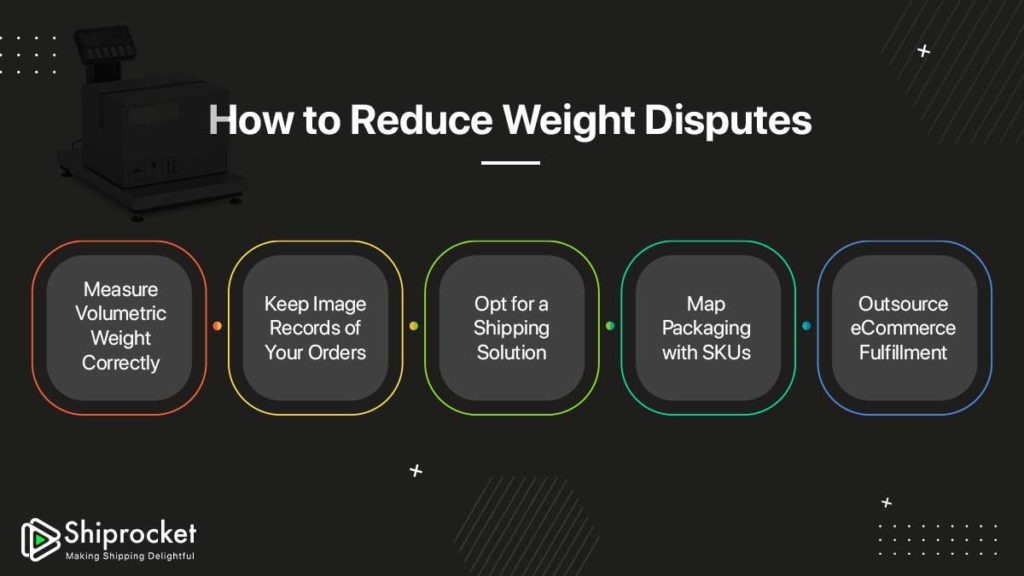
1. How Can You Measure Volumetric Weight More Accurately?
- Measure final shipment dimensions after packaging
- Use a standard measuring scale
- Always account for cushioning and outer box dimensions
- Avoid oversized boxes for lightweight products
Accurate measurement at this stage prevents most disputes.
2. Why Should You Maintain Image Records for Every Shipment?
Image records act as your strongest evidence during disputes.
Best practices include:
- Clicking photos while measuring length, breadth, and height
- Capturing the weighing scale clearly
- Taking images of the packed shipment from multiple angles
These images help validate your claim when raising disputes with courier partners.
3. How Does Using a Shipping Aggregator Help Reduce Discrepancies?
A shipping platform like Shiprocket centralises weight discrepancy data across courier partners.
Key advantages include:
- Consolidated view of all discrepancies
- Defined dispute-raising window (up to 7 days)
- Easy image uploads as proof
- Reduced chances of missing dispute deadlines
Shiprocket also allows sellers to freeze images and dimensions for repeat SKUs, eliminating repetitive uploads and reducing future errors.
4. How Does Mapping Packaging with SKUs Reduce Errors?
By mapping each SKU to a fixed packaging type:
- Dimensions remain consistent
- Volumetric weight stays predictable
- Packing errors are minimised
For example, a 500 g product always shipped in the same box will always attract the same chargeable weight, reducing disputes and operational confusion.
5. When Should You Outsource eCommerce Fulfilment?
If your order volumes are scaling rapidly or product variety is increasing, outsourcing fulfilment can be a strategic move.
With a 3PL solution like Shiprocket Fulfillment, you benefit from:
- Automated weighing and dimensioning machines
- Reduced manual errors
- Faster order processing
- Lower dispute rates
Advanced systems like automated Falcon machines ensure highly accurate weight measurement before dispatch.
How Do Weight Discrepancies Impact eCommerce Profitability?
Unmanaged weight discrepancies can:
- Increase shipping costs
- Reduce profit margins
- Create accounting inconsistencies
- Increase operational overhead
As eCommerce trends continue to focus on cost efficiency, faster delivery, and scalable operations, managing shipping accuracy has become a key competitive advantage.
Conclusion: How Can You Future-Proof Your eCommerce Shipping Strategy?
Weight discrepancies are no longer a minor operational issue—they are a direct reflection of how efficiently your eCommerce business is run. As shipping costs rise and courier partners rely more on automation, even small measurement errors can lead to repeated losses at scale.
By adopting accurate volumetric calculations, optimised and standardised packaging, proper image documentation, and technology-led shipping or fulfilment solutions, sellers can significantly reduce disputes and unexpected charges. These practices not only help control costs but also align with broader eCommerce trends focused on operational efficiency, scalability, and margin protection.
In a competitive eCommerce landscape, sellers who treat shipping accuracy as a priority rather than an afterthought will be better positioned to grow sustainably—without letting hidden logistics costs eat into their profits.