


- What Is EDPMS?
- How EDPMS Works, Step by Step
- Key Data Stored in EDPMS
- EDPMS vs IDPMS: What’s the Difference?
- EDPMS Rules That Changed in 2026
- How to Check Your EDPMS Status
- Common Mistakes That Keep EDPMS Entries Open
- Best Practices for EDPMS Compliance
- How Shiprocket X Can Help You Simplify Export Operations
- Conclusion
You shipped the order, the overseas buyer paid, and the money landed in your account. Job done? Not quite. Until your bank links that payment to the right shipping bill in EDPMS, the RBI still sees the export as unpaid.
For Indian D2C brands selling to buyers abroad, that gap is easy to miss. An open entry can hold up your eBRC, delay export incentives and invite questions from your bank later.
This guide explains the EDPMS full form, how the system works, how it differs from IDPMS, what changed under the 2026 FEMA rules, and the habits that keep your export entries closing on time.
What Is EDPMS?
EDPMS is the Export Data Processing and Monitoring System, a centralised database run by the Reserve Bank of India. It tracks each export from the moment Customs records it to the moment the payment for it reaches India.
The RBI launched EDPMS on 28 February 2014, and it has been in operation since March 2014. The RBI described it as a single master database for all exports, built to cut paper reporting and let banks track export documents and payments in near real time.
The logic is simple. Under the Foreign Exchange Management Act (FEMA), an exporter must realise and bring back the full value of what they export. EDPMS is how the RBI and banks check that this actually happens.
Who Uses EDPMS?
Several parties feed or read the same database:
- Customs, SEZs and STPI upload export data, such as shipping bills, when goods or software leave the country.
- Authorised Dealer (AD) banks acknowledge documents, record incoming payments and close entries.
- The RBI monitors outstanding exports across the system.
- Exporters don’t log in directly. You see your status through your bank and through ICEGATE.
Who Needs to Care About It?
If you export physical goods, every shipping bill creates an EDPMS entry against your AD code. That includes D2C brands shipping cross-border orders and B2B sellers sending bulk consignments abroad.
Service and software exporters are covered too, through SOFTEX forms and the Export Declaration Form (EDF). If you’re starting to sell overseas, our guide on how to receive international payments covers the payment side in more detail.
How EDPMS Works, Step by Step
Every export goes through the same basic cycle. Your job is to make each step easy for your bank to complete.
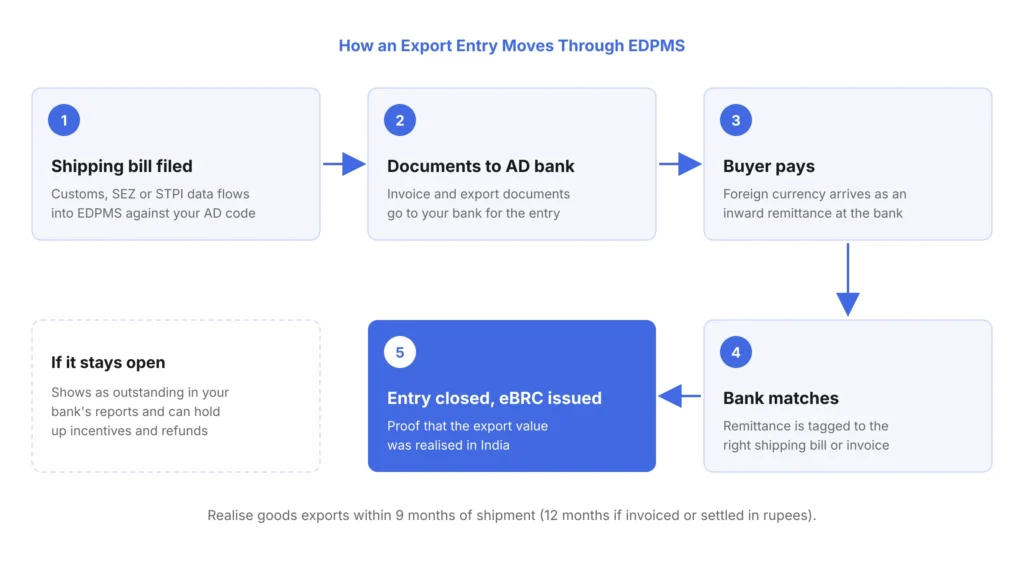
- Shipping bill filed. When goods are exported, Customs data flows into EDPMS through ICEGATE and is mapped to your bank’s AD code.
- Documents to the AD bank. You submit the invoice and export documents to your bank, which acknowledges the entry.
- Buyer pays. The overseas buyer sends foreign currency, which arrives as an inward remittance at your bank.
- Bank matches. The bank tags that remittance to the correct shipping bill or invoice.
- Entry closed. Once the value is realised, the bank closes the entry and an electronic Bank Realisation Certificate (eBRC) is generated.
If the money comes in but the bank can’t tell which export it belongs to, the entry stays open. That’s the most common reason exporters get chased for “outstanding” bills they’ve already been paid for.
From Paper FIRCs to eBRC
Before EDPMS, banks issued a physical Foreign Inward Remittance Certificate for each export payment. In 2016 the RBI moved this reporting into EDPMS, so the remittance data now lives in the system itself.
The eBRC is the end result. It’s the document you’ll use as proof of realisation when you claim export incentives or GST refunds, so a missing eBRC usually means money stuck somewhere else in your business.
Key Data Stored in EDPMS
Think of each EDPMS entry as a running record of one export. It typically holds:
| Data point | What it tells the bank |
|---|---|
| Shipping bill number and date | Which export this is and when it left India |
| Port code and AD code | Where it was shipped from and which bank handles it |
| Invoice value and currency | How much should come back |
| Inward remittance details | What has actually been received |
| Value reductions or write-offs | Any approved changes to the expected amount |
| Status | Open, overdue or closed |
Because the bank matches on these fields, small mismatches matter. A wrong invoice number, a different currency or a partial payment without explanation can all stop an entry from closing.
EDPMS vs IDPMS: What’s the Difference?
EDPMS has an import-side twin, the Import Data Processing and Monitoring System (IDPMS). It went live in October 2016 and tracks payments going out of India for imports.
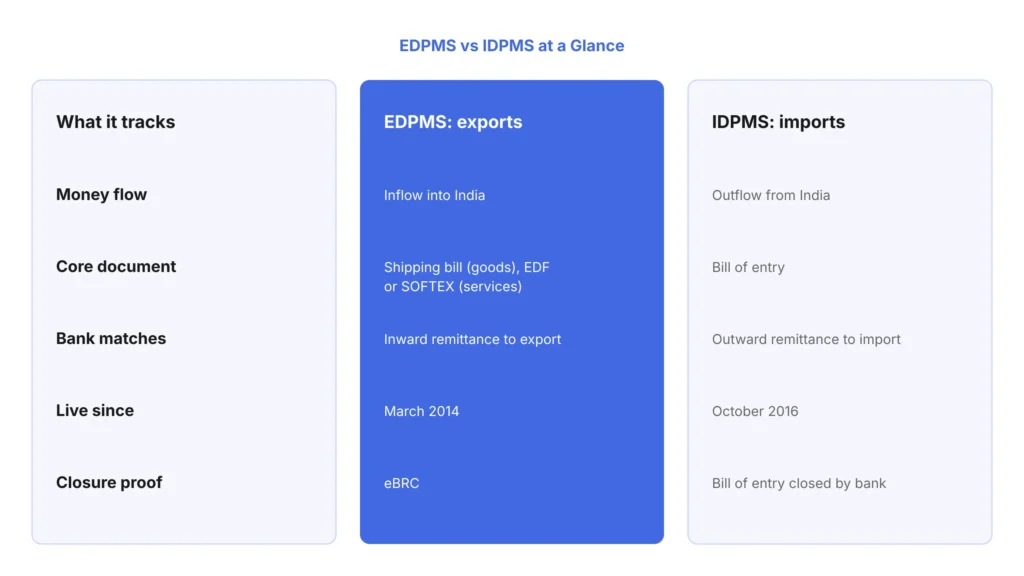
| EDPMS | IDPMS | |
|---|---|---|
| Covers | Exports | Imports |
| Money flow | Inflow into India | Outflow from India |
| Core document | Shipping bill, EDF or SOFTEX | Bill of entry |
| What the bank matches | Inward remittance to export | Outward remittance to import |
| Live since | March 2014 | October 2016 |
If your brand both imports raw materials or packaging and exports finished goods, you’ll have entries in both systems. The same discipline applies to each: clean documents, correct references and timely follow-up with your bank.
EDPMS Rules That Changed in 2026
The RBI replaced its older export and import framework with the Foreign Exchange Management (Export and Import of Goods and Services) Regulations, 2026. An amendment issued on 22 September 2026 took effect on 1 October 2026. Here’s what matters for exporters.
Realisation Timelines
Under the amended rules, export proceeds must generally be realised within:
- 9 months from the date of shipment for goods.
- 9 months from the date of invoice for services.
- 9 months from the date of sale for goods sent to an overseas warehouse.
- 12 months for exports invoiced or settled in Indian rupees.
Your AD bank can extend these periods if you give reasons it accepts. Don’t assume an extension, though. Ask for it before the deadline passes.
Small-Value Closure on Declaration
This is the big relief for small exporters and D2C brands with many low-value shipments. EDPMS entries for a shipping bill or services invoice of up to ₹10 lakh can now be closed on the exporter’s own declaration that the payment was realised, in full or otherwise.
You can also submit these declarations in bulk every quarter. For a brand shipping hundreds of small international orders, that’s far less paperwork than chasing each entry separately.
Service Exports and the EDF
Service exporters now file an Export Declaration Form stating the full export value within 30 days after the end of the month in which the invoice is raised. One EDF can cover several exports made in that month.
What Happened to the Caution List
Under the older rules, exporters with long-pending entries could be placed on an RBI caution list, which meant extra scrutiny on future shipments. Under the 2026 transition, exporters already on the list as of 30 September 2026 stay governed by those orders until they are removed. Check with your AD bank how your own open entries are being treated now.
How to Check Your EDPMS Status
You can’t log in to EDPMS yourself, but you have two ways to see where an entry stands.
- ICEGATE. On the ICEGATE portal, use the public enquiry for RBI shipping bill (EDPMS) status with your shipping bill number and date.
- Your AD bank. Most banks share an outstanding report of open shipping bills on request, and many show it in their trade or corporate banking portal.
Run this check monthly, not just at year end. An open entry is much easier to fix while the buyer, invoice and payment are still fresh.
Common Mistakes That Keep EDPMS Entries Open
Most stuck entries come from small, avoidable gaps. Watch for these:
- Missing references on the payment. Ask buyers to quote the invoice number when they pay, so the bank can match it.
- Payments through the wrong bank. If the shipping bill carries one AD code but the money lands at another bank, the entry won’t close on its own.
- Unexplained short payments. Discounts, bank charges or returns reduce what you receive. Tell your bank and record the reduction.
- Consolidated payments. One remittance covering many invoices needs a breakdown, or the bank can’t split it.
- No regular follow-up. Entries quietly age past the deadline when nobody owns the outstanding report.
The same rigour you apply to domestic settlements helps here. Our guide to ecommerce payment reconciliation walks through matching payments to orders, and the habits carry straight over to export receipts.
Best Practices for EDPMS Compliance
A little process goes a long way. Practical exporters tend to follow a routine like this:
- Keep one AD bank per export flow where you can, and make sure your AD code is registered at every port you ship from.
- Name invoices consistently across the shipping bill, invoice and payment advice.
- Choose payment partners that pass references through. When you pick a cross-border provider, check that it shares remittance details your bank can match. Our list of international payment gateways is a useful starting point.
- Use the ₹10 lakh declaration route for small entries, and file quarterly bulk declarations on a fixed calendar.
- Track eBRCs, not just payments. A payment without an eBRC means the job isn’t finished.
- Digitise your invoice records so you can answer bank queries quickly. Our post on invoice processing covers how to set that up.
How Shiprocket X Can Help You Simplify Export Operations
Managing EDPMS compliance becomes easier when your export documentation, shipment records and payment references are organised from the start. Shiprocket X helps Indian businesses simplify international shipping by bringing key export processes into a streamlined workflow.
From preparing shipments and managing export documentation to tracking international deliveries, Shiprocket X helps businesses maintain better visibility across their cross-border operations. This can make it easier to retrieve shipment details, verify shipping information and coordinate with your authorised dealer (AD) bank when reconciling export transactions.
For D2C brands and growing exporters handling multiple international orders, having shipment-related information organised can reduce manual effort and make follow-ups more manageable. While EDPMS entries are ultimately updated and closed by the relevant bank, maintaining accurate shipping and invoice records through your export workflow can help you address documentation mismatches and payment reconciliation queries more efficiently.
With Shiprocket X, you can focus on growing your international business while keeping your export operations organised and easier to manage.
Conclusion
EDPMS sounds like back-office jargon, but it decides whether your exports count as paid in the eyes of the RBI. Every shipping bill opens an entry, and only a matched payment closes it.
The 2026 rules make life easier for small exporters, with declaration-based closure for entries up to ₹10 lakh and quarterly bulk filing. They also tighten the window, with 9 months as the general deadline for realising export proceeds.
Keep your references clean, review your bank’s outstanding report every month and treat the eBRC as the finish line. Do that, and EDPMS becomes a routine check rather than a compliance headache.


