- How Sample Shipments Differ From Commercial Orders
- Documents You Need to Send Export Samples From India
- Packaging Samples for International Transit
- Single Sample vs Multiple Product Samples
- How to Choose an International Courier for Business Samples
- Pre-Dispatch Checklist for Export Samples
- Practical Example: A Moradabad Manufacturer Sends Samples to Germany
- Send Export Samples Faster With Shiprocket X
- Conclusion
An overseas distributor replies to your email. They like your catalogue, your prices look workable, and they’ve asked for one thing before they talk volumes: “Can you send samples?”
For many Indian manufacturers, wholesalers, artisans and D2C brands, sending export samples from India is the first real test of an export relationship. The sample is often the buyer’s first physical contact with your product. If it arrives late, damaged or stuck in customs with unclear paperwork, the buyer starts doubting your reliability before they’ve judged your quality.
This guide explains how to send export samples from India the right way. It covers how sample shipments differ from regular orders, the documents and declared value customs expects, packaging, courier choice, cost, and a pre-dispatch checklist you can use every time.
How Sample Shipments Differ From Commercial Orders
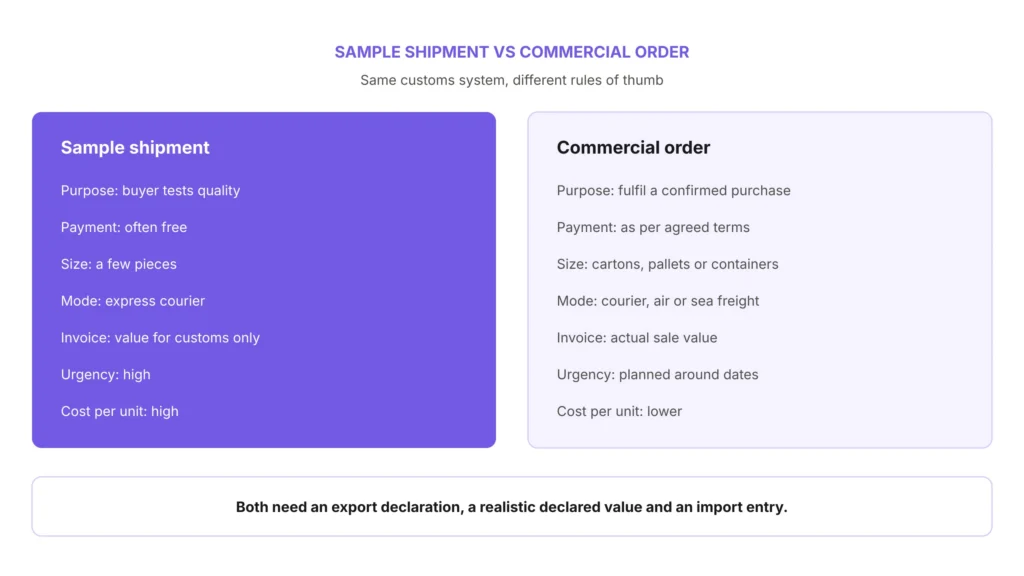
A sample shipment and a bulk order use the same customs system, but they behave differently in almost every other way. Samples are small, often free, and urgent. Orders are larger, paid, and planned.
| Factor | Sample shipment | Commercial order |
|---|---|---|
| Purpose | Let the buyer test quality before ordering | Fulfil a confirmed purchase |
| Payment | Often free or paid by the buyer later | Paid as per agreed terms |
| Size | A few pieces, usually under a few kilos | Cartons, pallets or containers |
| Mode | Express courier | Courier, air cargo or sea freight |
| Invoice | Shows a value for customs purposes only | Shows the actual sale value |
| Urgency | High: the buyer is comparing suppliers | Planned around delivery dates |
| Cost per unit | High, because there’s no volume | Lower, spread across the order |
The biggest practical difference is cost. Shipping a 1 kg sample by express courier can cost more than the sample itself, while freight per unit on a bulk order is a small slice of the price. That’s why sample shipping needs its own budget and its own decision rules.
Marking a Parcel “Sample” Doesn’t Exempt It From Customs
This is the most common misunderstanding about shipping product samples internationally. A sample is still goods crossing a border. It needs an export declaration in India and an import entry at the destination.
Whether duty applies depends on the destination country, the product and its value. Some countries let genuine samples of negligible value in duty-free, especially when they’re marked or cut so they can’t be sold. Others charge duty and tax on the declared value like any other import.
The rules also change. For example, US Customs and Border Protection has suspended duty-free de minimis treatment for low-value shipments from all countries, as its e-commerce FAQs explain. So even a small sample to a US buyer can now need a proper entry and attract duty.
Documents You Need to Send Export Samples From India
Product sample export documentation is lighter than for a full container, but it isn’t optional. Missing or vague papers are the main reason samples get held.
- Import Export Code (IEC): courier exports from a business need your Import Export Code, even for samples.
- Invoice: a commercial or proforma invoice listing every item, its quantity, unit value and total. Ask your courier which format it needs, since carriers and destinations differ.
- HS code for each item: customs uses it to apply duty and check restrictions. Our guide to HS codes in international shipping explains how to find the right one.
- Courier Shipping Bill: the authorised courier files this electronically with Indian customs. Samples usually go under CSB-IV, which our CSB-IV vs CSB-V guide explains in detail.
- Product-specific certificates: food, cosmetics, Ayurvedic products, plant material and medical items may need extra certificates at origin or destination, even as samples.
- KYC documents: your courier will ask for company KYC, usually GST and PAN details, before your first export.
Write a Precise Product Description
Customs officers can’t open every parcel, so they rely on your description. “Sample” or “handicraft items” on its own is too vague and invites a hold.
Write what the item is, what it’s made of and what it’s for. “Hand-woven cotton table runner, 33 x 180 cm, sample” tells customs everything. “Textile sample” doesn’t.
Declare a Realistic Value, Never Zero
Even free samples need a value on the invoice. A declared value of zero is a red flag for customs and often leads to delays or a reassessment.
Declare a fair value, usually your cost of production or a reasonable market value, and add a clear line such as “Free sample, no commercial value. Value declared for customs purposes only.” Don’t undervalue to save duty. If customs reassesses it, your buyer may face a bigger bill and a bad first impression.
Free samples also have a GST angle at home. Input tax credit on goods given away as free samples is generally blocked under Section 17(5)(h) of the CGST Act, so check the treatment with your CA before you send samples often.
Check Destination-Specific Restrictions
Some goods are restricted or banned in certain countries regardless of quantity. Food, seeds, leather from protected species, liquids, cosmetics, batteries and medicines are common trouble spots.
Before booking, check the destination’s import rules and the general list of prohibited items for international shipping. If you’ll show samples at trade fairs abroad and bring them back, ask FICCI, India’s issuing body for the ATA Carnet, whether a carnet suits your goods and destination.
Packaging Samples for International Transit
A sample travels through more hands than you expect: pickup, the hub, export customs, the airline, import customs and last-mile delivery. Pack it to survive all of them.
- Use a new, rigid outer box with cushioning on every side so nothing moves.
- Pack fragile items like ceramics, glass and brass separately, with double-boxing for anything breakable.
- Seal liquids and powders in leak-proof inner bags, then add absorbent material.
- Label every item inside with a product code that matches your invoice and catalogue.
- Put a copy of the invoice and a short note with your contact details inside the box.
Presentation matters too. A neatly packed box with labelled items and a printed spec sheet makes a buyer’s evaluation easier. For more ideas, read our international shipping packaging tips.
Single Sample vs Multiple Product Samples
Should you send one hero product or a range? It depends on what the buyer asked for and how much you know about their needs.
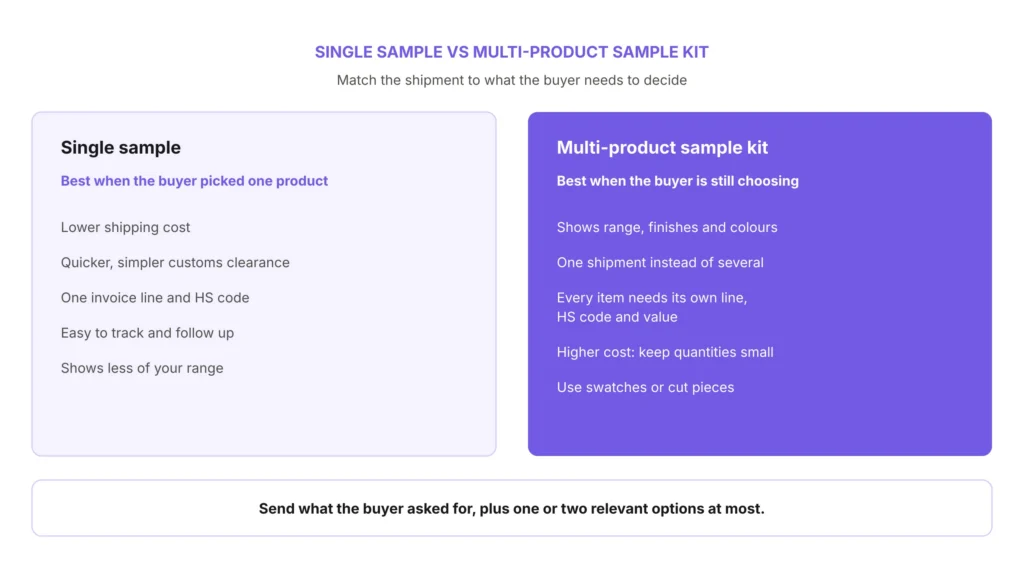
A single sample works when the buyer has picked a specific product from your catalogue. It’s cheaper to ship, quicker to clear and easy to describe on the invoice.
A multi-product sample kit works when the buyer is still choosing, or wants to judge your range, finishes or colours. It costs more and needs a longer invoice, since every item needs its own line, HS code and value.
A few rules help with multiple product samples:
- Send only what the buyer asked for, plus one or two relevant options at most.
- Keep quantities small. Many identical pieces look like a commercial shipment and can attract duty.
- Use swatches, cut pieces or small versions where they show the quality just as well.
- Combine everything into one shipment. Several small parcels usually cost more and may clear at different times.
How to Choose an International Courier for Business Samples
Speed matters with samples, because buyers are often comparing several suppliers at once. An express courier is usually the right choice over postal or economy services.
When you compare options, look at:
- Transit time: how many business days to the buyer’s city, including customs.
- Tracking: end-to-end tracking you can share with the buyer, not just the India leg.
- Customs support: whether the courier helps when a parcel is held for documents.
- Duty terms: whether you can pay destination duty yourself, so the buyer isn’t asked to pay before receiving a free sample. Our guide to Delivery Duty Paid shipments explains how this works.
- Pickup and weight rules: doorstep pickup, and how volumetric weight is calculated.
- Cover: whether loss or damage cover is available for higher-value samples.
To compare carriers in more depth, see our guide to choosing international shipping carriers.
Weigh the Sample Cost Against the Business Opportunity
Sample shipping isn’t cheap, so treat it as a sales cost with a clear limit. Ask three questions before you send:
- Is the buyer genuine? Check their website, company registration and trade history before sending anything costly. Our guide to finding buyers for your export products covers how to vet leads.
- What’s the realistic first order? A distributor who could order a container justifies an express kit. A one-off retailer enquiry may only justify a single piece.
- Who pays? Many exporters send the first sample free and ask the buyer to cover shipping or pay for repeat samples. Some adjust the sample cost against the first order.
Pre-Dispatch Checklist for Export Samples
Run through this list every time you’re sending export samples from India. It takes ten minutes and saves days of delay.
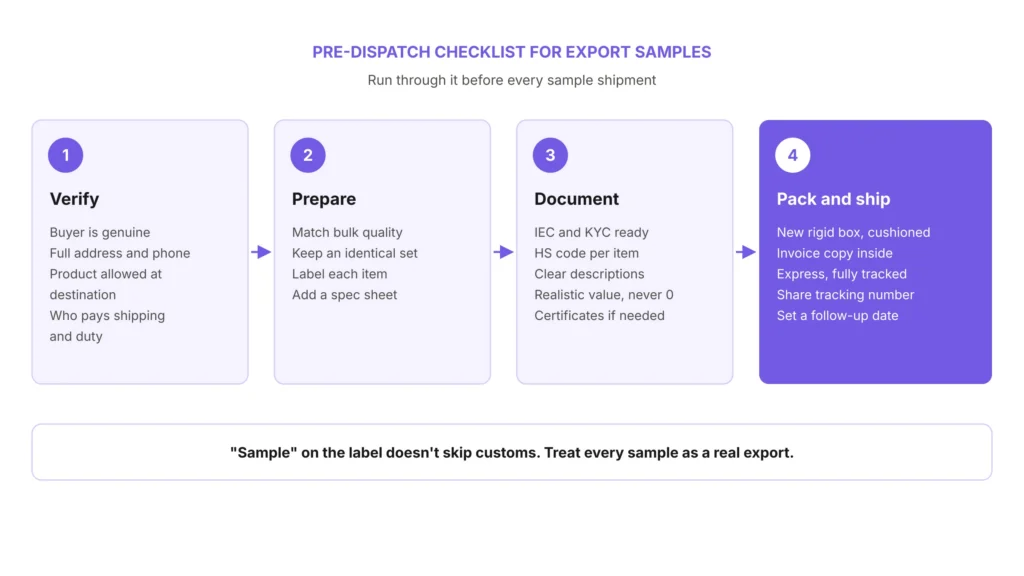
- Confirm the buyer’s full name, company, address, phone number and email.
- Check that the product is allowed in the destination country.
- Match each sample to what you can supply in bulk, and keep an identical set at home.
- Find the HS code for every item.
- Prepare the invoice with clear descriptions, quantities and a realistic value for customs purposes.
- Add any certificates the product needs.
- Pack in a strong new box with internal labels and a copy of the invoice.
- Agree who pays shipping and any destination duty.
- Book an express service with full tracking.
- Share the tracking number with the buyer and set a follow-up date.
Practical Example: A Moradabad Manufacturer Sends Samples to Germany
Here’s how this works in practice. The example below is illustrative.
A brassware manufacturer in Moradabad meets a home decor distributor from Germany at a trade fair. The distributor asks for samples of three products: a candle holder, a planter and a serving tray, each in two finishes.
The manufacturer starts by checking the distributor’s website and company details. Then they agree that six pieces is enough, rather than the full catalogue. They keep an identical set of six at the factory, so both sides can compare later.
Each item gets its own invoice line with a clear description, such as “Brass candle holder, antique finish, 15 cm, sample”, along with its HS code and a value based on production cost. The invoice states that the samples are free and the value is for customs purposes only.
The pieces are wrapped individually, double-boxed and shipped by express courier with full tracking. The manufacturer agrees to pay destination charges, so the distributor isn’t asked for money at the door. They email the tracking number with a product spec sheet and a price list.
When the parcel arrives, the manufacturer follows up within a week to ask for feedback. The distributor requests a change to one finish and asks for revised pricing. The deal isn’t closed yet, but the sample did its job: it got the conversation to the next stage with no customs surprises.
What Reliable Sample Delivery Does and Doesn’t Do
Reliable delivery shows a buyer you can meet deadlines and handle export paperwork. That counts for a lot when they’re judging a new supplier from another country.
But shipping alone doesn’t win the order. Product quality, pricing, minimum order quantities, lead times and how quickly you respond decide that. Think of a smooth sample delivery as removing a reason to say no, not as a reason to say yes. Once a buyer confirms, our guide to processing your first export order walks you through the next steps.
Send Export Samples Faster With Shiprocket X
Shiprocket X is Shiprocket’s cross-border shipping platform for Indian businesses. It lets you ship to 220+ countries and territories from one dashboard, compare international courier options, track shipments with email and WhatsApp updates, and upload orders under CSB-IV and CSB-V.
For samples, that means you can check rates and transit times before you book and share live tracking with your buyer. [[VERIFY: whether Shiprocket X supports free-sample (no-sale) shipments under CSB-IV and offers duty-paid options for samples]] When samples turn into bulk orders, Shiprocket Cargo handles larger B2B freight, and our guide to receiving international payments covers getting paid by overseas buyers.
Conclusion
Sending export samples from India is simple once you treat each sample as a real export. Describe it precisely, declare a realistic value, check the destination’s rules, pack it properly and ship it by a tracked express service.
Keep your sample budget tied to the size of the opportunity, and keep a matching set at home. Then follow up quickly. A well-handled sample won’t guarantee an order, but it gives your product a fair chance to win one.