
- Why Export Logistics for Manufacturers Is Different
- Step 1: Plan the Shipment Before Production Ends
- Step 2: Prepare Goods for International Freight
- Step 3: Get the Export Documents Right
- Step 4: Choose the Right International Freight Option
- Step 5: Coordinate the Factory Dispatch
- Step 6: Keep Visibility After Cargo Leaves the Factory
- Common Mistakes Manufacturers Make When Shipping Overseas
- Ship B2B Cargo Overseas with Shiprocket CargoX
- Conclusion
Your first overseas order is confirmed. A buyer in Germany wants 4,000 forged flanges, a retailer in the UK wants 12,000 cotton bedsheets, and a Dubai distributor needs brake pads for a fleet. The production team is ready. The question is how the goods actually get there.
That’s where international shipping for manufacturers gets tricky. Factory cargo is heavy, bulky and often on a deadline the buyer has already promised to someone else. A missed cut-off, a mismatched packing list or a damaged carton can wipe out the margin on the whole order.
This guide walks Indian manufacturers through the full journey: planning the shipment, preparing goods, coordinating the dispatch, choosing freight and keeping visibility until delivery. The examples come from engineering goods, textiles, auto components and industrial products.
Why Export Logistics for Manufacturers Is Different
A D2C brand shipping a few parcels a day can rely on a courier. A manufacturer exporting pallets, crates or full containers runs a different operation.
Here’s what changes when you ship from a factory floor:
- Volume and weight: consignments run from a few hundred kilos to several tonnes, so freight is charged per kg, per cubic metre or per container.
- B2B terms: the buyer’s purchase order sets the Incoterm, payment terms and delivery window, and you must match them exactly.
- Production dependency: the ship date depends on your production schedule, quality checks and packing capacity.
- Compliance load: customs, export controls, packaging rules and buyer certifications all apply to every shipment.
If you’re still choosing markets, our guide on how to expand your export business covers market selection. This post assumes you have an order and need to move it.
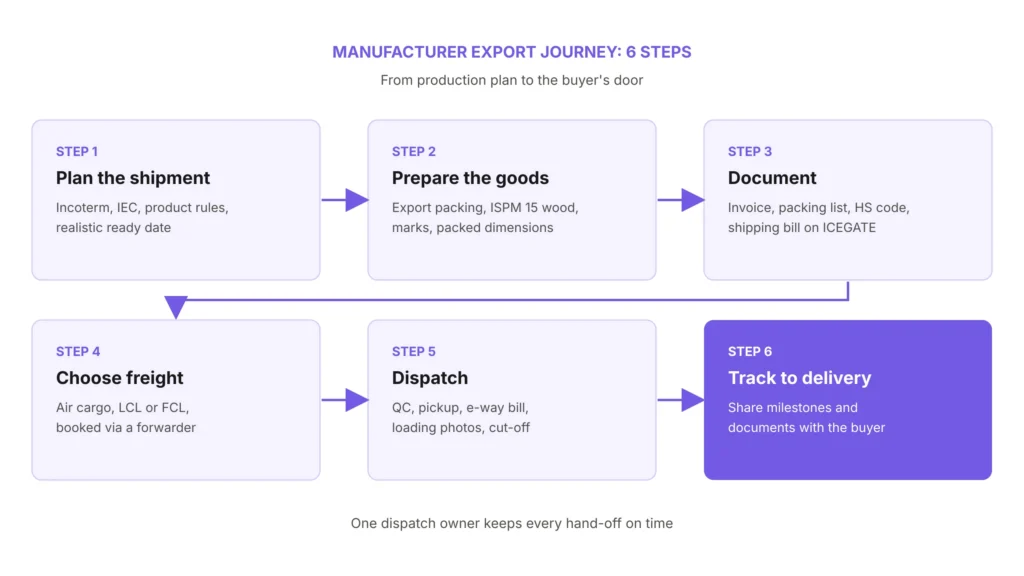
Step 1: Plan the Shipment Before Production Ends
Good export shipping is planned when the order is confirmed, not when the last carton is sealed. Start with these decisions.
Agree the Incoterm and Delivery Point
The Incoterm decides who pays for freight, insurance, export clearance and destination charges. FOB and FCA hand responsibility to the buyer at the port or a named place. CIF, CIP, DAP and DDP keep you responsible for longer.
New exporters often quote EXW to keep things simple, then find the buyer’s forwarder can’t clear the goods from India. Read our explainer on shipping Incoterms before you commit.
Check Registrations and Product Rules
You need an Import Export Code from the Directorate General of Foreign Trade and an AD code registered with customs. Our guide to the IEC registration process explains the steps.
Then check what the product itself needs. Some engineering items may fall under export controls. Textiles may need buyer-specified test reports. Auto components often need part-level traceability and the buyer’s labelling standard.
Fix a Realistic Ready Date
Work backwards from the buyer’s required delivery date. Subtract transit time, customs clearance at both ends, inland haulage and packing. What’s left is your real production deadline.
Build in a buffer for festive-season congestion and monsoon disruption. A one-week cushion is cheaper than switching a sea shipment to air at the last minute.
Step 2: Prepare Goods for International Freight
Export cargo is handled many times: forklifts at your dock, cranes at the port, conveyors at the airport. Your packing has to survive all of it.
Pack for the Product, Not the Shelf
Different industries face different risks in transit:
| Industry | Typical export cargo | Main transit risk | Packing that works |
|---|---|---|---|
| Engineering goods | Valves, pumps, flanges, machine parts | Rust, impact, shifting weight | VCI film, oil coating, wooden crates or skids |
| Textiles | Yarn, fabric rolls, garments, home linen | Moisture, mould, crushing | Poly-lined cartons, desiccants, strapped bales |
| Auto components | Brake pads, bearings, castings, electricals | Corrosion, mixed-up part numbers | Returnable bins or cartons by part number, sealed bags |
| Industrial goods | Panels, motors, tools, spares | Dust, shock, tipping | Foam inserts, shock indicators, palletised loads |
Any solid wood pallet or crate must meet the ISPM 15 standard, with heat treatment and the stamp to prove it. Uncertified wood can get a whole consignment rejected at the destination.
Mark and Label Every Package
Each package should show the buyer’s name, destination, package number such as “3 of 24”, gross and net weight, and handling marks. Auto component buyers often insist on their own barcode labels, so get the specification in writing.
Measure the Packed Cargo
Record the length, width, height and gross weight of every packed piece. Air freight is billed on the higher of actual and volumetric weight, and sea freight on weight or volume. Brochure dimensions lead to wrong quotes and surprise invoices.
Step 3: Get the Export Documents Right
Most delays at Indian ports and airports come down to paperwork that doesn’t match. Customs compares your documents with each other and with the cargo.
The core set for a manufacturer export includes:
- Commercial invoice: buyer, seller, Incoterm, HS codes, quantity, unit price and total value.
- Packing list: package-wise contents, dimensions, net and gross weight.
- Shipping bill: filed electronically on ICEGATE by you or your customs broker. See our guide on how to file a shipping bill.
- Air waybill or bill of lading: issued by the airline, shipping line or forwarder.
- Certificate of origin: needed to claim duty benefits under a trade agreement.
- Product documents: test reports, material certificates or inspection certificates the buyer or destination requires.
Use one HS code consistently across the invoice, packing list and shipping bill. A textile exporter who describes the same item as “cotton fabric” on one document and “home textiles” on another is asking for a query.
Step 4: Choose the Right International Freight Option
Freight mode is the biggest single lever on cost and delivery time. Most manufacturers use a mix rather than one mode for everything.
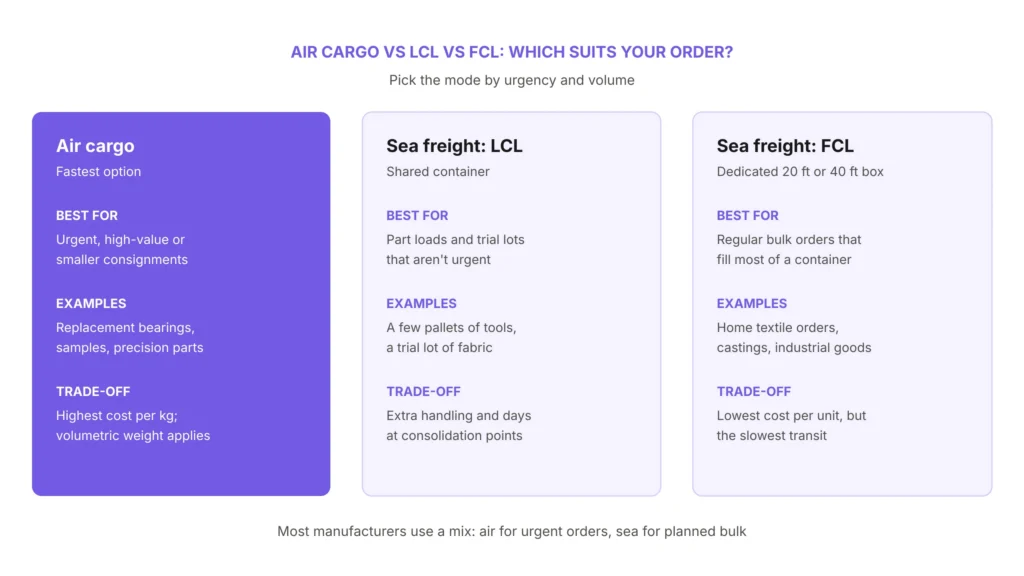
Air Cargo
International air cargo is the fastest way to move B2B consignments. It suits samples, urgent spares, high-value precision parts and first orders where the buyer is testing you.
An auto component supplier rushing replacement bearings to a plant line in Poland will almost always fly them. The freight cost is small next to the cost of a stopped line.
Sea Freight: LCL
Less than container load lets you share a container with other shippers. It works for part loads, such as a few pallets of industrial tools or a trial lot of fabric. Expect extra handling and a few more days at the consolidation points.
Sea Freight: FCL
Full container load gives you a dedicated 20 ft or 40 ft container. Once your cargo fills most of a container, FCL usually costs less per unit and gets handled less. A home textile mill shipping regular orders to the US typically moves on FCL. Our FCL shipping guide covers the process.
Some manufacturers can stuff containers at their own premises, with permission from customs, and seal them with RFID e-seals. That cuts handling at the port and reduces the risk of damage or pilferage.
Where a Freight Forwarder Fits
A forwarder books space, arranges pickup, coordinates customs clearance and handles the carrier documents. For most small and mid-sized manufacturers, that’s far easier than dealing with airlines and shipping lines directly. Read more on how international freight forwarding works.
Step 5: Coordinate the Factory Dispatch
The dispatch is where production, quality, logistics and accounts must work as one team. Missing one hand-off can cost a flight or a vessel cut-off.
Run each dispatch through a simple checklist:
- Final quality inspection done, including any buyer or third-party inspection.
- Packing list frozen and matched with the invoice.
- Pickup booked with the forwarder, with the vehicle size confirmed.
- E-way bill generated where GST rules require one for the move to the port or airport.
- Loading photos taken: cartons, crate marks, container number and seal.
- Shipping bill filed and cargo handed over before the cut-off.
Give one person ownership of the dispatch. In many engineering units, the production planner, the logistics executive and the accountant each assume someone else confirmed the pickup. Customs grants the Let Export Order after examination and clearance, and only then can the cargo be loaded.
Step 6: Keep Visibility After Cargo Leaves the Factory
Many manufacturers lose track of a shipment once the truck leaves the gate. The buyer, meanwhile, wants to know when to plan unloading, clearance and production.
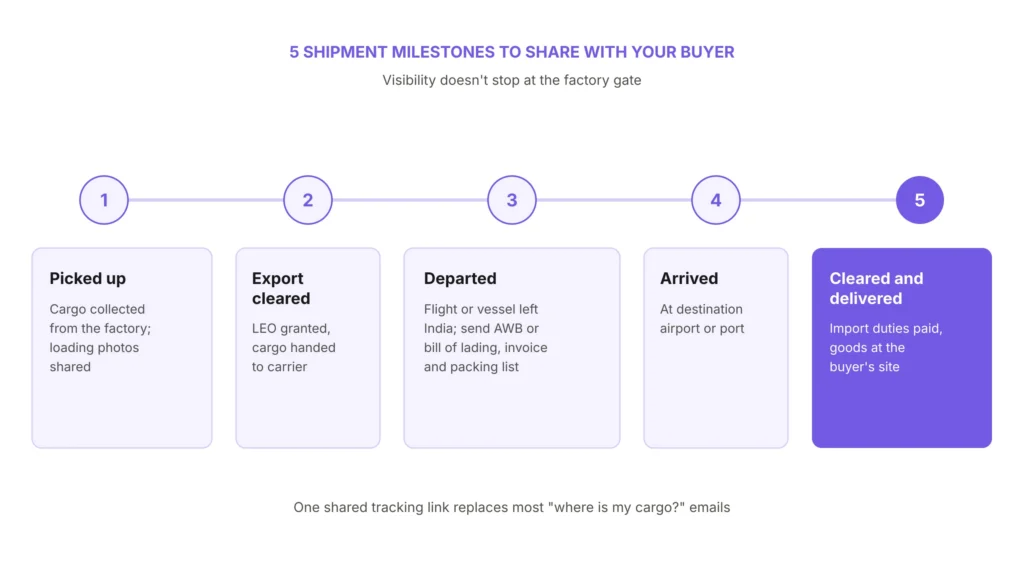
Track these milestones and share them with the buyer:
- Picked up: cargo collected from the factory.
- Export cleared: LEO granted and cargo handed to the carrier.
- Departed: flight or vessel left India, with the AWB or bill of lading number.
- Arrived: cargo reached the destination airport or port.
- Import cleared and delivered: duties paid and goods at the buyer’s site.
Send the AWB or bill of lading number, invoice copy and packing list to the buyer the day the cargo departs. Their customs broker needs these to prepare the import entry. A shared tracking link cuts down the “where is my cargo?” emails.
Insure the cargo too. A standard policy or a forwarder’s cover protects you against damage and loss in transit, which matters for high-value machine parts. See our explainer on cargo insurance.
Common Mistakes Manufacturers Make When Shipping Overseas
These come up again and again with first-time and growing exporters:
- Quoting freight before packing is final. The packed volume is often larger than expected, and the quote no longer holds.
- Ignoring dangerous goods rules. Batteries, paints, adhesives and some lubricants need declarations and special packing, especially by air.
- Choosing the cheapest mode for an urgent order. A delayed sea shipment can cost the next order.
- Leaving buyer labelling to the last day. Auto and retail buyers may reject cartons with the wrong labels.
- No single dispatch owner. Handovers fall through the gaps between departments.
Industry bodies like EEPC India also run awareness programmes on export procedures for engineering exporters, which help newer teams avoid these traps.
Ship B2B Cargo Overseas with Shiprocket CargoX
If your factory exports regular bulk consignments, Shiprocket CargoX is built for B2B air cargo from India. It handles international consignments starting from 20 kg, to 200+ countries and territories. You can get a quote, choose between Priority, Express and Economy services, and schedule a pickup online.
Each shipment gets real-time tracking from pickup to delivery that you can share with your buyer, along with documentation support and a dedicated key account manager. Read more about CargoX for global B2B shipping.
Conclusion
International shipping for manufacturers works best as a planned process, not a last-minute booking. Fix the Incoterm and ready date early, pack for the real risks your product faces, and keep every document consistent.
Choose freight by urgency and volume: air for speed, LCL for part loads, FCL for regular bulk. Then give one person ownership of each dispatch and keep the buyer updated until the goods arrive. Do that consistently and your logistics becomes a reason buyers reorder.