
- Dropshipping is legal in India, but you must follow all compliance and platform policies.
- Register your business (sole proprietorship, partnership, or Pvt Ltd) and obtain a GST number, especially if you sell through eCommerce platforms.
- Keep tax records updated and file GST and income tax returns on time.
- Those under 18 can start a dropshipping business only with a guardian who can handle legal and financial obligations.
- Each marketplace (Amazon, eBay, Etsy) has its own dropshipping rules; follow them strictly.
- Use a reliable logistics partner like Shiprocket to ensure smooth, timely deliveries.
If you are starting an online business with limited capital or no storage space, dropshipping can feel like a game-changer. You can list products, take orders and have your supplier ship them directly to your customers. No inventory costs. No warehouse management. No big upfront investment.
This simple model is the reason many first-time sellers across India are choosing dropshipping, and the market is projected to reach USD 1.02 million by 2030. But with this convenience also comes confusion. Many new sellers wonder whether dropshipping is actually legal in India and what rules they need to follow to avoid trouble.
In this blog, you will find the exact dropshipping legal requirements in India, the platform-specific rules to keep in mind, and how to manage logistics more efficiently as your online business grows.
What Legal Requirements Must Be Followed for Dropshipping in India?
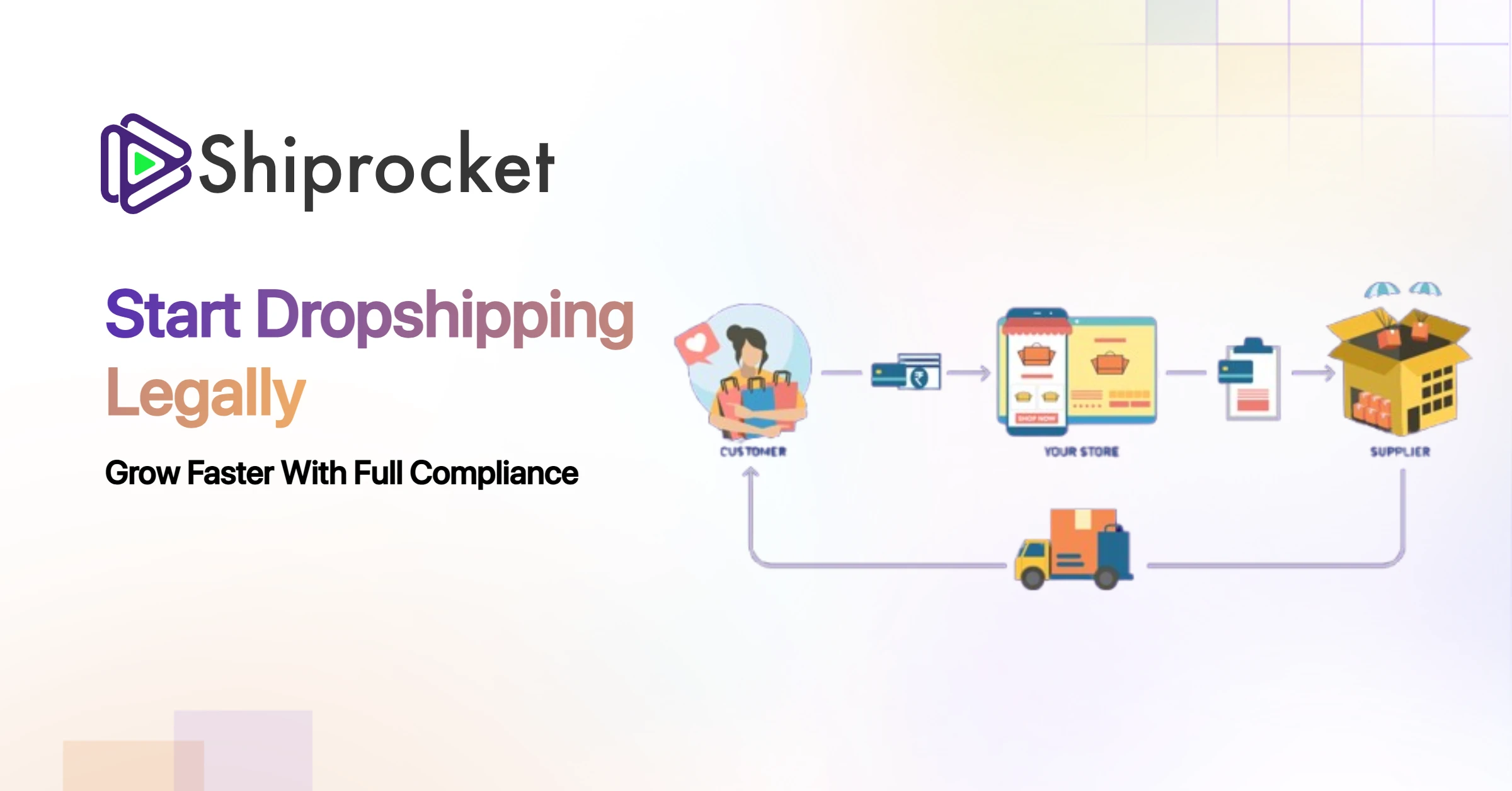
Dropshipping is simple to operate. You list products, customers place orders and your wholesaler ships them. However, you must follow several compliance requirements to run your business legally. Here is a clear breakdown.
Register Your Business
You must formally register your dropshipping business. You can choose to register as a:
- Sole Proprietor
- Partnership Firm
- Private Limited Company
Business registration helps you open a current account, pay taxes properly and avoid legal issues.
Apply for Dropshipping-Specific GST
You must apply for GST registration once your turnover crosses ₹40 lakh for goods or ₹20 lakh for services.
If you import products, you must also apply for Integrated GST (IGST). This is especially important when selling on Amazon, Shopify, Etsy and similar platforms.
A valid GST number also allows you to claim input tax credit.
Use the Shiprocket GST Calculator to compute your total selling price.
File GST Returns
You must submit the following to file a GST return:
- Sales invoices
- Purchase bills
- Tax collected on sales
- Tax paid on purchases
Sellers are required to file two monthly returns and one annual return.
Pay Income Tax
Your dropshipping income is taxable. You must file income tax returns through the e-filing portal.
Keep records of invoices, expenses and bank statements.
The income tax threshold is ₹3 lakh. Any earnings above this amount are taxable.
Import/Export Compliance
You must understand the import and export obligations if you’re sourcing/selling products outside India. Here are the customs and licensing rules to follow:
- Import Export Code
An IEC is a 10-digit code that allows you to carry out export and import operations. It is issued by the Directorate General of Foreign Trade (DGFT) and has a lifetime validity.
Remember that operating without an authentic IEC can draw fines and shipment confiscation.
- Product Category Specific Approvals
You must obtain approval for selling products, depending on their category:
- FSSAI for food products
- CDSCO for pharmaceutical products
- BIS for electronic products
Indian Laws
You must follow all dropshipping legal requirements in India to run a risk-free business:
Comply with the consumer protection and returns policy that requires you to:
- Maintain transparent pricing (including taxes)
- Clear descriptions to avoid misleading customers
- Well-defined redressal and query system
Intellectual property compliance to follow:
- Trademark laws to avoid infringement
- Copyright laws protect your original images and content
- Patent laws to verify rights before selling patented products
Are There Any Age Restrictions on Dropshipping?
Any individual can start a dropshipping business in India. However, those below 18 years must enter into legally binding contracts with the consent of a parent or guardian. This ensures that the guardian can manage the legal and financial formalities of the business. They are responsible for:
- Signing contracts with shipping companies and suppliers
- Opening a bank account
- Registering the business with local and state authorities
- Managing payment processing services
- Handling tax obligations
What Platform-Specific Rules Should Dropshippers Be Aware of?
Every eCommerce marketplace has its own policies for dropshipping. To avoid account issues, you must ensure your store fully complies with each platform’s requirements:
- Amazon
To run a dropshipping business on Amazon, make sure you follow these rules:
- Only your name should appear on the seller’s profile. You cannot show a partner/distributor/marketplace as the seller.
- Your business name should be mentioned on every paper, including invoices and packing slips.
- You must remove any information related to third-party sellers before the products are shipped.
- Only you are responsible for accepting and processing returns. Use Shiprocket Return Refund Policy Generator to clearly lay out your terms and conditions.
- You must follow the dropshipping-related terms and conditions of Amazon.
- eBay
Start selling on the third-party platform by following these rules:
- You should be the owner of the products.
- If not, then sign an agreement with the wholesale supplier to list and sell their products.
- Claim yourself as the seller on the invoices and packing slips.
- Make sure the delivery is complete within the mentioned timeline.
- Etsy
Etsy allows you to dropship only a limited products. So, make sure you are only listing the following products on this marketing place:
- Art and craft supplies
- Party favours
- Gift baskets
- Vintage products (20 years or older)
Simplify Logistics and Tracking with Shiprocket
Running a dropshipping business is more beneficial compared to traditional eCommerce models. But your business can face challenges if your logistics partner is unreliable. Delivery delays, lost shipments, or damaged products can quickly affect customer trust and sales.
Choose a reliable partner who helps you comply with local/international laws for smooth operations. Shiprocket supports your business by simplifying both logistics and order tracking. You can set up a branded tracking page so customers can monitor their orders with ease. Shiprocket also works with multiple carriers to maintain delivery timelines and reduce damage rates.
Our goal is to give you a dependable logistics system that helps your business scale confidently.
Conclusion
Dropshipping can be a powerful and profitable business model; low risk, minimal upfront investment, and high scalability. But long-term success depends on how responsibly you operate. When you follow the dropshipping legal requirements in India around taxation, imports, product approvals, and customer protection, you don’t just stay compliant; you build a business that customers and partners can trust.
Think of compliance as the foundation that keeps your brand strong as you grow. Pair this with reliable suppliers and a logistics partner that ensures timely, damage-free deliveries, and you give your business the structure it needs to thrive; not just today, but in the years ahead.