
- Delayed, Stuck or Lost? Know What You’re Dealing With
- What to Do When Your International Package Is Lost: Step by Step
- Claims and Compensation: How Lost Shipment Compensation Works
- For eCommerce Sellers: Protecting Your Buyer and Your Margin
- Track, Protect and Resolve Cross-Border Shipments with Shiprocket X
- Conclusion
Your buyer in Toronto messages you: the order shipped two weeks ago, tracking hasn’t moved in nine days and they want to know where it is. You open the tracking page and see the same scan they do. Is this a lost international package, or just a slow one?
That question decides everything that follows. Raise a claim too early and the carrier tells you to wait. Wait too long and you may miss the claim window, lose the buyer and eat the cost of the order.
This guide walks you through it step by step. You’ll learn how to read the warning signs, how to request an international shipment investigation, how claims and compensation work, and what eCommerce sellers should do for the customer while the courier searches.
Delayed, Stuck or Lost? Know What You’re Dealing With
An international package not delivered on time isn’t automatically lost. Cross-border parcels pass through an origin hub, an export customs check, a flight, import customs and a local last-mile carrier. Each handover is a point where tracking can go quiet.
Before you act, work out which of these four situations you’re in.
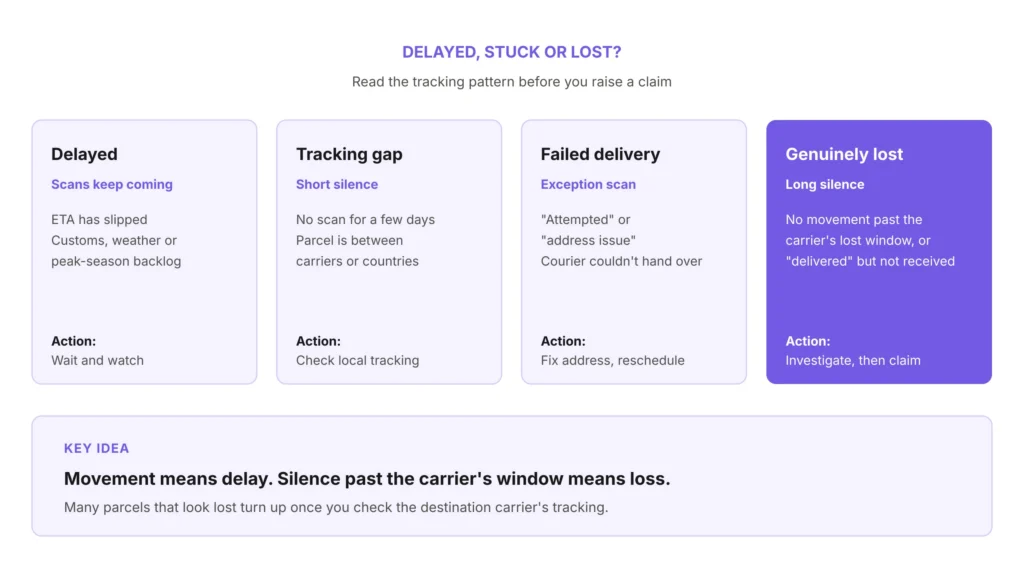
| Situation | What tracking shows | What it usually means | What to do |
|---|---|---|---|
| Delayed shipment | Scans keep coming, but the ETA has slipped | Customs hold, weather, flight capacity or peak-season backlog | Wait, and watch for customs requests |
| Tracking gap | No new scan for several days, often after “departed” or “in transit” | The parcel is between carriers or countries and nobody has scanned it yet | Check the destination carrier’s own tracking |
| Failed delivery | “Delivery attempted”, “recipient not available” or “address issue” | The courier reached the area but couldn’t hand it over | Confirm the address and reschedule fast |
| Genuinely missing | No movement long past the carrier’s lost-parcel window, or “delivered” with no parcel | The parcel may be misrouted, mis-delivered or lost | Request an investigation and prepare a claim |
The pattern matters. A delay has movement, a gap has silence for a short spell, a failed delivery has an exception scan, and a real loss has silence that runs past the carrier’s own threshold.
Why tracking goes quiet on international routes
Most tracking gaps happen at handovers. When a parcel leaves India, the export carrier often passes it to a partner in the destination country, which issues a new local tracking number. If you only watch the first number, the parcel can look frozen while it’s actually moving.
Customs is the other big cause. A parcel held for missing paperwork, duty payment or an unclear item description may show no update for days. Our explainer on what “arrived at carrier facility” means covers one of the most common stalled statuses.
When a package is officially treated as lost
There’s no single rule for this. Each carrier and postal service sets its own window before it will treat a parcel as lost, and it is usually longer for international shipments than domestic ones.
Postal networks also follow a fixed order. The USPS guide to international inquiries explains that the Universal Postal Union requires an inquiry before a claim can be processed, and that the destination country’s postal administration investigates whether the item was delivered. Private express couriers have their own versions of the same idea: search first, compensate second.
What to Do When Your International Package Is Lost: Step by Step
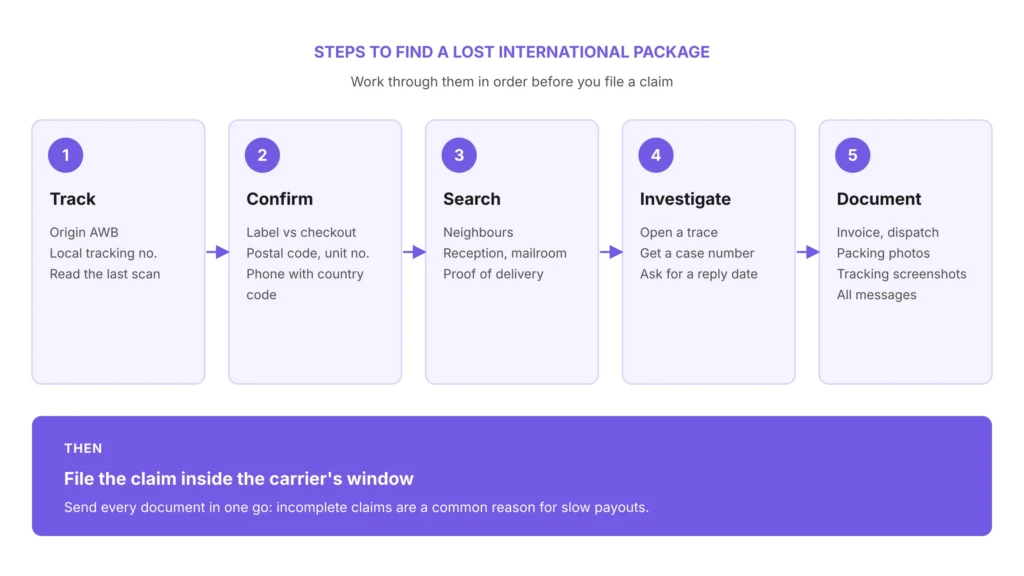
Once you’re fairly sure the parcel isn’t just delayed, work through these steps in order. Many cases that start as a lost international package are solved in the first few steps.
Step 1: Check every tracking source
Start with the tracking number on your label, then look for a secondary or local tracking number in the scan history. Enter that number on the destination carrier’s website.
Look closely at the last scan. Note the date, location and status code. “Held by customs”, “awaiting documents” and “delivery exception” each point to a different fix. If you sell on your own store, our guide on how to track your international courier shows where to find each update.
Step 2: Confirm the delivery address
Compare the address on the shipping label with the one the buyer entered at checkout. Small errors cause big problems abroad: a missing apartment number, a wrong postal code, a transliterated street name or a phone number without the country code.
If you spot a mistake, contact the carrier right away. Many carriers can correct or redirect a parcel that hasn’t been delivered yet, though fees and options vary.
Step 3: Handle “package marked delivered but not received”
A “delivered” scan with no parcel is one of the most stressful cases. Ask the recipient to check with neighbours, building reception, the mailroom and any safe place where couriers leave parcels.
Next, ask the carrier for proof of delivery. That may include a GPS location, a photo or a signature. If the proof shows the wrong building or an unfamiliar name, save it, because it becomes key evidence in the claim.
Step 4: Contact the carrier and request an investigation
If the first three steps don’t solve it, open a formal case. Ask the carrier, or your shipping platform, for an international shipment investigation, sometimes called a trace, tracer or inquiry.
Share the tracking number, ship date, sender and recipient details, a description of the contents and the declared value. Ask for a case or reference number and an expected response date, and get it in writing.
Step 5: Document everything
Build a simple file for every missing parcel. It should hold:
- The commercial invoice and the order record
- Proof of dispatch, such as the pickup scan, manifest or handover receipt
- Photos of the packed item and the sealed, labelled box
- Screenshots of the tracking history, with dates
- Every email, chat and call note with the carrier and the buyer
Good records speed up the investigation and are usually needed for a courier lost parcel claim. They also protect you if the buyer raises a chargeback or a marketplace dispute.
Claims and Compensation: How Lost Shipment Compensation Works
If the investigation confirms the parcel is lost, you can file a claim. But lost shipment compensation is never automatic, and the rules differ widely between carriers.
Before you file, check these five points in your carrier’s terms and the service you booked:
- Claim deadline: most carriers set a fixed window from the ship date or the expected delivery date. Miss it and the claim can be rejected outright.
- Who can claim: many carriers accept claims only from the shipper, not the recipient. On postal routes, the sender usually files with the origin postal service.
- Eligibility: prohibited or restricted items, poor packaging or an inaccurate declaration can void a claim.
- Liability limit: a carrier’s default liability is often capped by weight or by a fixed amount, which may be far below the parcel’s value.
- Insurance or protection: if you bought declared-value cover or shipment protection, the payout follows that policy’s limits and exclusions.
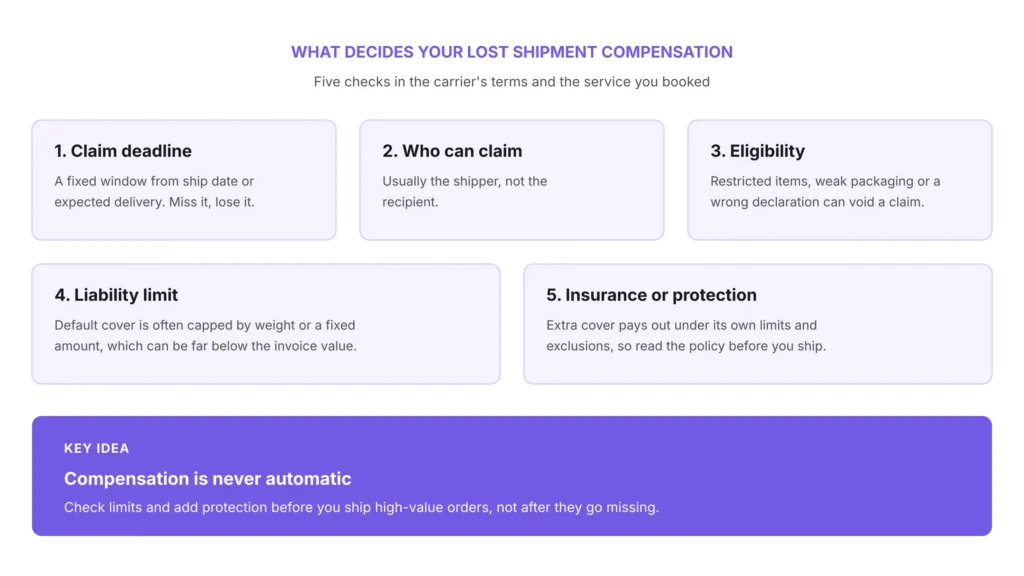
Liability limits catch many sellers off guard. If you shipped a ₹15,000 silk saree without extra cover, the carrier may only owe you its standard limit, not the invoice value. Our guide to international shipping insurance explains how declared value and insurance close that gap.
What to include in a lost parcel claim
Most claim forms ask for the same set of documents: the tracking number, the commercial invoice, proof of value such as a purchase bill, proof of dispatch and the investigation reference. Some also ask for a written statement from the recipient that the parcel never arrived.
Send everything in one go. Incomplete claims are a common reason for slow payouts.
If you’re the recipient in India
If you ordered from an overseas store and the parcel never arrived, contact the seller first. They hold the shipping contract, so they can open the investigation and file the claim faster than you can.
If a seller or courier operating in India doesn’t resolve a genuine complaint, you can register a grievance with the National Consumer Helpline run by the Department of Consumer Affairs, through its portal or the toll-free number 1915.
For eCommerce Sellers: Protecting Your Buyer and Your Margin
A lost international package costs you twice: the product and the customer’s trust. How you handle the next 48 hours often decides whether the buyer orders again.
Tell the customer before they chase you
Message the buyer as soon as tracking stalls past the expected date. Explain what you know, what you’ve done and when you’ll update them next. A short, honest note beats silence every time.
Keep the tone calm and specific: “We’ve opened an investigation with the carrier, reference number X. We’ll update you by Friday.” Our guide on communicating with international customers has more templates and timing tips.
Replacement or refund?
There’s no single right answer. Use the order value, stock levels and the buyer’s urgency to decide.
| Choose a replacement when | Choose a refund when |
|---|---|
| The item is in stock and the buyer still wants it | The item is out of stock or made to order |
| The order is time-sensitive, such as a gift or festival purchase | The buyer asks for their money back |
| The order value is low enough to absorb a second shipment | The order value is high and you need the claim to settle first |
| The buyer is a repeat or high-value customer | Fraud signs exist, such as repeat “not received” claims from one address |
Whichever you choose, record it against the order. If the original parcel turns up later, you’ll know whether to request a return or let it go.
Keep clean order records and proof of dispatch
Your order management system should show, for every international order, the invoice, the AWB number, the pickup scan and the declared value. This is your proof of dispatch in a claim and your defence in a payment dispute.
It also helps you spot patterns. If parcels to one country or through one carrier go missing more often, that’s a routing decision, not bad luck.
Prevent the next missing international parcel
Most losses trace back to a few fixable causes:
- Accurate labelling: print clear labels with the full address, postal code and a phone number with the country code. Remove old labels from reused boxes. Our post on why shipping labels matter in international shipping covers placement and content.
- Suitable packaging: use a sturdy box, fill empty space and seal every seam. A damaged box can lose its label in transit. See our international shipping packaging tips for details.
- Precise paperwork: describe the contents clearly on the invoice and declare an honest value, so customs doesn’t hold the parcel.
- Tracked services: avoid untracked services for anything you can’t afford to lose.
- Protection for high-value orders: add insurance or shipment protection when the carrier’s default liability won’t cover the product.
For a wider look at prevention and response, read our guide on how to handle lost shipments.
Track, Protect and Resolve Cross-Border Shipments with Shiprocket X
Shiprocket X lets Indian sellers ship to 220+ countries and territories and track every order by AWB, order ID or mobile number. Buyers get Email and WhatsApp updates and a customisable tracking page, which cuts “where is my order” queries before they turn into lost-parcel panic.
For in-transit risk, Shiprocket X offers a shipment security cover that lets you claim up to ₹5,000 in case of damage or loss, and SecureX shipment protection lets you raise claims through Shiprocket as a single point of contact. Check the eligibility and claim window in the current terms before you rely on either for a specific order.
Conclusion
A lost international package is rarely lost on day one. Many turn out to be delayed, held at customs or waiting on a failed delivery that a quick address fix can solve.
When a parcel really is missing, move in order: check every tracking source, confirm the address, request a formal investigation, document everything and file the claim inside the carrier’s window. Meanwhile, keep the buyer informed and decide on a replacement or refund early.
Then fix the root cause. Clear labels, strong packaging, honest declarations and the right protection keep the next order from going missing.