How B2B Lead Generation Works in 2026: Strategies & Trends

- B2B lead generation is about attracting, capturing and converting high-quality business prospects.
- The process is more complex in 2026 due to longer sales cycles, multiple decision-makers, silent research procedures and highly informed buyers.
- A good strategy is defined by a mix of SEO, content marketing, LinkedIn outreach, webinars, email nurturing and AI-driven tools.
- Full-funnel optimisation (TOFU, MOFU, BOFU) is critical to guide prospects from awareness to conversion.
- Using the right tools (CRM, analytics, automation platforms) can make lead generation scalable and predictable.
- Success depends on consistent execution, data-driven optimisation, account-based marketing and a multi-channel approach rather than relying on a single tactic.
- What is B2B Lead Generation?
- Why B2B Lead Generation Is More Complex in 2026
- What Are the Top B2B Lead Generation Strategies That Work?
- What Is the Full-Funnel Approach to B2B Lead Generation?
- What Are the Best Tools and Technologies for Getting B2B Leads?
- Avail Next Level Order Fulfillment with Shiprocket
- Takeaway
Generating B2B leads is one of the primary goals for any eCommerce business. There are different methods of doing business, but generating B2B leads is one of the most effective ways to increase profitability quickly. However, there are different strategies you can adopt to do it. Identifying which option is most effective for your business is the best way to increase lead volume.
However, this process has become more complex in 2026. Buyers now prefer a more self-educated and digital-first journey, where they complete 70–80% of their research anonymously before even contacting a supplier. This calls for new strategies and methods that you can quickly adapt to.
What is B2B Lead Generation?
Business-to-business (B2B) lead generation is the process of finding, attracting and capturing leads of other businesses that might be interested in your product or service.
Instead of going after individual consumers as you would in B2C, you should go after people who have the power to make buying decisions within companies, like managers, founders, business development or procurement teams, when it comes to B2B.
Why B2B Lead Generation Is More Complex in 2026
B2B lead generation has changed a lot over the years. In 2026, businesses must navigate a highly informed and multi-layered buying journey. Getting leads is harder because businesses have to deal with several problems.
- Longer and multi-touch sales cycles
Decisions in B2B are rarely instant. Before buying, buyers research, compare, validate and approve. The abundance of online information has lengthened this journey in 2026. A single deal may require weeks or months of emails and follow-ups.
- Multiple decision-makers involved
B2B buyers include managers, finance heads and executives, unlike B2C buyers. Each has different priorities, so your messaging must address multiple perspectives. This complicates targeting and communication.
- Highly informed buyers
B2B buyers research a lot before talking to salespeople. They compare competitors, read reviews, consume content and check out solutions. When they engage, they have a plethora of options. This approach makes it harder to influence them unless your value proposition is unique and differentiated.
- Rise of AI and personalisation expectations
AI has taken over marketing and made buyers expect personalised experiences. Sending generic emails no longer works. Businesses must use data, automation and AI to make custom content and outreach to increase sophistication.
- Increased competition
All companies invest in SEO, paid ads, LinkedIn and content marketing. Digital channels are now more crowded and competitive. To differentiate themselves, companies must prioritise visibility, positioning, authority and cross-platform engagement.
- Data privacy and first-party data challenges
Companies cannot rely on easy access to data due to stricter privacy regulations and the decline of third-party cookies. Now, B2B marketers must build and use first-party data through ethical and value-driven lead capture.
- Need for full-funnel integration
Lead generation in 2026 requires marketing, sales, customer satisfaction and success teams to work together. Connect and optimise every touchpoint, from the first to the last conversion. Any funnel disconnect can cost opportunities.
What Are the Top B2B Lead Generation Strategies That Work?
In 2026, B2B lead generation requires a multi-channel, full-funnel system that attracts and converts high-quality leads.
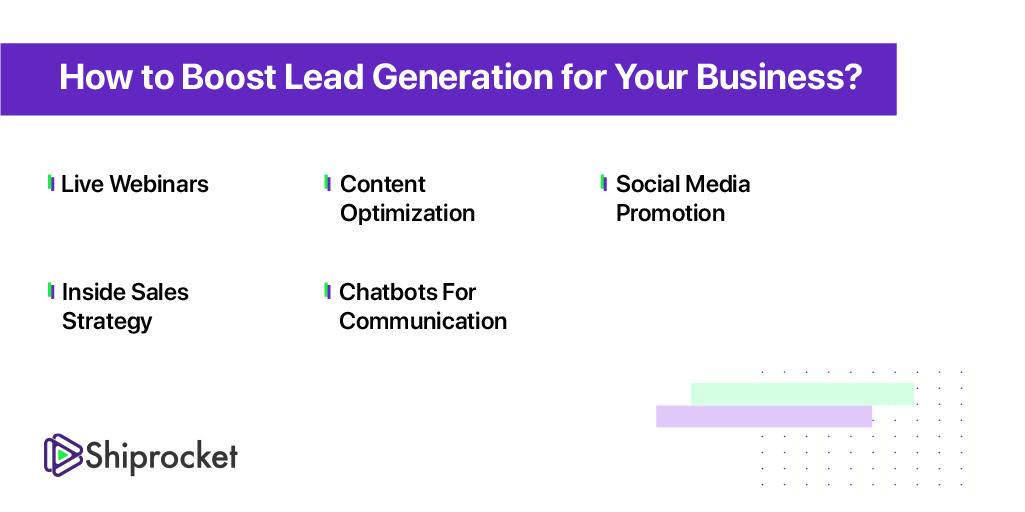
Here are the best ways businesses are growing predictably.
Live webinars
B2B marketers consider webinars as an effective tool for generating quality leads. This is because webinars provide companies with the opportunity to target and educate their audiences. It allows them to connect with your business. In 2026, the need for B2B companies to host webinars is even bigger.
The restrictions due to the COVID-19 pandemic made companies leverage these events to reach a larger audience and run product demonstrations. Companies can use these webinars to make partnerships with other companies and generate leads by hosting webinars.
Content marketing and SEO optimisation
Content and SEO remain the foundation of sustainable B2B lead generation. Today’s buyers actively search for solutions, and if your business doesn’t appear during that discovery phase, you lose potential leads before the conversation even begins. A strong keyword strategy focused on search intent helps you target users who are already looking for what you offer.
Businesses are increasingly investing in pillar pages, in-depth blog content, and case studies to build authority and capture organic traffic. Optimising on-page elements, such as meta titles, descriptions, internal linking, and content structure, ensures better visibility on search engines. While SEO takes time, it delivers compounding results, generating consistent inbound leads without ongoing acquisition costs.
Social media promotion
Social media engagement and promotion is a powerful medium that marketers use to generate B2B leads. The best way to promote on social media is to join social media groups to engage customers and professionals and generate leads. The key to succeeding in this is to initiate and engage in conversations with people in the group.
Once the people of the group get to know your brand, use that connection to interest them in your product or service offerings.
Inside sales strategy
The inside sales strategy is also referred to as remote or virtual selling and is an effective way to generate B2B leads. It involves reaching out to the customers virtually rather than meeting them in person. To use this promotion technique, you’ll need a team of trained professionals who can respond to specific questions related to your products.
In general, the inside selling strategy requires following the prospects throughout the sales cycle for B2B lead generation.
Chatbots for communication
A report shows that responding to customers within a few minutes is important, but only 10% of B2B companies are able to do so. Today, customers want quick responses to their queries. The AI-enabled chatbot is the solution for instant communication that provides a fast and easy way for B2B companies to interact with their target audiences.
The chatbots can be automated and used to communicate with customers as well as guide them instantly. When a prospect interacts with the chatbot, you’ll be able to gather the data, including their name, business type, email addresses, phone numbers, feedback and preferences.
LinkedIn lead generation (high-intent channel)
LinkedIn has become the best place to find business-to-business leads because it lets you connect directly with decision-makers. The best way to do things in 2026 is by using natural content and targeted outreach.
To build trust, founder-led content and personal branding are important. Sharing brand insights, case studies and opinions regularly can establish the brand as an authority. LinkedIn outreach funnels that include connection requests and follow-ups turn engagements into leads.
Being active in niche groups and conversations makes you even more visible and trustworthy.
What Is the Full-Funnel Approach to B2B Lead Generation?
A good B2B lead generation plan isn’t made up of separate strategies; it’s based on a funnel that moves prospects from awareness of the opportunity to conversion. When businesses sync their efforts through the entire funnel in 2026, they can generate many more qualified leads and achieve much higher conversion rates.
Top of Funnel (TOFU): Increasing awareness and attracting the right audience
People who might buy from you first learn about your brand at the top of the funnel. At this point, the aim is to teach and attract a large and relevant audience.
SEO and content marketing are essential in this case. By optimising blogs, guides, product descriptions and industry insights for search intent, businesses can attract users who are actively seeking solutions.
Social media portals such as LinkedIn improve your reach. This helps brands share content and interact with their target audience. The aim is to get more traffic and improve brand awareness.
Middle of Funnel (MOFU): Nurturing and building trust
Once a potential customer knows about your brand, you need to keep them interested and earn trust. Several businesses fail because they do not put effort into making connections. Webinars and virtual events work well because they allow businesses to teach their customers in an interactive and engaging way. Email nurturing campaigns facilitate communication by providing users with relevant content according to their actions and interests.
Case studies and real-life examples are essential at this stage because they show proof of results and make buyers less hesitant. MOFU’s goal is to move prospects from interested to likely to buy by showing them why your solution is worth exploring.
Bottom of Funnel (BOFU): Converting leads into customers
This is when prospects know your brand and are thinking about purchasing from you. Now is the time to switch their attention to converting and then finally closing.
The essential points of contact are now product demos, one-on-one consultations and sales calls. Businesses can take care of specific concerns and provide solutions that fit the needs of prospects.
High-intent leads are effectively converted when you have a strong sales process that is backed up by data and insights.
The purpose of BOFU is to solve problems and make the right choice.
What Are the Best Tools and Technologies for Getting B2B Leads?
Without the proper tools, it is not possible to run a successful B2B lead generation campaign in 2026. Businesses usually require a well-integrated technical stack to capture, track, nurture and then convert leads across the funnel. The process has several touchpoints.
CRM tools for lead management
CRM platforms are essential when it comes to generating leads. Businesses can store information, keep track of interactions, and manage entire sales pipelines in a single place with tools such as HubSpot and Salesforce.
The marketing and sales teams can work together better with a good CRM, which makes sure that no leads are missed or lost. It also provides teams with information on how leads act, which allows them to focus on the important prospects and helps boost conversion rates.
Email automation and nurturing tools
With the help of email automation tools, businesses can stay in touch with leads at once without losing any personal touch. Segmentation workflows, drip campaign and behaviour-based triggers can all be made with platforms such as Mailchimp and HubSpot.
All these tools ensure that leads receive the accurate message at the right time. This makes them interested and moves them along the funnel easily.
SEO and content optimisation tools
Businesses must make their content search engine optimised (SEO) if they want to consistently get leads that come to them. Tools like Google Search Console, Ahrefs and SEMrush can help you find keywords with a lot of intent and keep an eye on your rankings.
With these insights, marketers can improve the visibility of their content to get more qualified traffic.
LinkedIn and outreach automation tools
LinkedIn is the perfect place for business-to-business (B2B) companies to find new leads, but it can take a lot of time to manage all the outreach by hand. Automated prospecting, personalised outreach and engagement can be tracked with the help of tools such as LinkedIn Sales Navigator, Apollo and Lemlist.
If used properly, all these tools can help make things efficient while letting people talk to each other in a personal way.
Chatbot and conversational marketing platforms
Chatbots powered by Drift and Tidio allow you to talk to website visitors and that too in real time. With these platforms, you can qualify leads, answer questions and even set up meetings.
Chatbots help businesses get leads they might have missed by speeding up responses and making the user experience better.
Analytics and performance tracking tools
Tracking performance is the core of making your lead generation strategy work better. Tools like Google Analytics and Hotjar give you information about how users act, how many of them convert and how well your campaigns are doing.
Businesses can use these insights to figure out what’s working and where they need to make changes.
Avail Next Level Order Fulfillment with Shiprocket
Taking care of multiple leads can slow down operations if you have a growing business. Shiprocket brings everything onto one platform, managing eCommerce tasks and reducing manual effort. A wide courier network covering thousands of pincodes allows you to reach customers in both metropolitan and smaller cities.
Automated order processing and smart courier allocation help you dispatch faster and reduce delays. Tools to minimise RTO and improve delivery success rates improve profitability. Shiprocket fits into your workflow easily, so you can focus entirely on lead generation while logistics and eCommerce operations are taken care of.
Takeaway
B2B lead generation is not easy because you can’t execute a strategy that works for someone else’s business.
Finding a strategy that fits perfectly for important for effective lead generation. It is all about knowing your audience and how they interact with your business. Using tools that automate easy tasks and track operations assist you greatly, along with an end-to-end eCommerce enabler, like Shiprocket.