What is an SLA in Shipping? Meaning, Importance & Metrics

- SLA = Service Level Agreement; defines timelines, quality and responsibilities.
- Ensures products reach customers on time; reduces cancellations.
- Builds customer loyalty and trust; improves seller ratings.
- Provides transparency between seller, marketplace and logistics provider.
- Includes performance metrics, penalties, rewards and contingency plans.
- Key for managing customer expectations and operational efficiency.
- Automate inventory management to save time and reduce errors.
- Partner with reliable logistics providers for on-time delivery.
- Standardise packaging to prevent damage and returns.
- Maintain communication for quick problem resolution.
- Boosts brand reputation and marketplace competitiveness.
Selling online today means tapping into one of India’s fastest‑growing markets. The Indian eCommerce industry is expected to grow from around $211 billion in 2025 to over $326 billion by 2029, driven by rising internet access, smartphone adoption and increasing trust in digital payments. As more customers shop online every month, delivery expectations are rising and marketplaces expect sellers to meet these standards consistently.
For sellers outside major cities, this can be challenging due to longer delivery routes and limited logistics options. A Service Level Agreement (SLA) becomes essential in such situations. Understanding what is an SLA is and how it affects shipping performance helps you plan deliveries efficiently, manage customer expectations and avoid penalties.
Following clear processes for inventory, packaging and shipping allows you to build trust with buyers, improve ratings and grow your business confidently in a competitive online marketplace.
What is an SLA?
A Service Level Agreement defines particular aspects of a provided service – from the time frame to the quality, among various other specifics. Since the marketplace is directly answerable to the customer, the seller essentially has to enter into an SLA with the market. Certain assurances that the marketplaces provide the customer are being met. There can be many types of SLAs; a customer-based SLA that stands between the buyer and a seller or a service-based SLA that operates between a seller and a service provider, for example, a logistics company. SLAs are taken quite seriously by most online marketplaces because their reputation depends on them.
Importance of an SLA
Understanding the value of SLA in shipping can help you see why it is crucial for your business. Here are some of the key benefits:
- Reduces Order Cancellations
An SLA provides you with a definite time frame that you can stick to while processing and delivering an order. This way, entering into an SLA with your marketplace is one way to ensure that your product reaches your customer on time, reducing cancellations.
- Increases Loyalty
Adhering to an SLA is a sure-shot way of getting better seller ratings and increasing the level of commitment and loyalty of the customer. SLA is a great way to have transparency and mutual agreement between different parties in the transaction–the seller, the customer and the marketplace.
- Helps Manage Customer Expectations
From the seller’s point of view, an SLA is a great way to manage the customer’s expectations. While marketplaces tend to push for faster delivery times, it is not always possible to provide such services for various reasons. A well-drafted SLA prepares the seller and the marketplace for such possibilities and envisions consequences if such situations occur. This might include a penalty system for the seller, the logistics provider or the relevant service provider.
Things to Consider before Signing an SLA
Before entering into a Service Level Agreement, carefully evaluate its terms to ensure it aligns with your business capabilities and goals. Ask yourself the following questions:
- Is the SLA aligned with your business objectives?
- Are the terms of the SLA manageable?
- What are the specific benchmarks that are monitored in the process?
- How does the SLA measure performance, and how does it deal with non-performance?
- Is there a reward system for exceptional performance?
- Creating a plan in case of liabilities.
Common SLA Metrics You Should Track
To meet your SLA commitments and improve shipping performance, it’s important to track key metrics. These metrics help you identify bottlenecks, optimise operations and ensure customer satisfaction. Here’s what to focus on:
- On-Time Delivery Rate
- Measures the percentage of orders delivered within the SLA timeline.
- Benchmark: Aim for 95%+ on-time deliveries to maintain top ratings.
- Order Processing Time
- Time from order placement to dispatch. Faster processing improves SLA compliance.
- Return Rate / Delivery Accuracy
- Tracks orders returned due to delays, damages or incorrect items.
- Reducing this enhances customer satisfaction and seller ratings.
- Customer Response Time
- Time taken to acknowledge and respond to delivery-related queries.
- Quick responses prevent complaints from escalating and help maintain trust.
- SLA Compliance Rate
- Percentage of orders meeting all SLA requirements (timely delivery, accurate dispatch, proper packaging).
How to Track Them:
- Use platforms like Shiprocket dashboards to monitor delivery timelines and fulfillment performance.
- Set targets for each metric and analyse regularly to identify delays or process gaps.
- Automate reporting to trigger alerts on SLA breaches, enabling faster corrective action.
Tracking these metrics consistently ensures your operations stay aligned with SLA commitments, reduces penalties and improves customer loyalty.
Handling SLA Failures Without Losing Customers
Even with careful planning, delays or issues can occur. How you respond determines customer satisfaction and protects your seller ratings. Here’s how to handle SLA breaches effectively:
- Set Realistic Delivery Expectations
- Commit to delivery timelines that match your resources, courier network and order volume.
- Avoid overpromising; delivering slightly later but reliably is better than frequent SLA violations.
- Monitor Performance Proactively
- Use tools like Shiprocket dashboards to track orders in real-time.
- Set alerts for approaching SLA deadlines, delayed shipments or failed deliveries to act quickly.
- Communicate Transparently
- Notify customers immediately about delays or issues.
- Provide clear updates, rescheduled delivery dates or alternatives such as expedited shipping.
- Plan for Contingencies
- Maintain backup courier options, buffer times during peak seasons and alternate fulfillment plans.
- This reduces the chance of SLA breaches affecting customer experience.
- Learn and Improve
- Analyse SLA failures to identify recurring issues.
- Optimise inventory, packaging and logistics processes to prevent future breaches.
By combining proactive prevention and structured response, sellers can minimise the negative impact of SLA failures, retain customer trust and maintain strong marketplace ratings.
Reap Benefits of the SLA – Improve Your Shipping Time
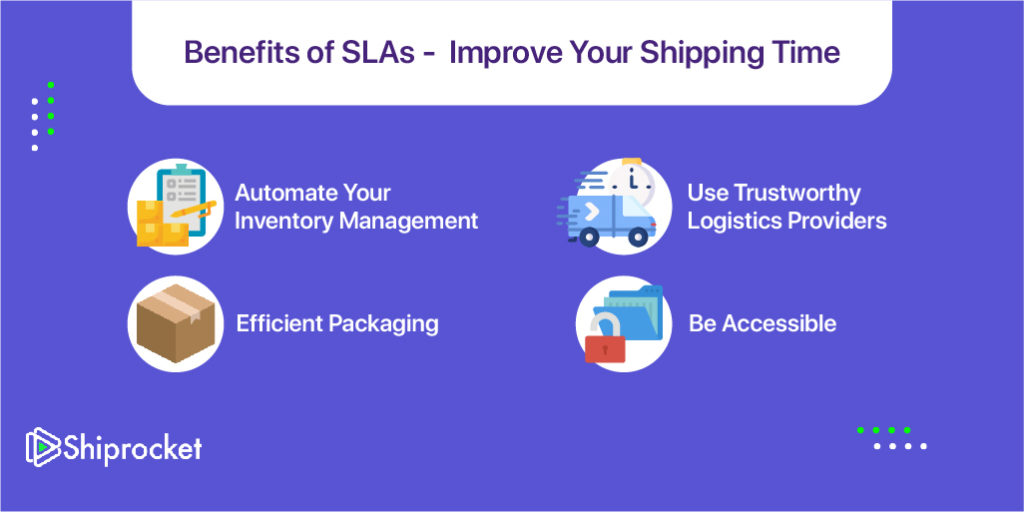
Having an efficient picking, packing and logistics system is the only way that you can honor the terms of your SLA and reap its benefits. If you are outsourcing your logistics needs, then you might need to sign another service level agreement with your logistics provider, except for the fact that, in this case, they would be the ones liable to provide the service. Here are some benefits of the SLA that would help improve your shipping time and therefore make the most of your SLA:
- Automate Your Inventory Management
Use multi-channel inventory management software to automate your warehouse. This will save you valuable person-hours of doing monotonous work and drastically reduce the chances of mistakes.
- Use Trustworthy Logistics Providers
Using reliable logistics partners will make sure the shipping liability falls on them, and in turn, you only have to worry about product quality and packaging. And you would know, you can trust them with on-time deliveries.
- Efficient Packaging
Having an efficient packaging system saves a lot of time and effort in a warehouse. Try to automate as much of the process as you can. Create standardised methods and steps that the package must go through, from quality checks to invoicing, adding shipping labels and safety materials to ensure that the package is safe and sound when it travels. This reduces the chance of damage during transit and, therefore, product returns.
- Be Accessible
Finally, always be accessible to your customer and your service provider. Try to find quick and efficient solutions to problems. The longer you let a problem sit idle, the more time-consuming it becomes.
A Service Level Agreement can either become a hassle, or it can become an efficient tool to keep track of your progress, depending upon how you look at it. Hope this article has cleared all your doubts on SLA. For any queries, do not hesitate to write to us in the comments section below!
How Shiprocket Supports SLA Compliance Across Different Product Categories
Meeting Service Level Agreements can be challenging, especially when your products vary in size, fragility or delivery urgency. Platforms like Shiprocket help sellers streamline shipping operations and meet SLA requirements, regardless of product type.
Here’s how it works for different categories:
- Electronics and Gadgets: These products often have strict delivery expectations and high customer sensitivity to delays. Shiprocket provides multiple courier options with optimised routes, real-time tracking and delivery updates, ensuring products reach customers on time and minimising SLA violations.
- Fashion and Apparel: Timely deliveries are critical during peak seasons and festivals. Shiprocket’s smart courier allocation, automated label generation and optimised fulfillment help reduce delays, while secure packaging solutions minimise product damage, reduce returns and maintain SLA compliance.
- Home & Furniture: Bulky or fragile items require specialised handling. Shiprocket offers services for large shipments with secure packaging, scheduled pickups and partner couriers experienced in handling furniture. This ensures timely deliveries without compromising product safety.
- Perishables and FMCG: For time-sensitive items, adherence to SLA is crucial to maintain product quality. Shiprocket’s temperature-controlled options, express delivery services and real-time performance monitoring ensure that perishable goods reach customers fresh and within the promised timelines.
Using Shiprocket gives sellers access to dashboards and analytics that track delivery performance, identify bottlenecks and proactively manage SLA compliance. By leveraging these tools, sellers can reduce penalties, improve customer satisfaction and grow their business even when operating outside major cities.
Conclusion
A Service Level Agreement (SLA) is not just a contract; it is a strategic tool that can directly impact your business growth and customer trust. For sellers operating outside major cities, it provides a clear roadmap for delivering products on time, reducing cancellations and maintaining strong ratings even in challenging logistics scenarios. The real takeaway is that meeting SLA commitments builds reliability, which translates into repeat customers, greater visibility on marketplaces and a competitive advantage over sellers who compete only on price.
By proactively planning inventory, streamlining packaging and choosing the right logistics partners, you can turn SLA compliance into a business strength that supports long-term growth.